



The Insurance Mistakes That Cost Oregon Contractors Jobs: 2026 Guide
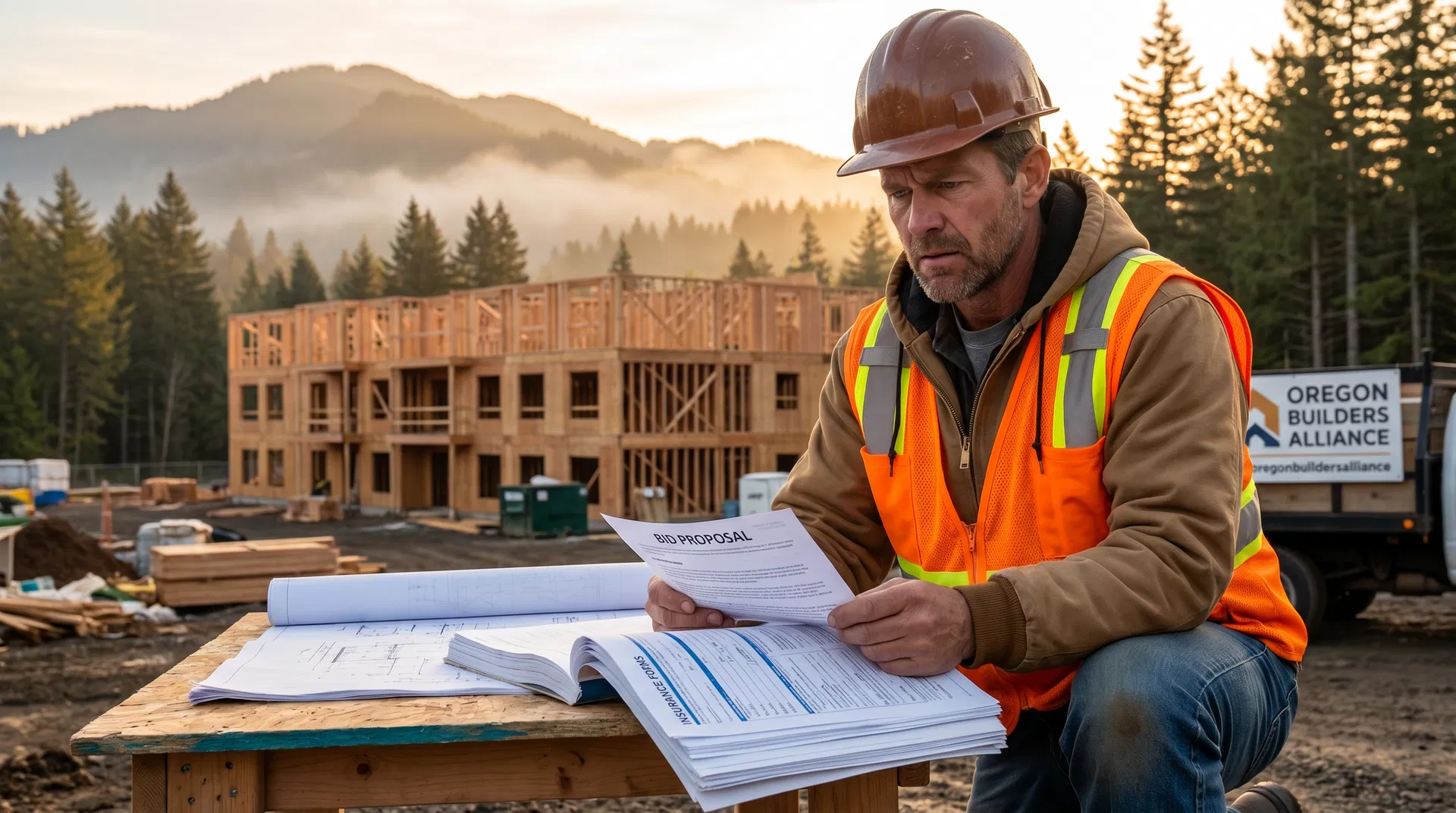
The Insurance Mistakes That Cost Oregon Contractors Jobs: 2026 Guide

In Oregon's competitive construction market, winning jobs requires more than skill and a fair price. Every year, qualified contractors lose bids — and sometimes entire client relationships — because of preventable insurance problems. Wrong coverage limits, missing endorsements, lapsed certificates, and gaps in workers' compensation are among the most common reasons Oregon contractors get disqualified before the work even begins. This guide breaks down the most costly insurance mistakes Oregon contractors make, and exactly how to fix them before they cost you your next job.
Whether you're a general contractor bidding on commercial projects, a specialty trade working as a subcontractor, or a small residential contractor trying to grow your business, your contractor insurance program is a direct factor in your ability to win work. Owners, GCs, and public agencies all review insurance requirements before awarding contracts — and the bar keeps rising every year.
Oregon CCB License Requires Active Insurance
The Oregon Construction Contractors Board (CCB) requires all licensed contractors to maintain active general liability insurance and, if you have employees, workers' compensation coverage. A lapse in coverage can result in license suspension — meaning you cannot legally bid or perform work in Oregon until coverage is reinstated and the CCB is notified. Don't let an administrative oversight shut down your business.
Is Your Contractor Insurance Costing You Jobs?
Insure Pacific's Oregon-licensed commercial agents specialize in contractor insurance. We'll review your current program, identify gaps, and make sure your certificates and endorsements meet the requirements of your biggest clients — before you lose another bid.
Mistake #1: Carrying the Wrong General Liability Limits
The most common insurance mistake Oregon contractors make is carrying general liability limits that don't meet contract requirements. Many contractors purchase a $500,000 per-occurrence policy because it satisfies the minimum CCB requirement — but the majority of commercial contracts, public agency bids, and general contractor subcontract agreements require $1,000,000 per occurrence and $2,000,000 aggregate. Some large commercial projects and public works contracts require $2M per occurrence.
When a GC or owner reviews your certificate of insurance and your limits don't match their contract requirements, your bid is disqualified — often without a phone call. The fix is straightforward: review the insurance requirements section of every contract you bid before submitting, and confirm with your agent that your general liability coverage meets or exceeds those limits. Increasing from $500K to $1M per occurrence typically costs only $200–$500 more per year — a small price compared to losing a $50,000 job.
| Project Type | Typical Per-Occurrence Requirement | Aggregate Requirement |
|---|---|---|
| Residential remodel (private homeowner) | $300K–$500K | $600K–$1M |
| Small commercial (private owner) | $1,000,000 | $2,000,000 |
| GC subcontract agreement | $1,000,000 | $2,000,000 |
| Oregon public agency / government | $1M–$2M | $2M–$4M |
| Large commercial / institutional | $2,000,000 | $4,000,000 |
Mistake #2: Not Being Listed as an Additional Insured
Nearly every commercial contract and GC subcontract agreement requires that the hiring party be named as an Additional Insured on your general liability policy. This is not the same as providing a certificate of insurance — it requires a specific endorsement added to your policy that extends your GL coverage to protect the GC or owner if they are sued for something arising from your work.
Many contractors carry adequate limits but fail to add the required additional insured endorsements before submitting their certificate. When the GC reviews the certificate and the additional insured endorsement is missing, the subcontract is held up or the contractor is replaced. The most commonly required endorsements are the CG 20 10 (ongoing operations) and CG 20 37 (completed operations). Some contracts also require primary and non-contributory language, meaning your policy pays first before the GC's own insurance. Confirm with your agent that your policy includes these endorsements and that they can be added to certificates quickly when contracts require them.
Mistake #3: Lapsed or Expired Certificates of Insurance
A certificate of insurance (COI) is only valid for the policy period it references. If your policy renews on July 1 and you submit a certificate dated June 15 for a project starting August 1, the GC's compliance team will flag it as expired before the project even begins. Similarly, if your policy lapses due to a missed payment and you're working under a certificate that references that lapsed policy, you are operating without coverage — and the GC may terminate your contract immediately upon discovery.
Oregon contractors should maintain a system for tracking certificate expiration dates and requesting updated certificates from their agent immediately after each policy renewal. Many contractors also lose jobs because they can't produce a certificate quickly enough — a GC needs a sub on-site Monday and the contractor can't get a COI issued until Wednesday. Work with an agent who can issue certificates same-day so you never lose a job to administrative delays.
Mistake #4: Missing Workers' Compensation Coverage
Oregon law requires all employers with one or more employees to carry workers' compensation insurance. This is not optional — and it's one of the most scrutinized items on any subcontract compliance checklist. GCs and public agencies verify workers' comp coverage before allowing any worker on-site. If your workers' comp policy lapses, you can be removed from a job site immediately and may face fines from the Oregon Workers' Compensation Division.
A common mistake among small contractors is misclassifying employees as independent contractors to avoid the workers' comp requirement. Oregon has strict rules about worker classification, and the Oregon Workers' Compensation Division actively audits contractors. If a worker is injured and is later reclassified as an employee, you face uninsured claims, penalties, and potential license suspension. Sole proprietors with no employees can elect to be exempt, but this must be documented properly with the CCB.
Mistake #5: No Builder's Risk Coverage on Your Projects
Builder's risk insurance covers a structure under construction against fire, theft, vandalism, wind, and other covered perils during the build period. Many contractors assume the property owner's homeowners or commercial property policy covers the project during construction — it typically does not. Standard property policies exclude buildings under construction or major renovation.
On commercial projects, the contract will specify who is responsible for providing builder's risk — sometimes the owner, sometimes the GC. As a subcontractor, you need to know whether builder's risk is in place before you begin work, because if the structure is damaged and there's no coverage, the project may halt and you may not get paid for work already completed. On residential remodels and additions, the homeowner's policy may have gaps that leave your work unprotected. Talk to your contractor insurance agent about builder's risk requirements for every project you bid.
Mistake #6: No Tools and Equipment Coverage
General liability insurance does not cover your tools, equipment, and materials. If your tools are stolen from a job site, your truck is broken into, or your equipment is damaged in transit, a GL policy pays nothing. Contractors who don't carry inland marine / tools and equipment coverage absorb these losses out of pocket — and for a small contractor, a $15,000 tool theft can be financially devastating.
Inland marine policies for contractors typically cover hand tools, power tools, portable equipment, and materials in transit or stored at job sites. For contractors with heavy equipment — excavators, skid steers, lifts — a separate equipment floater provides broader coverage including mechanical breakdown and rental reimbursement while equipment is being repaired. This coverage is often surprisingly affordable relative to the value it protects.
Mistake #7: Using Personal Auto for Business Purposes
If you drive a personal vehicle to job sites, haul materials, or transport employees in a vehicle covered by a personal auto policy, you may have a significant coverage gap. Most personal auto policies exclude coverage for vehicles used for business purposes — meaning if you're in an accident while driving to a job site, your personal insurer may deny the claim.
Oregon contractors who use vehicles for business need commercial auto insurance that covers business use, hauling of tools and materials, and any employees who drive company vehicles. If you use subcontractors who drive their own vehicles on your projects, you also need hired and non-owned auto coverage to protect against liability arising from their vehicle use on your behalf. This is a frequently overlooked gap that can result in a six-figure uninsured claim.
Mistake #8: Not Verifying Your Subcontractors' Insurance
As a general contractor, you are responsible for the work performed on your projects — including work done by your subcontractors. If a subcontractor causes property damage or injures someone on your job site and they don't have adequate insurance, the claim comes back to you. Your GL policy may cover it, but your premiums will increase and your claims history will be affected.
Best practice is to require every subcontractor to provide a certificate of insurance naming you as an additional insured before they begin work. Verify that their coverage meets the same limits your contract requires, that their workers' comp is active, and that their policy hasn't lapsed. Maintaining a subcontractor compliance file with current COIs for every sub you use protects you and demonstrates professionalism to the GCs and owners who hire you. Learn more about managing subcontractor insurance requirements.
Mistake #9: No Surety Bond When Required
Oregon CCB requires most contractors to carry a contractor license bond as a condition of licensure. The bond amount varies by license type — residential general contractors require a $20,000 bond, while commercial contractors require $20,000 as well, with some specialty licenses requiring different amounts. Beyond the CCB requirement, many public works contracts and larger commercial projects require performance and payment bonds — which are separate from and significantly larger than license bonds.
Contractors who have never bid public works projects are often surprised to learn that performance and payment bonds are required for virtually all Oregon public agency contracts over $100,000. These bonds guarantee that the contractor will complete the project and pay all subcontractors and suppliers. Without the ability to obtain these bonds, you are effectively locked out of the public works market. Bond capacity is tied to your financial strength, experience, and claims history — so maintaining a clean record matters for your bonding capacity as well as your insurance premiums.
Mistake #10: Inadequate Umbrella Coverage
A serious construction site injury — a worker falling from height, a bystander struck by equipment, a fire spreading from a job site to neighboring properties — can easily generate a claim exceeding your primary GL limits. A $1M GL policy sounds substantial, but a catastrophic injury claim with medical costs, lost wages, and pain and suffering damages can reach $2M–$5M or more. Without an umbrella policy, you are personally exposed to any judgment above your primary limits.
Commercial umbrella policies for contractors typically start at $1M in additional coverage and cost $500–$2,000 per year depending on your operations. Many commercial contracts now require contractors to carry a $2M or $5M umbrella in addition to the primary GL limits. An umbrella policy is one of the most cost-effective ways to increase your coverage and your competitiveness on larger projects — and it provides peace of mind that a single catastrophic claim won't end your business.
Free Contractor Insurance Compliance Review
Insure Pacific's Oregon-licensed agents will review your current certificates, endorsements, and coverage limits against the requirements of your biggest contracts — at no charge. Stop losing bids to preventable insurance problems.
Oregon Contractor Insurance Compliance Checklist
Use this checklist before submitting your next bid to make sure your insurance program meets the requirements of the contract:
General liability limits meet contract requirements ($1M/$2M minimum for most commercial work)
Additional insured endorsements (CG 20 10 and CG 20 37) available for the hiring party
Primary and non-contributory language available if required by contract
Workers' compensation active and covering all employees (including any misclassified as 1099)
Certificate of insurance current and covering the full project period
Commercial auto coverage for all business-use vehicles (not personal auto)
Hired and non-owned auto coverage if subcontractors drive their own vehicles on your projects
Tools and equipment / inland marine coverage for tools, equipment, and materials in transit
Builder's risk in place for the project (confirm who is responsible — owner or GC)
Umbrella policy meets contract requirements ($1M–$5M depending on project size)
CCB contractor license bond current and in required amount
Performance and payment bonds available if required (public works projects over $100K)
Oregon-Specific Insurance Requirements for Contractors
Oregon has some of the most specific contractor licensing and insurance requirements in the country. The Oregon CCB administers contractor licensing and requires proof of insurance for all license types. Key Oregon-specific requirements include:
CCB License Bond
Oregon requires a $20,000 contractor license bond for most residential and commercial contractor license types. This bond protects consumers against contractor fraud, incomplete work, or failure to pay subcontractors — it is not the same as general liability insurance. Learn more about Oregon contractor bonds.
Oregon Workers' Compensation Division
Oregon's workers' comp system is administered by the Workers' Compensation Division (WCD) and requires all employers to carry coverage. Oregon has strict worker classification rules — misclassifying employees as independent contractors to avoid workers' comp is a common and costly mistake. Learn about Oregon workers' compensation requirements.
Oregon Public Works Bonding Requirements
Oregon public works contracts over $100,000 require performance and payment bonds under ORS 279C.380. These bonds must be issued by a surety company licensed in Oregon and in amounts equal to the contract price. Contractors without established bonding relationships cannot bid these projects.
Central Oregon Wildfire Exposure
Contractors working in Central Oregon, Southern Oregon, and other high-wildfire-risk areas face additional insurance challenges. Some carriers are restricting or non-renewing policies in high-risk areas. Contractors building or remodeling in these areas should ensure their builder's risk and GL policies cover wildfire-related losses and that their subcontractors carry adequate coverage as well. Learn about Oregon wildfire insurance for contractors.
How Insure Pacific Helps Oregon Contractors Win More Jobs
Insure Pacific has been serving Oregon contractors since 1935. We understand the specific insurance requirements of Oregon's construction market — from CCB licensing requirements to public works bonding, from residential remodel certificates to large commercial subcontract compliance. Our independent agents work with 50+ carriers to build comprehensive contractor insurance programs that meet the requirements of your clients and help you win more work.
We can issue certificates of insurance same-day, add additional insured endorsements quickly, and help you understand exactly what your contracts require before you submit your bid. If you've lost jobs due to insurance problems — or if you're not sure whether your current program meets the requirements of your biggest clients — contact us for a free contractor insurance review. There's no obligation, and it could be the difference between winning and losing your next job.
Stop Losing Bids to Insurance Problems
Insure Pacific's Oregon-licensed agents specialize in contractor insurance. We'll make sure your certificates, endorsements, and limits meet the requirements of your biggest clients — so your insurance helps you win jobs, not lose them.
Frequently Asked Questions: Contractor Insurance in Oregon
What insurance do Oregon contractors need to get a CCB license?
Oregon CCB requires general liability insurance and a contractor license bond for most license types. If you have employees, workers' compensation is also required. Minimum GL limits vary by license type, but most residential and commercial contractor licenses require at least $500,000 per occurrence. The CCB bond requirement is typically $20,000.
Why do I keep getting disqualified from bids for insurance reasons?
The most common reasons are: (1) GL limits below the contract requirement — most commercial contracts require $1M per occurrence, (2) missing additional insured endorsements, (3) expired or soon-to-expire certificates, (4) no umbrella policy when required, or (5) workers' comp coverage that doesn't cover all workers on the project. Review the insurance requirements section of every contract before bidding.
What is an additional insured endorsement and why do GCs require it?
An additional insured endorsement extends your GL policy to cover the GC or owner if they are sued for something arising from your work. The most commonly required endorsements are CG 20 10 (ongoing operations) and CG 20 37 (completed operations). Without these endorsements, your certificate of insurance does not satisfy the additional insured requirement in most subcontract agreements.
Do I need workers' comp if I'm a sole proprietor with no employees?
Oregon sole proprietors with no employees are not required to carry workers' compensation, but they can elect to cover themselves. If you hire any workers — even part-time or seasonal — you are required to carry workers' comp. Misclassifying employees as independent contractors to avoid this requirement is a common and costly mistake that can result in fines and uninsured claims.
How much does contractor insurance cost in Oregon?
Oregon contractor insurance costs vary widely based on trade, revenue, payroll, claims history, and coverage limits. A small residential contractor might pay $1,500–$3,000/year for GL and workers' comp. A mid-size commercial contractor with employees might pay $8,000–$25,000/year. Adding an umbrella, tools coverage, and commercial auto will increase the total but also significantly improve your ability to win commercial and public works bids.
What is the difference between a contractor license bond and general liability insurance?
A contractor license bond (required by Oregon CCB) protects consumers against contractor fraud, incomplete work, or failure to pay subcontractors. General liability insurance protects you against third-party bodily injury and property damage claims. They serve different purposes and are both required — one does not substitute for the other.
Our Licensed Coverage Area
States highlighted in blue are states where Insure Pacific holds an active insurance license.
Hover to highlight — click a state to visit its insurance page
Our Oregon Office Locations
Hover over a marker to see the office — click to visit their website.
Hover to highlight — click to visit that office's website
Ready to Get Protected?
Talk to a Local Oregon Insurance Expert
Insure Pacific has been serving Oregon families and businesses since 1935. We work with 50+ carriers so you get real options — not just one company's answer.
Related Articles
 Commercial Insurance
Buying a Commercial Building: Insurance Questions to Answer Before Closing
Read Article → Farm & Ranch
One Ranch, Several Policies: Coordinating Home, Farm, Commercial Auto, and Umbrella Insurance
Read Article → Commercial Insurance
Non-Emergency Medical Transportation Insurance: Passenger Injuries, Wheelchair Lifts, Driver Screening, Contracts & Commercial Auto Limits
Read Article → Personal Insurance
Full-Time RV Insurance: When Your Motorhome Becomes Your Primary Home
Read Article →Get in Touch
Ready to protect what matters most? Contact us today for a no-obligation insurance review. Our experienced agents are here to help you find the right coverage for your needs.


