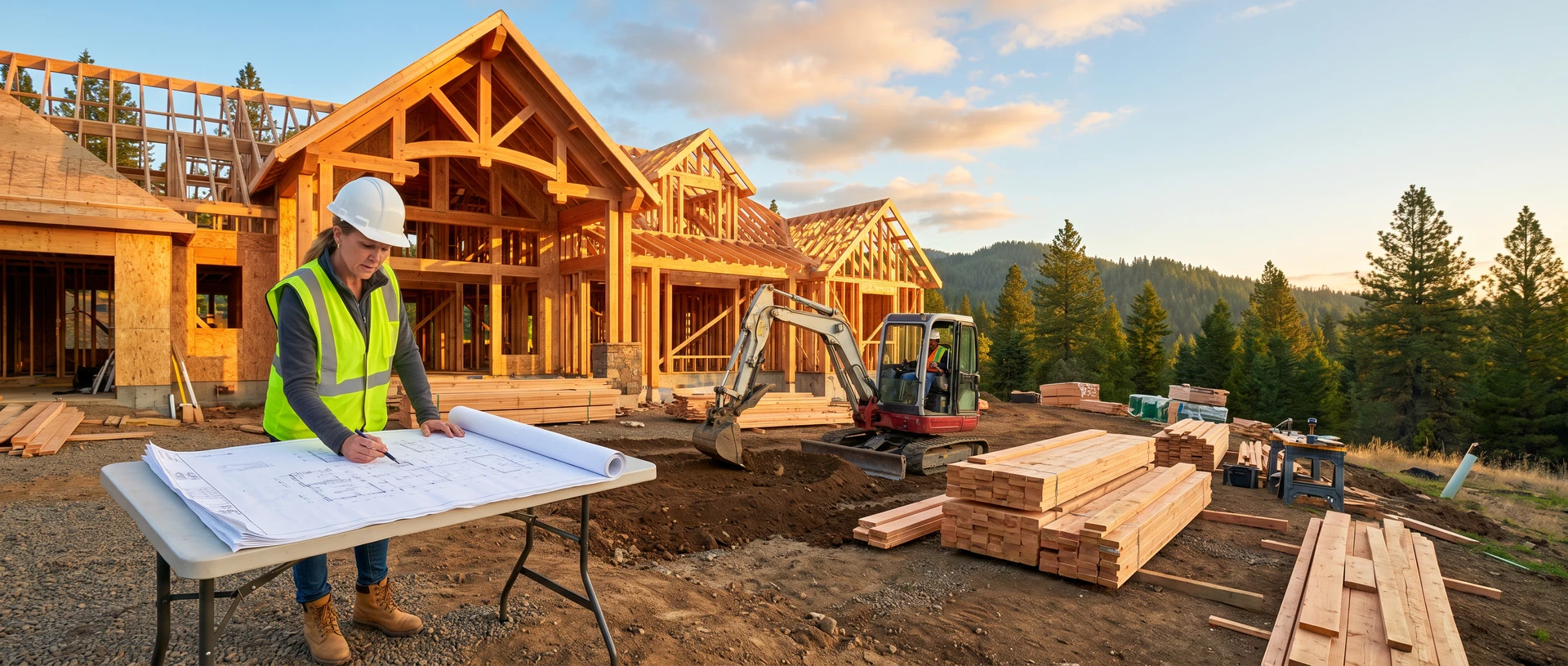

A construction project can have substantial value long before it is ready to occupy. Framing, materials, fixtures, mechanical systems, and the work already completed may be exposed to fire, theft, vandalism, wind, or a weather event while the project is still changing every day. That is where Builders Risk Insurance—also called course-of-construction coverage—belongs in the conversation.
This article is educational, not legal, lending, contracting, or coverage advice. Coverage depends on the actual policy form, endorsements, exclusions, deductibles, project facts, carrier underwriting, and the construction contract. Review those documents before relying on any coverage decision.
What Builders Risk Insurance is—and what it is not
Builders risk is property coverage designed for a building or structure while it is under construction, undergoing a substantial alteration, or—in some cases—receiving a defined installation. Oregon’s public-contract guidance describes builders risk as all-risk direct physical-loss coverage and emphasizes a limit tied to the full completed value of a new structure or the replacement value of covered alterations.[1] The practical question is not simply, “Do we have a policy?” It is whether the policy is designed for this specific project, its current stage, its material flow, and the interests named in the contract.
Builders risk commonly addresses damage to the work itself and to materials, fixtures, or equipment intended to become a permanent part of the project. It is not a substitute for general liability insurance, which addresses a different category of third-party bodily-injury and property-damage allegations. It also does not automatically replace workers’ compensation, commercial auto, professional liability, pollution liability, or a contractor’s tools-and-equipment solution. A construction insurance review should consider how these policies work alongside one another rather than treating builders risk as a complete program.
Which Oregon projects may need the conversation?
Builders risk may be relevant to a ground-up home, a commercial tenant improvement, an apartment or mixed-use project, a restaurant buildout, a major remodel, a school or public-work project, or an installation involving valuable materials and equipment. Oregon’s guidance calls out new construction, substantial alterations such as bearing-wall or foundation work, and equipment installation in an existing building as common situations for builders risk consideration.[1]
The named insured and loss-payee structure matter. A property owner, developer, general contractor, lender, and certain subcontractors may all have a financial interest, but the contract must establish who obtains the coverage, whose interests are recognized, and how a loss is adjusted. Before signing, compare the insurance requirements against the scope, indemnity language, waiver-of-subrogation wording, deductibles, and completion obligations. This is especially important for a project in Bend, Redmond, Prineville, Sisters, the Oregon Coast, or another area where wildfire, wind, snow, water, earthquake, and material-delivery considerations can vary materially by location.
| Project question | Why it matters |
|---|---|
| What is the completed value? | The limit should be evaluated against the total value that would exist when covered construction is complete, not merely the amount already installed. |
| Where are materials today? | On-site, off-site, and in-transit materials may be treated differently under the form or its endorsements. |
| Is there an existing structure? | A renovation may need a careful discussion of what is covered in the pre-existing building and what is excluded. |
| Who is named in the contract? | Owner, contractor, lender, and subcontractor interests must align with the insurance requirements and loss-payment provisions. |
| What happens if completion is delayed? | Soft costs, delay-in-completion, and expediting expense are not interchangeable and must be reviewed as separate project needs. |
Covered property and the limits that deserve scrutiny
Policy wording controls, but construction-property discussions often include the partially completed structure, materials at the jobsite, and materials or fixtures intended to become permanent. Oregon’s published clause also identifies foundations, excavations, grading, permanent fencing, scaffolding, construction forms, and temporary jobsite structures as items that may be addressed in a builders risk policy.[1] That does not mean every carrier treats every item the same way. It means the scope of work, valuation, and site conditions should be documented accurately before a quote is bound.
The completed-value issue deserves particular attention. Oregon warns that a short limit can produce a partial payment rather than a full loss payment when the insured value is below the completed value required by the form.[1] Inflation, change orders, owner-furnished materials, specialty finishes, engineering changes, and supply-chain shifts can all alter the project budget. A mid-project update may be as important as the original application.
Before the first delivery
Bring the construction contract and budget to the insurance review
Insure Pacific can help owners, builders, and contractors compare Builders Risk questions with broader commercial insurance, commercial auto, and commercial property considerations. We will review the project details; the policy and carrier determine coverage.
Request a Builders Risk Review →Extensions that can matter after a covered loss
A direct physical loss may trigger costs beyond repairing damaged lumber or replacing a fixture. The Hartford identifies extensions often considered on construction projects, including debris removal, demolition and increased cost of construction, expediting expense, extra expense, soft costs, delay-in-completion, and adjacent-property or existing-structure coverage.[2] The availability, limits, waiting periods, and definitions can differ substantially by carrier and project.
For example, Oregon’s guidance notes that soft-cost endorsements may address certain post-loss expenses such as interest, taxes, advertising, architect and engineer fees, added insurance premiums, legal costs, and accounting fees; the actual definition must be reviewed with the insurer.[1] A project financed with a construction loan, governed by a strict delivery date, or connected to a lease-up schedule may have exposures that a standard property limit alone does not answer.
Independent Insurance Agency Since 1935
Not Sure If You Have the Right Coverage?
Our licensed agents compare 50+ carriers to find you the best coverage at the right price — at no extra cost to you.
Five exclusions and gaps to discuss before work starts
No builders risk policy should be evaluated from the declarations page alone. The Hartford notes that forms vary and flags several recurring exclusions or limitations, including mold and pollution, defective materials/workmanship/design, water intrusion, earth movement, and settling, cracking, or shrinkage.[2] An exclusion for the cost to correct defective work can be particularly significant in a construction dispute, even when resulting damage is treated differently under a particular form. Do not assume that a phrase such as “all risk” means every cause or every cost is covered.
Earthquake and flood deserve their own Oregon conversation. Oregon’s public builders-risk clause requires earthquake and flood within its specified public-contract structure, but a private project must be evaluated on its own contract and form.[1] In Central Oregon, wildfire defensible-space and access issues can affect both project risk and underwriting. On the Coast, wind, water, and flood-zone questions may take priority. The right review is geographic and project-specific.
- Faulty workmanship and design: Ask how the form treats the defective work itself and any ensuing damage.
- Water: Clarify the effect of rain, surface water, flood, sewer backup, and water intrusion wording.
- Earth movement: Review earthquake, landslide, settling, and soil-movement terms rather than relying on shorthand.
- Pollution and mold: Determine whether separate pollution-liability discussions are appropriate for the work performed.
- Liability to others: Coordinate the builders-risk form with general liability, additional-insured, and contract requirements.
Materials in transit, off-site storage, and installation work
A project’s most valuable materials may not yet be at the jobsite. Oregon distinguishes an installation floater for labor, equipment, materials, or fixtures that are in transit, stored off site, or being installed and tested, particularly where they will become a permanent part of a building.[1] US Assure likewise identifies in-transit materials as a coverage point that may be available under a builders-risk policy, subject to the actual form and endorsements.[3]
That is why an owner or contractor should map the material path: supplier, temporary storage, transit, jobsite, installation, testing, and acceptance. A contractor with tools and mobile equipment may also need an inland marine insurance discussion that is separate from materials intended for the project. The insured property, insured interest, and coverage territory should not be assumed.
How to prepare for a practical Builders Risk review
Bring the information that lets an agent and carrier evaluate the actual risk instead of a simplified description. That usually includes the address, construction type, occupancy and exposure details, project start and expected completion dates, current and completed values, renovation versus new-build scope, subcontractor structure, lender requirements, construction contract, deductible tolerance, loss history, material storage plan, and requested endorsements. If the project changes, treat the original application as a living document rather than a one-time form.
A policy review is also a good time to coordinate the project with commercial umbrella insurance, certificates, subcontractor insurance requirements, and the team’s incident-reporting procedures. The goal is not to promise that every loss will be covered. It is to identify important decisions before the loss, the lender deadline, or the first delivery puts pressure on the project.
Build the insurance conversation around the job you are actually building
Whether you are breaking ground on a new home, modernizing a commercial space, or coordinating a multi-party development, Insure Pacific can help you review Builders Risk Insurance with your project documents and broader coverage needs in view.