



Commercial Insurance for Contractors Working on Solar Energy Projects
Commercial Insurance for Contractors Working on Solar Energy Projects

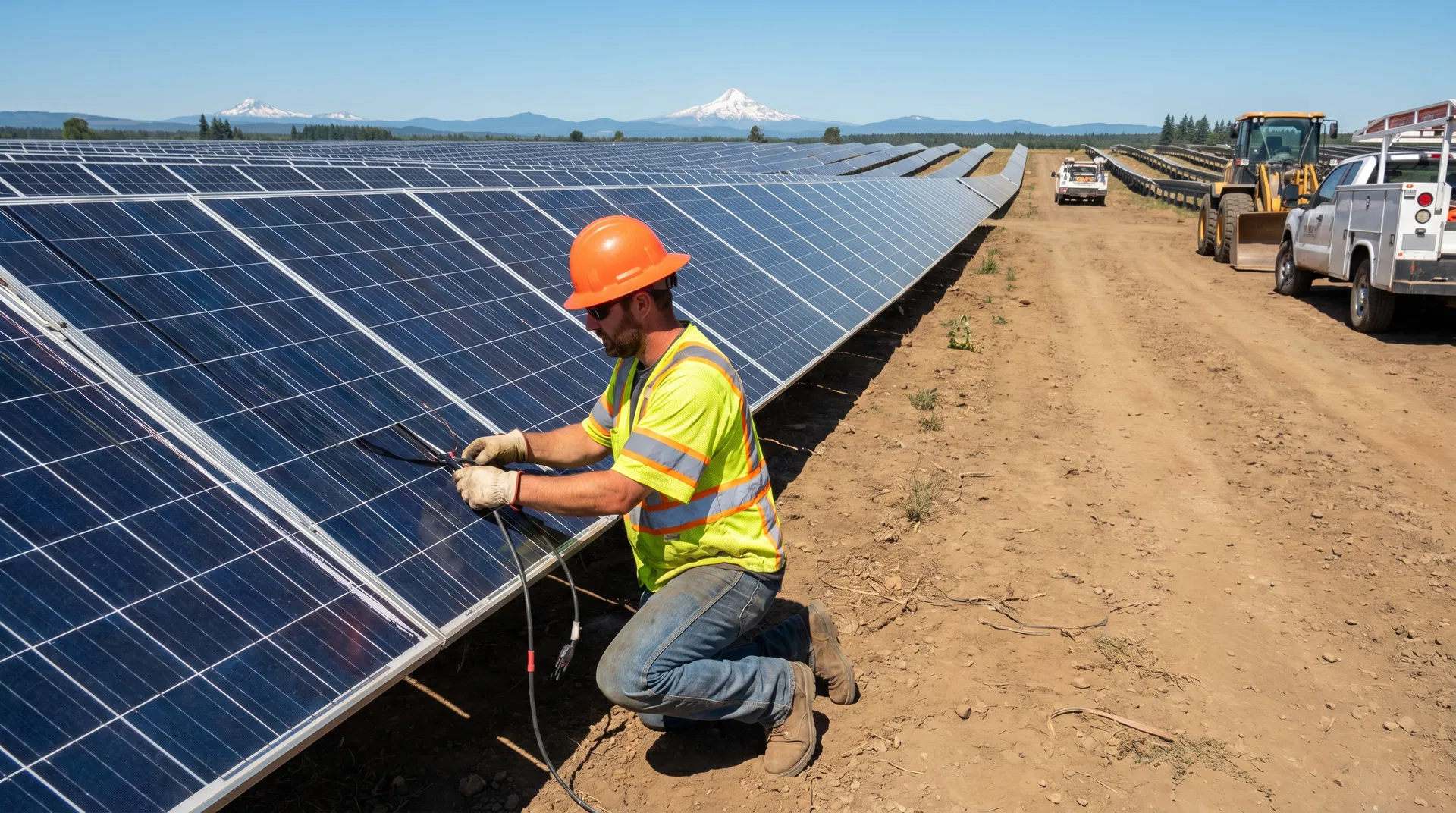
Oregon's solar energy sector is expanding rapidly, driven by state renewable energy mandates, federal tax incentives, and growing demand from commercial and agricultural customers across the Pacific Northwest. For the contractors who build these projects — electrical contractors, excavation firms, civil engineers, and specialty installers — the insurance requirements are significantly more complex than a standard contractor's policy. Solar projects combine high-voltage electrical work, ground disturbance, expensive equipment, and extended construction timelines in ways that create unique and often underinsured exposures.
Insure Pacific works with contractors across Oregon and the western United States, including the growing number of trades firms entering the solar energy market. This guide covers the four primary insurance categories every solar contractor needs to understand: general liability for electrical contractors, coverage for excavation and grading firms, builder's risk during the construction phase, and equipment coverage for the solar arrays themselves.
Solar Work Often Requires Separate Policy Endorsements
Many standard contractor general liability policies exclude or severely limit coverage for solar energy work, high-voltage electrical installations, and work performed at heights above 15 feet. If your policy wasn't specifically underwritten for solar work, you may have significant gaps — even if you've been paying premiums for years.
Electrical Contractors: The Highest-Risk Trade on Any Solar Project
Electrical contractors bear the greatest risk exposure on solar projects because they work with high-voltage DC systems that behave differently from standard AC electrical work. Solar panels generate DC power that cannot be simply "switched off" — as long as sunlight hits the panels, they are producing electricity. This creates arc flash hazards, electrocution risks, and fire risks that require specialized training, equipment, and insurance coverage.
For Oregon electrical contractors, the minimum recommended general liability coverage for solar work is $2 million per occurrence and $4 million aggregate — significantly higher than the $1M/$2M standard for general electrical work. This reflects the higher severity of potential claims: a fire caused by a faulty solar installation can result in total property loss, and an arc flash injury can generate medical bills in the hundreds of thousands of dollars. Many commercial and utility-scale solar project owners require $5 million in liability coverage as a contract condition.
Oregon electrical contractors working on solar projects should also verify that their policy includes Products-Completed Operations coverage, which protects against claims arising from defective work after the project is complete. Solar systems have 25-year expected lifespans, and a wiring defect that causes a fire five years after installation can still generate a claim against the original installing contractor. Standard contractor policies often limit Products-Completed Operations to two or three years — inadequate for solar work.
Workers' compensation for electrical contractors on solar projects also requires attention. Rooftop work, work at height, and high-voltage exposure all affect workers' comp classification codes and premium rates. Misclassifying employees on solar projects can result in significant premium adjustments at audit — and potential coverage disputes if a worker is injured. Our commercial insurance specialists can review your workers' comp classifications to ensure accuracy before your next audit.
Excavation and Grading Firms: Underground Risks on Solar Sites
Ground-mounted solar arrays require significant site preparation: grading, trenching for conduit runs, installation of racking foundations, and sometimes environmental mitigation work. Excavation contractors on solar projects face the standard underground utility strike risks plus additional exposures specific to solar sites — including damage to pre-installed conduit, underground collection system cables, and monitoring equipment.
Oregon's "call before you dig" requirements (Oregon 811) apply to all excavation work, but solar sites often have complex underground infrastructure that isn't fully mapped in utility databases. An excavation contractor who damages an underground DC collection cable on a utility-scale solar project can face claims in the tens of thousands of dollars for cable replacement alone — plus business interruption costs for the project owner if the damage delays commissioning.
Excavation firms working on solar projects should ensure their general liability policy includes coverage for underground property damage and that their inland marine/equipment floater covers their heavy equipment while on solar project sites. Some solar project owners require excavation contractors to carry pollution liability coverage as well, particularly on projects near wetlands, waterways, or agricultural land — a common situation in Oregon's Willamette Valley and eastern Oregon.
Key Coverages for Excavation Contractors on Solar Projects
General Liability: $1M–$2M per occurrence; verify underground property damage is included
Equipment Floater: Covers heavy equipment (excavators, graders, compactors) on-site
Pollution Liability: Required by many project owners; covers fuel spills, soil contamination
Commercial Auto: Covers equipment transport and on-site vehicle use
Workers' Comp: Excavation classification codes; verify solar site work is included
Excavation contractors who are new to solar work should review their existing coverage with an independent agent before signing their first solar contract. The contractual insurance requirements on solar projects are often more stringent than what excavation firms carry for standard residential or commercial work. Learn more about our contractor insurance programs or get a quote tailored to your solar work.
Builder's Risk Insurance: Protecting Solar Projects During Construction
Builder's risk insurance is a specialized form of property coverage that protects a construction project from the moment materials arrive on site until the project is substantially complete and handed over to the owner. For solar projects, builder's risk is not optional — it is typically required by the project owner, the lender, and often by the interconnection agreement with the utility.
Solar projects present unique builder's risk challenges. Panels are expensive, fragile, and attractive to thieves — panel theft from solar construction sites has become a significant problem in Oregon and across the western US. Inverters, transformers, and monitoring equipment represent additional high-value targets. A single theft event on a mid-size commercial solar project can result in losses of $50,000 to $200,000 or more. Standard builder's risk policies may have sub-limits for theft that are inadequate for solar projects.
Weather is another critical builder's risk consideration for Oregon solar projects. Hail can damage panels during installation before they're fully secured. Wind can topple partially-erected racking systems. Flooding can damage electrical components stored on-site. A well-structured solar builder's risk policy should cover all of these perils with limits that reflect the full replacement cost of the project — not just the materials cost.
| Builder's Risk Component | What It Covers | Solar-Specific Consideration |
|---|---|---|
| Materials & Equipment | Panels, inverters, racking, wiring, transformers | Verify theft sub-limits are adequate; panels are high-value targets |
| Soft Costs | Re-design fees, permit re-applications, financing costs | Critical for utility-scale projects with complex permitting |
| Delay in Opening | Lost revenue from delayed commissioning | Important for projects with power purchase agreements (PPAs) |
| Transit Coverage | Panels and equipment in transit to site | Panels are fragile; verify transit coverage is included |
| Testing & Commissioning | Equipment damage during startup and testing | Inverter damage during commissioning is a common claim |
The question of who purchases builder's risk — the general contractor, the project owner, or the EPC (engineering, procurement, and construction) firm — varies by project structure. Regardless of who holds the policy, every contractor on the project should verify that they are named as an additional insured and that the policy limits are adequate for the full project value. Our team can help you navigate builder's risk requirements for your next solar project — contact us to discuss your specific situation.
Equipment Coverage: Protecting Solar Arrays After Installation
Once a solar project is complete and operational, the builder's risk policy expires and the project transitions to operational property coverage. For contractors who own and operate solar systems — increasingly common as contractors take on power purchase agreements or community solar projects — this transition is a critical insurance moment that is frequently mishandled.
Operational solar equipment coverage typically includes all-risk property coverage for the panels, inverters, racking, and electrical infrastructure; equipment breakdown coverage for inverters and transformers (which are excluded from standard property policies); and business interruption coverage for lost revenue when the system is down for repairs. In Oregon, where hail, ice storms, and wildfire smoke can all affect solar production, comprehensive operational coverage is essential.
For contractors who install solar systems for commercial clients, the Products-Completed Operations coverage in their general liability policy is the primary protection against post-installation claims. But this coverage has limits — both in terms of dollar amounts and the types of claims it covers. A defective installation that causes a fire, for example, may be covered under Products-Completed Operations, but a system that simply underperforms due to design errors may not be. Professional liability (errors and omissions) coverage fills this gap for contractors who also provide design or engineering services.
Oregon contractors entering the solar market should work with an independent agent who understands both the construction insurance market and the renewable energy insurance market — two distinct specialties that don't always overlap. Insure Pacific's commercial insurance team can build a comprehensive program that covers your solar work from the first shovel in the ground through the 25-year operational life of the system. You may also find our guide on commercial insurance for Oregon manufacturers helpful for understanding related coverage considerations.
Navigating Solar Project Contractual Insurance Requirements
One of the most common pain points for contractors entering the solar market is the insurance requirements embedded in project contracts. Solar project owners, utilities, and lenders often require coverage levels and policy endorsements that go well beyond what a standard contractor policy provides. Understanding these requirements before you sign a contract — not after — is essential to avoiding costly surprises.
Additional Insured Requirements
Most solar contracts require you to name the project owner, lender, and sometimes the utility as additional insureds on your general liability and auto policies. Verify your policy allows blanket additional insured endorsements.
Waiver of Subrogation
Solar contracts typically require a waiver of subrogation — your insurer agrees not to pursue claims against the project owner. Not all policies include this; it may require a specific endorsement.
Minimum Liability Limits
Commercial solar projects commonly require $2M–$5M in general liability, $1M in auto liability, and $5M–$10M in umbrella coverage. Verify your limits meet contract requirements before mobilizing.
Workers' Comp Requirements
Oregon requires workers' comp for any employer with one or more employees. Solar contracts may also require specific employers' liability limits (typically $1M/$1M/$1M) beyond the state minimum.
Professional Liability
Contractors who provide design services, energy modeling, or system sizing recommendations may be required to carry professional liability (E&O) coverage — typically $1M–$2M.
Certificate Timing
Solar contracts often require certificates of insurance before mobilization. Working with an agent who can issue certificates quickly — and who understands solar project requirements — prevents costly delays.
Oregon's solar market is growing, and the contractors who position themselves with the right insurance program will be best placed to win the contracts that come with it. Whether you're an established electrical contractor adding solar to your services, an excavation firm working your first solar site, or a specialty solar installer looking to scale up, Insure Pacific can build a program that meets your contractual requirements and protects your business. Request a quote or contact our commercial team to get started.
Our Licensed Coverage Area
States highlighted in blue are states where Insure Pacific holds an active insurance license.
Hover to highlight — click a state to visit its insurance page
Our Oregon Office Locations
Hover over a marker to see the office — click to visit their website.
Hover to highlight — click to visit that office's website
Ready to Get Protected?
Talk to a Local Oregon Insurance Expert
Insure Pacific has been serving Oregon families and businesses since 1935. We work with 50+ carriers so you get real options — not just one company's answer.
Related Articles
 Commercial Insurance
General Liability Insurance: What It Covers—and What It Doesn’t
Read Article → Commercial Insurance
Multi-State Workers’ Compensation: Remote Employees, Traveling Crews, and Out-of-State Jobs
Read Article → Commercial Insurance
Import and Export Cargo Insurance: Ocean Freight, Ports, Customs, and Inland Transportation
Read Article → Commercial Insurance
Has Your Business Outgrown Its Insurance? Revenue, Payroll, New Locations, and New Services
Read Article →Get in Touch
Ready to protect what matters most? Contact us today for a no-obligation insurance review. Our experienced agents are here to help you find the right coverage for your needs.


