



Fleet Insurance Across Multiple States: How Western Businesses With Vehicles in Several States Should Structure Their Coverage

Fleet Insurance Across Multiple States: How Western Businesses With Vehicles in Several States Should Structure Their Coverage

Your trucks cross state lines every week. Your drivers move between Oregon and Idaho, Nevada and Arizona, Colorado and Texas. Your equipment sits in depot yards in three different states on any given Tuesday. But your insurance program? It was probably written for a simpler time — when your operation was smaller, your routes shorter, and the regulatory landscape less complicated. For western businesses with vehicles operating across multiple states, that gap between what you have and what you actually need is where the most expensive surprises live.
Insure Pacific is licensed across all ten states in the American West and works with more than 50 commercial carriers. This guide is a practical, state-by-state breakdown of how fleet insurance works across the western United States — covering FMCSA requirements, state minimums, the coverage stack every multi-state fleet needs, and the specific gaps that catch logistics companies, construction firms, and service businesses off guard. No jargon. No generic advice. Just what you need to know to protect your operation.
The Most Dangerous Fleet Coverage Assumption
The most common and costly mistake we see with multi-state fleets: assuming that a commercial auto policy written in Oregon automatically covers everything that happens in Nevada, Arizona, or Texas at the same limits. It does — but only up to the minimum required in each state. If your Oregon policy carries $1M in liability and Nevada only requires $750K, you're fine. But if your policy carries $500K and a state requires $750K, your carrier may deny the excess claim. Always verify your policy limits against every state you operate in.
Operating a Fleet Across Multiple Western States?
Insure Pacific is licensed in Oregon, Idaho, Nevada, Arizona, Washington, California, Utah, Colorado, Texas, and Montana. One agent, one relationship, one coordinated fleet program across your entire western operation.
How Commercial Auto Insurance Works Across State Lines
The first thing to understand about multi-state fleet insurance is that a standard commercial auto policy is not a state-specific document. Unlike homeowners insurance, which is written for a specific property in a specific state, commercial auto insurance follows the vehicle. Your policy covers your trucks wherever they operate in the United States — and it automatically adjusts to meet the minimum liability requirements of whatever state your vehicle is in when a loss occurs.
This sounds reassuring, but it creates a critical nuance: the policy adjusts to the state minimum, not to your policy limit. If your commercial auto policy carries $1 million in combined single limit (CSL) liability, you're covered at $1 million in every state. But if your policy only carries $300,000 CSL and you're operating a vehicle over 26,000 pounds in interstate commerce, you may be out of compliance with FMCSA requirements — and your carrier may not cover the gap between your policy limit and the federal minimum.
The vehicle's state of registration determines which state's insurance regulations govern the policy itself. If your trucks are registered in Oregon, your policy is an Oregon commercial auto policy. But the coverage it provides must meet or exceed the requirements of every state where your vehicles operate. This is why fleet managers need to understand not just their home state's requirements, but the requirements of every state on their regular routes.
| State | Basic Commercial Min. | USDOT/Interstate (≥10K lbs) | Key Notes |
|---|---|---|---|
| Oregon | 25/50/20 | $750K CSL | High UM/UIM requirements; strong worker protections |
| Idaho | 25/50/15 | $750K CSL | Lower minimums; rural routes common |
| Nevada | 25/50/20 | $750K CSL | High-traffic I-15 and US-93 corridors |
| Arizona | 25/50/15 | $750K CSL (>26K lbs) | $300K for 20K–26K lbs; extreme heat adds risk |
| Washington | 25/50/10 | $750K CSL | Port of Seattle logistics hub; high freight volume |
| California | 30/60/15 | $750K CSL | Strictest regulations; AB5 driver classification issues |
| Utah | 25/65/15 | $750K CSL | I-15 corridor; growing logistics hub |
| Colorado | 25/50/15 | $750K CSL | <10K lbs: $300K; ≥10K lbs: $750K |
| Texas | 30/60/25 | $750K CSL | Largest state by route miles; diverse cargo |
| Montana | 25/50/20 | $750K CSL | Long rural distances; limited carrier options |
Sources: FMCSA 49 CFR Part 387; state motor carrier regulations. Limits shown are minimums — actual recommended coverage for most western fleets is $1M–$2M CSL.

Insure Pacific covers all major western commercial corridors — from the I-5 Pacific Coast to the I-10 Sun Belt and I-25 Mountain corridor.
FMCSA Requirements: What Interstate Carriers Must Know
If your business operates vehicles in interstate commerce — meaning your trucks cross state lines for hire, or carry goods that originated in another state — you are subject to Federal Motor Carrier Safety Administration (FMCSA) regulations under 49 CFR Part 387. These federal requirements sit on top of state minimums and apply regardless of which state your vehicles are registered in.
The core FMCSA requirement for most property-carrying for-hire carriers is a minimum of $750,000 in public liability coverage. This applies to general freight carriers operating vehicles over 10,001 pounds in gross vehicle weight. Carriers transporting certain hazardous materials face higher minimums: $1 million for oil and petroleum products, and up to $5 million for certain hazardous substances and explosives. Passenger carriers face even higher requirements — $1.5 million CSL for vehicles carrying 1 to 15 passengers, and $5 million for 16 or more.
The critical compliance document for interstate carriers is the MCS-90 endorsement — a federal form that must be attached to your commercial auto policy and filed with the FMCSA. The MCS-90 is not insurance; it's a guarantee that your insurer will pay claims up to the federal minimum even if the underlying policy would otherwise deny coverage. Without a properly filed MCS-90, the FMCSA will not activate or maintain your operating authority. A lapse in coverage — even for a single day — triggers immediate authority suspension and can take weeks to reinstate.
General Freight (For-Hire)
Non-hazardous property carriers operating vehicles over 10,001 lbs in interstate commerce. Most western logistics and trucking companies fall here.
Hazardous Materials
Oil/petroleum: $1M minimum. Certain hazardous substances and explosives: $5M minimum. Applies to carriers transporting regulated materials across state lines.
Passenger Carriers
1–15 passengers: $1.5M minimum. 16+ passengers: $5M minimum. Applies to charter buses, shuttle services, and tour operators crossing state lines.
The Complete Coverage Stack for Multi-State Fleets
Commercial auto liability is the foundation of any fleet insurance program, but it's only one layer of a complete coverage stack. Western businesses operating vehicles across multiple states typically need six to eight distinct coverage types to be fully protected. Understanding what each layer covers — and more importantly, what it doesn't — is the difference between a fleet that recovers from a major loss and one that doesn't.
Commercial Auto Liability
Covers: Bodily injury and property damage you cause to others with your vehicles. The foundation of every fleet program.
Gap: Does NOT cover your own vehicles, your cargo, or injuries to your drivers. Does not cover loading/unloading incidents at customer sites.
Recommended: $1M–$2M CSL for most western fleets; $750K minimum for FMCSA compliance
Physical Damage (Comp & Collision)
Covers: Damage to your own vehicles from collisions, theft, fire, vandalism, hail, and other perils.
Gap: Does NOT cover cargo inside the vehicle. Does not cover equipment mounted on or in the vehicle unless specifically scheduled.
Recommended: Actual cash value or agreed value; consider stated value for specialty vehicles
Motor Truck Cargo (MTC)
Covers: Covers the goods you're transporting for others if they're damaged, destroyed, or stolen while in your care.
Gap: Standard commercial auto NEVER covers cargo. This is a separate policy. Limits must match the value of the highest-value load you carry.
Recommended: $100K–$500K depending on cargo type and load values
Non-Trucking Liability (NTL)
Covers: Covers owner-operators when they're using their truck for personal use — NOT under dispatch from a motor carrier.
Gap: The motor carrier's policy covers the truck while under dispatch. NTL fills the gap when the driver is off-duty. Without it, there's no coverage.
Recommended: Required for all owner-operators; typically $1M CSL
Hired & Non-Owned Auto (HNOA)
Covers: Covers liability when employees use rented vehicles or their own personal vehicles for business purposes.
Gap: Personal auto policies exclude business use. If an employee runs an errand in their personal car and causes an accident, your business is exposed without HNOA.
Recommended: Add to commercial auto or general liability policy; essential for service companies
Commercial Umbrella / Excess Liability
Covers: Provides additional liability limits above your primary commercial auto, GL, and other underlying policies.
Gap: A single serious accident — especially one involving injuries — can exhaust $1M in primary limits quickly. Umbrella provides the buffer.
Recommended: $2M–$5M for most western fleets; higher for passenger carriers or hazmat

FMCSA compliance requires continuous insurance coverage — any lapse triggers immediate operating authority suspension, which can take weeks to reinstate.
Western Industry Profiles: Logistics, Construction, and Service Companies
The American West's economy runs on three primary fleet-dependent industries: logistics and trucking, construction and contracting, and field service companies. Each has a distinct risk profile, a different relationship with FMCSA requirements, and different coverage gaps that standard policies routinely miss. Insure Pacific works with all three across our ten-state footprint — here's what each needs.

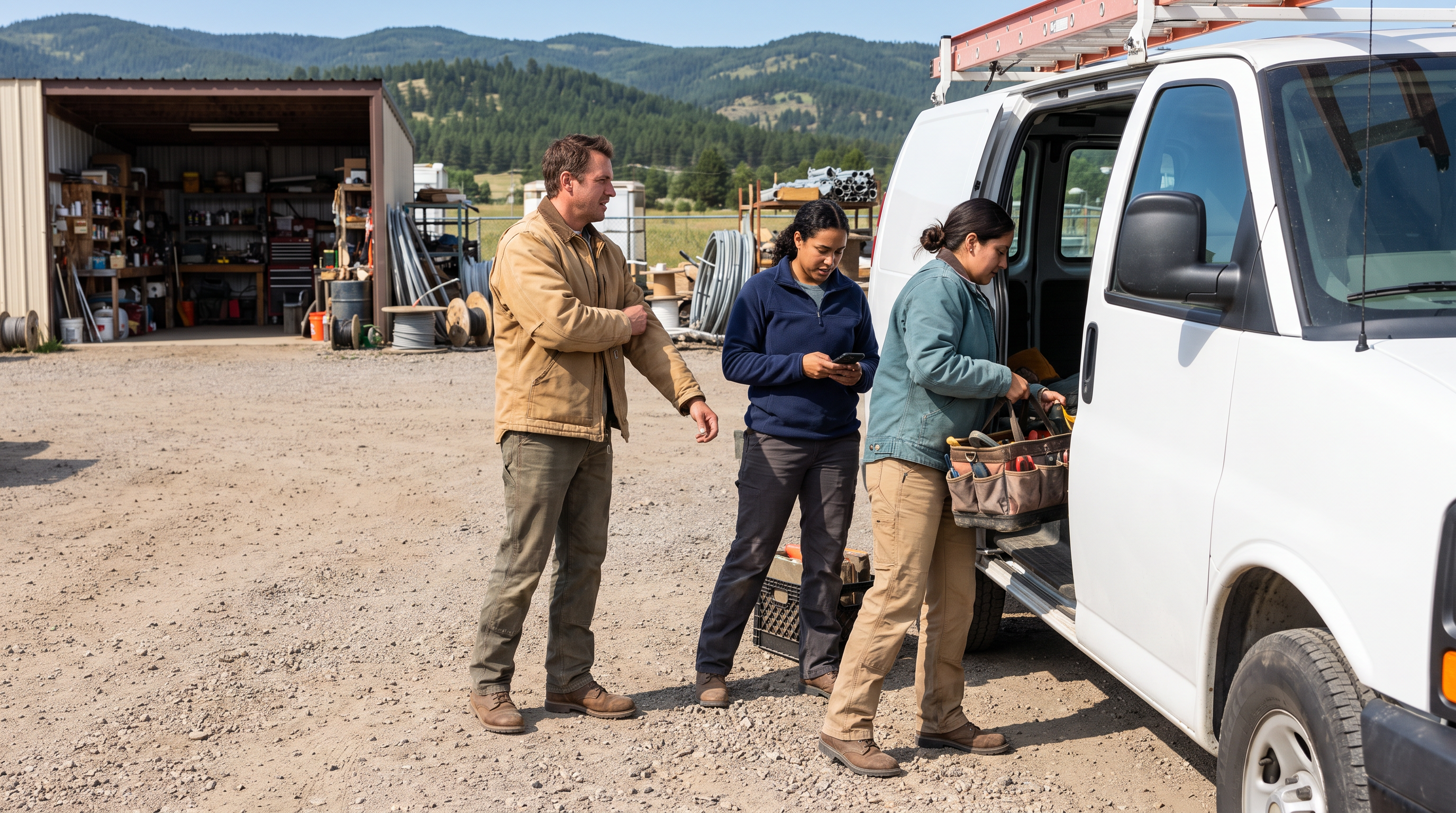
From Utah canyon country construction routes to Portland urban delivery to Denver service corridors — western fleets face diverse terrain, climate, and regulatory environments.
Logistics & Trucking
Active in: OR, WA, ID, NV, CA, AZ, UT, CO, TX
Key Risks:
- FMCSA compliance and MCS-90 filing
- High-value cargo loss (electronics, produce, equipment)
- Driver turnover and MVR management
- Fuel spill liability on mountain passes
- Port of Seattle/LA drayage requirements
Must-Have Coverage:
MCS-90 endorsement, Motor Truck Cargo, Umbrella $2M+, Occupational Accident for owner-operators
Learn about commercial insurance →Construction & Contracting
Active in: OR, ID, NV, AZ, UT, CO, TX, MT
Key Risks:
- Equipment on vehicles (not covered by commercial auto)
- Towing heavy equipment across state lines
- Job site liability during loading/unloading
- Employee-owned trucks used on job sites
- Seasonal route changes (winter mountain closures)
Must-Have Coverage:
Inland Marine for tools/equipment, HNOA for employee vehicles, GL with completed operations, Umbrella $2M+
Learn about commercial insurance →Service Companies (HVAC, Plumbing, IT)
Active in: OR, WA, ID, NV, CA, AZ, UT, CO
Key Risks:
- Employee-owned vehicles used for service calls
- Tools and equipment in service vans
- Customer property damage during service
- Multi-state licensing and contractor bonds
- Cyber liability for connected service systems
Must-Have Coverage:
HNOA, Inland Marine for tools, GL with professional liability, Umbrella $1M+
Learn about commercial insurance →The 7 Most Common Multi-State Fleet Coverage Mistakes
After reviewing fleet insurance programs for businesses across ten western states, these are the coverage mistakes we see most often — and the ones that cause the most financial damage when a loss occurs.
Treating the $750K FMCSA Minimum as Adequate Coverage
The federal $750,000 minimum was set in 1980 and has never been adjusted for inflation. In today's dollars, that's roughly $280,000 in 1980 purchasing power. A single serious accident involving injuries, medical costs, and lost wages can easily exceed $750K. Most western fleet operators should carry $1M–$2M CSL as a baseline, with an umbrella above that.
No Cargo Insurance on a For-Hire Carrier
Commercial auto liability covers damage you cause to others. It does not cover the goods you're transporting. If your truck is involved in an accident and the cargo is destroyed, your customer will come after you — and your commercial auto policy won't respond. Motor Truck Cargo insurance is a separate policy and is essential for any carrier transporting goods for others.
Assuming Personal Auto Covers Employee Business Use
When an employee uses their personal vehicle to make a delivery, pick up parts, or visit a customer, their personal auto policy almost certainly excludes that use. If they cause an accident, your business faces the liability claim with no coverage. Hired and Non-Owned Auto (HNOA) coverage closes this gap and is inexpensive to add.
No Non-Trucking Liability for Owner-Operators
Motor carriers who use owner-operators need to understand the coverage gap that exists when those drivers are not under dispatch. The carrier's policy covers the truck while it's working for the carrier. When the driver is off-duty, driving home, or running personal errands, there's no coverage unless the driver has Non-Trucking Liability. This gap has produced some of the largest uninsured claims in the trucking industry.
Equipment on Vehicles Not Scheduled on the Policy
Tools, equipment, and specialty attachments mounted on or carried in commercial vehicles are generally not covered by commercial auto insurance. A $50,000 piece of survey equipment in the back of a service truck, a $30,000 crane attachment on a flatbed — these need to be specifically scheduled on an inland marine or equipment floater policy. We find this gap constantly in construction and service company fleet reviews.
Letting Coverage Lapse During Slow Seasons
Some fleet operators reduce or cancel coverage during slow seasons to save money. For FMCSA-regulated carriers, this is catastrophic: a single day of lapsed coverage triggers authority suspension, and reinstatement can take 30–90 days. Even for non-regulated fleets, a lapse creates a gap in claims history that makes future coverage more expensive. Keep coverage continuous — adjust limits and vehicles on the policy instead.
Not Updating the Policy When Adding Vehicles or States
Every vehicle must be listed on your commercial auto policy to be covered. Every state where you regularly operate should be disclosed to your carrier. When you add a truck, hire a driver in a new state, or start a new route, your policy needs to be updated. Carriers can deny claims on unlisted vehicles, and operating in an undisclosed state can create coverage disputes.
Is Your Fleet Fully Covered Across Every State You Operate In?
Insure Pacific offers free fleet insurance reviews for western businesses. We'll check your FMCSA compliance, identify coverage gaps, and shop 50+ carriers to find the right program for your routes and vehicles.
Fleet Size and the Right Policy Structure
Fleet insurance isn't one-size-fits-all — the right policy structure depends heavily on how many vehicles you operate, what types they are, and how your drivers are classified. Understanding these thresholds helps you avoid both under-insurance (too little coverage) and over-insurance (paying for coverage you don't need).
| Fleet Size | Recommended Structure | Key Considerations |
|---|---|---|
| 1–4 Vehicles | Individual commercial auto policies per vehicle | Simple to manage; each vehicle can be with different carriers if needed; less leverage on pricing |
| 5–9 Vehicles | Fleet policy (single policy covering all vehicles) | Better pricing; single renewal date; easier to add/remove vehicles; fleet discount typically kicks in at 5+ |
| 10–24 Vehicles | Fleet program with telematics discount | Telematics (GPS/driver monitoring) can reduce premiums 10–20%; loss control services available; dedicated underwriter |
| 25+ Vehicles | Dedicated fleet program with loss control | Custom rating based on your fleet's loss history; safety program requirements; potential for captive or self-insured retention |
Driver Management: The Hidden Premium Driver
In fleet insurance, your drivers are your biggest risk factor — and your biggest opportunity to control costs. Carriers underwrite fleet policies based heavily on the driving records of your employees. A single driver with multiple violations or accidents can increase your entire fleet's premium by 20–40%. Conversely, a well-documented driver management program can qualify your fleet for significant discounts.
Every carrier will require Motor Vehicle Records (MVRs) for all listed drivers at policy inception and typically at each renewal. Most carriers use a points-based system to evaluate drivers: minor violations (speeding, improper lane change) add 1–2 points; major violations (DUI, reckless driving, hit-and-run) add 4–6 points and may make a driver uninsurable with standard carriers. Carriers typically exclude drivers with more than 3 violations in the past 3 years or any major violation in the past 5 years.
For multi-state fleets, driver management is complicated by the fact that violations in other states may not appear on an Oregon or Idaho MVR check. A comprehensive fleet program should include annual MVR checks in every state where your drivers hold licenses — not just the state where they're employed. Insure Pacific can help structure a driver qualification program that satisfies carrier requirements and keeps your premiums competitive.
Fleet Insurance Readiness Checklist
Frequently Asked Questions
Do I need a separate policy for each state my fleet operates in?
No. A standard commercial auto policy covers your vehicles in all 50 states. However, the policy must be written with limits that meet or exceed the highest minimum required in any state where you regularly operate. If you're an FMCSA-regulated carrier, you also need a properly filed MCS-90 endorsement — which is a federal form, not a state-specific one.
What's the difference between a for-hire carrier and a private carrier for insurance purposes?
A for-hire carrier transports goods or passengers for compensation — you're paid to move someone else's stuff. A private carrier transports its own goods in its own vehicles (a plumbing company driving its own tools to job sites, for example). For-hire carriers are subject to FMCSA regulations and the $750K minimum. Private carriers are not subject to FMCSA minimums, though they still need commercial auto insurance and should carry adequate limits.
How does cargo insurance work if my truck is in an accident in Arizona but the cargo was loaded in Oregon?
Motor Truck Cargo insurance follows the cargo, not the state. If your truck is in an accident in Arizona and the cargo is damaged, your MTC policy responds regardless of where the cargo originated. The key is that your MTC policy limits must be adequate to cover the value of the cargo you're carrying — and you should review your policy for any exclusions related to the type of cargo you transport.
Can I add vehicles to my fleet policy mid-term?
Yes. Most fleet policies allow you to add vehicles mid-term with a pro-rated premium adjustment. You should notify your agent immediately when you acquire a new vehicle — coverage typically doesn't apply until the vehicle is added to the policy. Some policies include a 30-day automatic coverage provision for newly acquired vehicles, but you should never rely on this as a substitute for prompt notification.
What happens to my FMCSA operating authority if my insurance lapses?
The FMCSA will immediately suspend your operating authority if your insurance lapses — even for a single day. Your insurer is required to notify the FMCSA 30 days before cancellation, but if you fail to pay a premium or your policy is cancelled for other reasons, the suspension can happen quickly. Reinstatement requires filing new insurance, paying a reinstatement fee, and waiting for FMCSA processing — a process that can take 30–90 days and costs you revenue every day your authority is suspended.
How does Insure Pacific handle fleet insurance for businesses operating in multiple states?
As an independent agency licensed in all ten western states, Insure Pacific can write a single coordinated fleet program that covers your entire operation — regardless of which states your vehicles operate in. We work with 50+ commercial carriers, including specialty fleet programs, to find the right combination of coverage and price for your specific fleet size, vehicle types, cargo, and routes. One agent, one renewal, one program.
Ready to Build a Coordinated Fleet Insurance Program?
Insure Pacific has been serving western businesses since 1935. We're licensed in 10 states, work with 50+ commercial carriers, and specialize in fleet programs for logistics, construction, and service companies across the American West. Let's review your fleet and build a program that actually covers what you need.
Our Licensed Coverage Area
States highlighted in blue are states where Insure Pacific holds an active insurance license.
Hover to highlight — click a state to visit its insurance page
Our Oregon Office Locations
Hover over a marker to see the office — click to visit their website.
Hover to highlight — click to visit that office's website
Ready to Get Protected?
Talk to a Local Oregon Insurance Expert
Insure Pacific has been serving Oregon families and businesses since 1935. We work with 50+ carriers so you get real options — not just one company's answer.
Related Articles
 Commercial Insurance
Multi-State Workers’ Compensation: Remote Employees, Traveling Crews, and Out-of-State Jobs
Read Article → Commercial Insurance
Import and Export Cargo Insurance: Ocean Freight, Ports, Customs, and Inland Transportation
Read Article → Commercial Insurance
Has Your Business Outgrown Its Insurance? Revenue, Payroll, New Locations, and New Services
Read Article → Commercial Insurance
Buying a Commercial Building: Insurance Questions to Answer Before Closing
Read Article →Get in Touch
Ready to protect what matters most? Contact us today for a no-obligation insurance review. Our experienced agents are here to help you find the right coverage for your needs.


