



Food Trucks, Pop-Ups, and Farmers Markets: Insuring the Booming Street Food and Mobile Business Economy Across the West
Food Trucks, Pop-Ups, and Farmers Markets: Insuring the Booming Street Food and Mobile Business Economy Across the West

Portland's food cart pods. Denver's weekend farmers markets. Austin's legendary trailer parks. Bend's Saturday Market. The American West has built a thriving, deeply rooted street food and mobile business culture that generates billions in economic activity and supports tens of thousands of entrepreneurs. Yet most of these business owners — food truck operators, pop-up boutique vendors, farmers market food producers, mobile caterers — are operating with insurance that was never designed for them.
The gap between what mobile business owners think they have covered and what their policies actually protect is one of the most consequential — and most overlooked — insurance problems in the American West. A standard Business Owner's Policy (BOP) was designed for a business with a fixed address. A food truck is a commercial vehicle, a commercial kitchen, a retail storefront, and an event vendor all at once. The coverage stack required to protect it properly is fundamentally different from what most operators carry. This guide maps exactly what you need, where the gaps hide, and how Insure Pacific helps mobile entrepreneurs across our ten western states build coverage that actually works.
The Most Dangerous Assumption in Food Truck Insurance
The single most common — and most costly — mistake mobile business owners make: assuming that a standard Business Owner's Policy covers their food truck or mobile equipment. A BOP is designed for a fixed-location business. It typically excludes vehicles, vehicle-mounted equipment (your fryers, refrigerators, and generators), and coverage at third-party event venues. The moment you drive your truck to a farmers market or festival, you may be operating with no effective commercial coverage at all.
Food Truck or Mobile Business? Let's Build Your Coverage Stack.
Insure Pacific is licensed across 10 western states and works with 50+ carriers who specialize in mobile and commercial business coverage. One call, one agent, complete protection.
Why Standard Business Insurance Fails Mobile Operators
The Business Owner's Policy was designed in an era when "business" meant a fixed address — a storefront, an office, a warehouse. It bundles general liability and commercial property coverage into a single policy, which works well for a bakery with a permanent kitchen or a boutique with a lease. But a food truck, mobile boutique, or pop-up market vendor operates in a fundamentally different way, and the standard BOP has three critical failure points for mobile businesses.
First, the vehicle exclusion. A BOP covers business property at or near the listed business address. Your food truck is a vehicle — and vehicles are explicitly excluded from standard property coverage. The commercial kitchen equipment bolted to the floor of your truck, the refrigeration units, the generator, the point-of-sale system — all of it is vehicle-mounted, and none of it is covered under a standard BOP when it's in or on the truck. You need commercial auto coverage for the vehicle itself, and a separate inland marine or commercial property floater for the equipment inside it.
Second, the location exclusion. A BOP's general liability coverage applies at or near the listed business address. When you drive your truck to a farmers market, a food cart pod, a festival, or a private event, you're operating at a third-party venue. Many standard GL policies don't automatically extend to off-premises locations — and even those that do may not satisfy the additional insured requirements that event organizers demand. The Bend Farmers Market, the Portland Saturday Market, and the Denver City Park Farmers Market all require vendors to carry a Certificate of Insurance (COI) naming the market as an additional insured. A basic BOP may not produce a valid COI for these purposes.
Third, the product liability gap. If a customer gets sick from food you sell, or is injured by a product from your mobile boutique, product liability coverage pays for their medical bills and legal defense costs. Some general liability policies include product liability as standard; others exclude it or require a specific endorsement. Food truck operators must confirm — in writing, from their carrier — that product liability is included and that food-borne illness claims are not excluded. This is not a safe assumption.
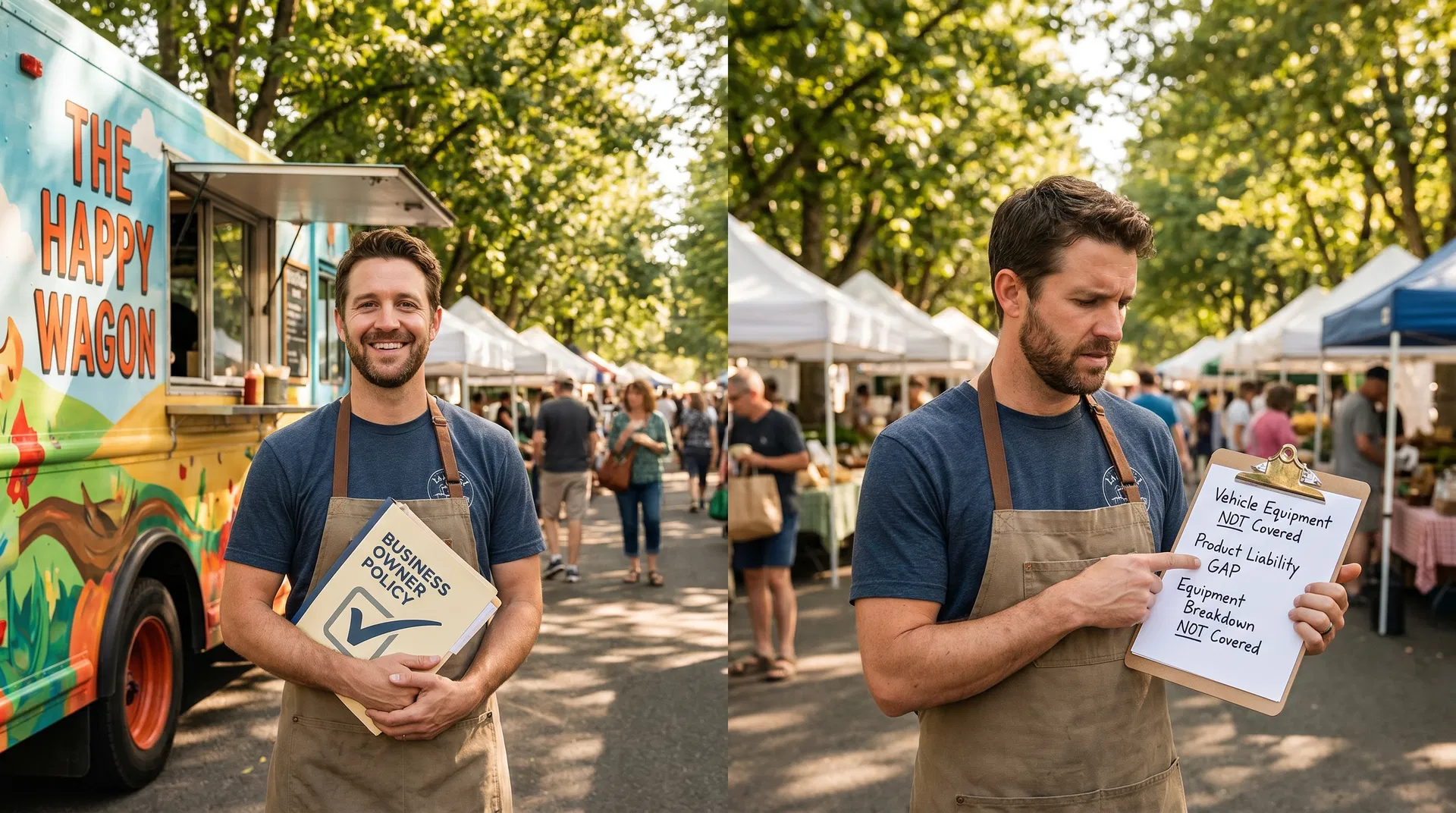
The gap between what a standard BOP covers and what a food truck operator actually needs is wider than most owners realize — and it only becomes visible at claim time.
The Complete Coverage Stack for Food Trucks and Mobile Businesses
A properly insured food truck or mobile business typically requires six distinct coverage types. Some can be bundled into a single commercial package policy; others must be purchased separately. Here is what each layer covers, why it matters, and what happens if you skip it.
1. Commercial Auto Insurance — The Non-Negotiable Foundation
Your food truck is a commercial vehicle. Personal auto insurance explicitly excludes vehicles used for commercial purposes — if you're driving your truck to events and selling food, your personal auto policy will not cover an accident. Commercial auto insurance covers the vehicle itself for collision, comprehensive (theft, fire, vandalism), and liability arising from driving. In Oregon, Texas, Colorado, Nevada, and every other western state, commercial auto is legally required to operate a business vehicle on public roads. Cost benchmark: approximately $170/month ($2,041/year) for food service vehicles. This is the foundation of your coverage stack — everything else builds on top of it.
2. General Liability with Product Liability — Your Event Access Pass
General liability insurance covers third-party bodily injury and property damage claims — a customer slips on a wet surface near your truck, a tent stake damages a neighboring vendor's equipment, a child is injured at your pop-up booth. Most events, farmers markets, and food cart pods require a minimum of $1,000,000 per occurrence / $2,000,000 aggregate general liability on a Certificate of Insurance (COI). Product liability — which covers illness or injury caused by food or products you sell — should be explicitly confirmed as included, not assumed. The COI must also be able to name the event organizer as an additional insured, which requires a specific endorsement on your policy.
3. Equipment Breakdown Coverage — The One Most Operators Skip
Your commercial fryer, refrigeration units, generator, and point-of-sale system are the heart of your business. Standard property insurance covers fire, theft, and vandalism — but it does not cover mechanical or electrical breakdown. If your refrigeration unit fails on a hot July afternoon at the Portland Saturday Market and you lose $2,000 in perishable inventory, a standard property policy pays nothing. Equipment breakdown coverage (sometimes called boiler and machinery coverage) specifically covers the cost of repairing or replacing equipment that fails due to mechanical breakdown, electrical arcing, or power surges. For a food truck, this coverage is essential — and it's typically inexpensive to add.
4. Inland Marine / Commercial Property Floater — Coverage for Equipment on the Move
Inland marine insurance — despite its nautical name — is the coverage designed for business property that moves. If you're a mobile boutique vendor who transports $15,000 in merchandise to weekend markets, or a food truck operator with $30,000 in custom kitchen equipment, inland marine coverage protects that property while it's in transit, at the event venue, and being loaded and unloaded. Standard commercial property policies cover property at a fixed address; inland marine covers property wherever it goes. For pop-up vendors and mobile boutique operators who don't have a permanent business location, this is often the primary property coverage layer.
5. Workers' Compensation — Required the Moment You Hire
If you have any employees — even part-time weekend help — workers' compensation insurance is legally required in Oregon, Washington, Colorado, Nevada, and most other western states. Workers' comp covers medical expenses and lost wages for employees injured on the job. A food truck kitchen is a high-risk environment: burns, cuts, slips, and heat-related illness are real hazards. Operating without workers' comp when you have employees exposes you to significant fines, penalties, and personal liability for employee injuries. The moment you hire your first employee, workers' comp is not optional.
6. Commercial Umbrella — For Large Events and Growing Operations
As your mobile business grows and you begin participating in larger festivals, corporate events, and high-profile markets, event organizers may require $2,000,000 or even $5,000,000 in liability coverage. A commercial umbrella policy provides excess liability coverage above your underlying GL and commercial auto limits, at a fraction of the cost of increasing those underlying limits. For food truck operators who want to participate in major western food festivals — Portland's Feast, Denver's A Taste of Colorado, Austin's Texas Monthly BBQ Festival — a commercial umbrella is often the difference between qualifying as a vendor and being turned away.
Coverage Matrix: What Each Policy Covers (and Doesn't)
The table below shows how each coverage type responds to the most common loss scenarios for food trucks and mobile businesses. The gaps in a standard BOP are immediately visible — which is why a custom commercial package is essential for mobile operators.
| Loss Scenario | Standard BOP | Commercial Auto | GL + Product Liability | Equipment Breakdown | Inland Marine |
|---|---|---|---|---|---|
| Truck damaged in accident while driving to event | ✗ | ✓ | ✗ | ✗ | ✗ |
| Fryer stolen from truck overnight | ✗ | ✓ (comprehensive) | ✗ | ✗ | ✓ |
| Customer slips near truck at farmers market | ⚠ may not extend | ✗ | ✓ | ✗ | ✗ |
| Customer gets food poisoning from your product | ⚠ check exclusions | ✗ | ✓ (with product liability) | ✗ | ✗ |
| Refrigeration unit breaks down, food spoils | ✗ | ✗ | ✗ | ✓ | ✗ |
| Generator fails mid-event, lost revenue | ✗ | ✗ | ✗ | ✓ (with BI rider) | ✗ |
| Merchandise damaged in transit to pop-up market | ✗ | ✗ | ✗ | ✗ | ✓ |
| Employee burned in kitchen accident | ✗ | ✗ | ✗ | ✗ | ✗ |
✓ = covered | ✗ = not covered | ⚠ = may be covered, verify with carrier | Workers' comp (not shown) is required separately for any employees.
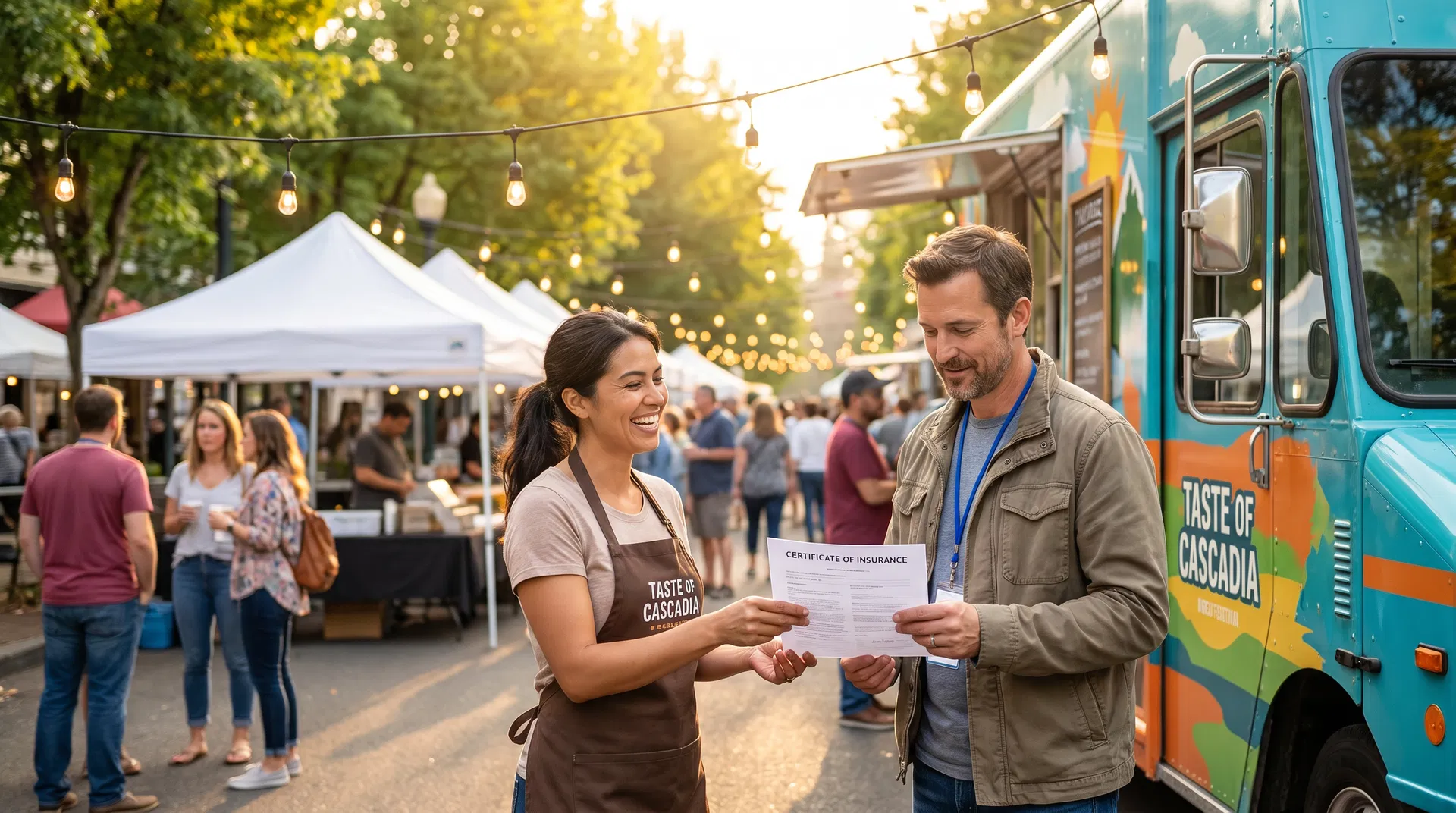
Most western farmers markets and food festivals require a Certificate of Insurance (COI) naming the organizer as additional insured before you can set up. Without the right policy, you can't participate.
The Certificate of Insurance: Your Ticket to Every Event
In the mobile business world, your Certificate of Insurance (COI) is as important as your business license. Event organizers, farmers market managers, festival coordinators, and commissary kitchens all require proof of insurance before they'll let you set up. And they don't just want to see that you have insurance — they want to see specific limits, specific coverage types, and often a specific endorsement naming their organization as an additional insured on your policy.
The standard COI requirement across most western markets and festivals is $1,000,000 per occurrence / $2,000,000 aggregate general liability. Larger events — Portland's Feast Oregon, Denver's A Taste of Colorado, Austin City Limits Market — may require $2,000,000 per occurrence. Corporate catering clients and private event venues often add requirements for primary and noncontributory coverage and a waiver of subrogation. These are not just bureaucratic formalities; they're contractual requirements that determine whether you can participate and earn revenue.
The additional insured endorsement is particularly important. When an event organizer requires additional insured status, they're asking to be named on your policy so that if a claim arises at their event, your insurance responds first — before theirs. Not all GL policies include this endorsement automatically; it must be specifically requested and added. An agent who understands the mobile business world will build this into your policy from the start, so you can produce a COI for any event within 24 hours.
State-by-State: What Mobile Business Owners Need to Know
Insurance requirements for mobile businesses vary by state, and so does the regulatory environment for food trucks and pop-up vendors. Here's what operators need to know in each of Insure Pacific's key western states.
Oregon
Home of the Food Cart PodPortland's ~500 food carts and ~25 food cart pods make Oregon the most food-truck-dense state per capita in the country. Oregon requires commercial auto insurance for any business vehicle. The Oregon Department of Agriculture and local health departments regulate mobile food units separately from fixed restaurants. Most Portland food cart pods require vendors to carry $1M GL with the pod operator as additional insured. Workers' comp is mandatory for any employees under Oregon law.
Oregon Commercial InsuranceTexas
Austin's Trailer Park CultureTexas requires minimum commercial auto liability of $30,000/$60,000/$25,000 for business vehicles. Austin's legendary food trailer parks — South Congress, East 6th Street, The Drag — are a defining feature of the city's food culture. Texas has relatively permissive food truck regulations compared to other states, but event venues and private commissaries typically impose their own insurance requirements. Texas does not require workers' comp by law, but most commissary kitchens and event venues require it.
Texas Commercial InsuranceColorado
Denver's Weekend Market EcosystemDenver's City Park Farmers Market, Cherry Creek Farmers Market, and South Pearl Street Farmers Market collectively host hundreds of food and product vendors each weekend. Colorado requires workers' comp for any employees. Denver and other Colorado municipalities have specific mobile food vendor permitting requirements that often include proof of insurance. Colorado's high-altitude outdoor events create unique equipment risks — generators and refrigeration units work harder in thin air and extreme temperature swings.
Colorado Commercial InsuranceNevada
Las Vegas Events and BeyondNevada's event scene — from Las Vegas Strip events to Reno's Artown Festival to Henderson's Water Street District markets — creates significant demand for mobile food vendors. Nevada event venues, particularly in Las Vegas, often require $2M+ GL limits due to the high-value, high-liability nature of large-scale events. Nevada does not have a state income tax, making it attractive for mobile business registration, but insurance requirements are driven by venue contracts rather than state law.
Nevada Commercial InsuranceIdaho
Boise's Growing Food SceneBoise's Capitol City Public Market and the broader Treasure Valley food truck scene have grown significantly in recent years. Idaho has relatively straightforward mobile food vendor regulations, with permitting handled at the county level. Idaho requires workers' comp for employees. The state's agricultural fair circuit — from the Western Idaho Fair to county fairs across the state — creates seasonal opportunities for mobile food vendors that require event-specific COIs.
Idaho Farm & Ranch InsuranceWashington
Seattle's Food Truck SceneSeattle's food truck scene is concentrated around South Lake Union, Capitol Hill, and the University District. Washington State requires workers' comp (L&I coverage) for any employees — one of the most strictly enforced workers' comp requirements in the West. Washington's outdoor event season is shorter than other western states due to weather, but the Pacific Northwest food culture drives strong demand for mobile vendors at summer markets and festivals.
Washington Commercial Insurance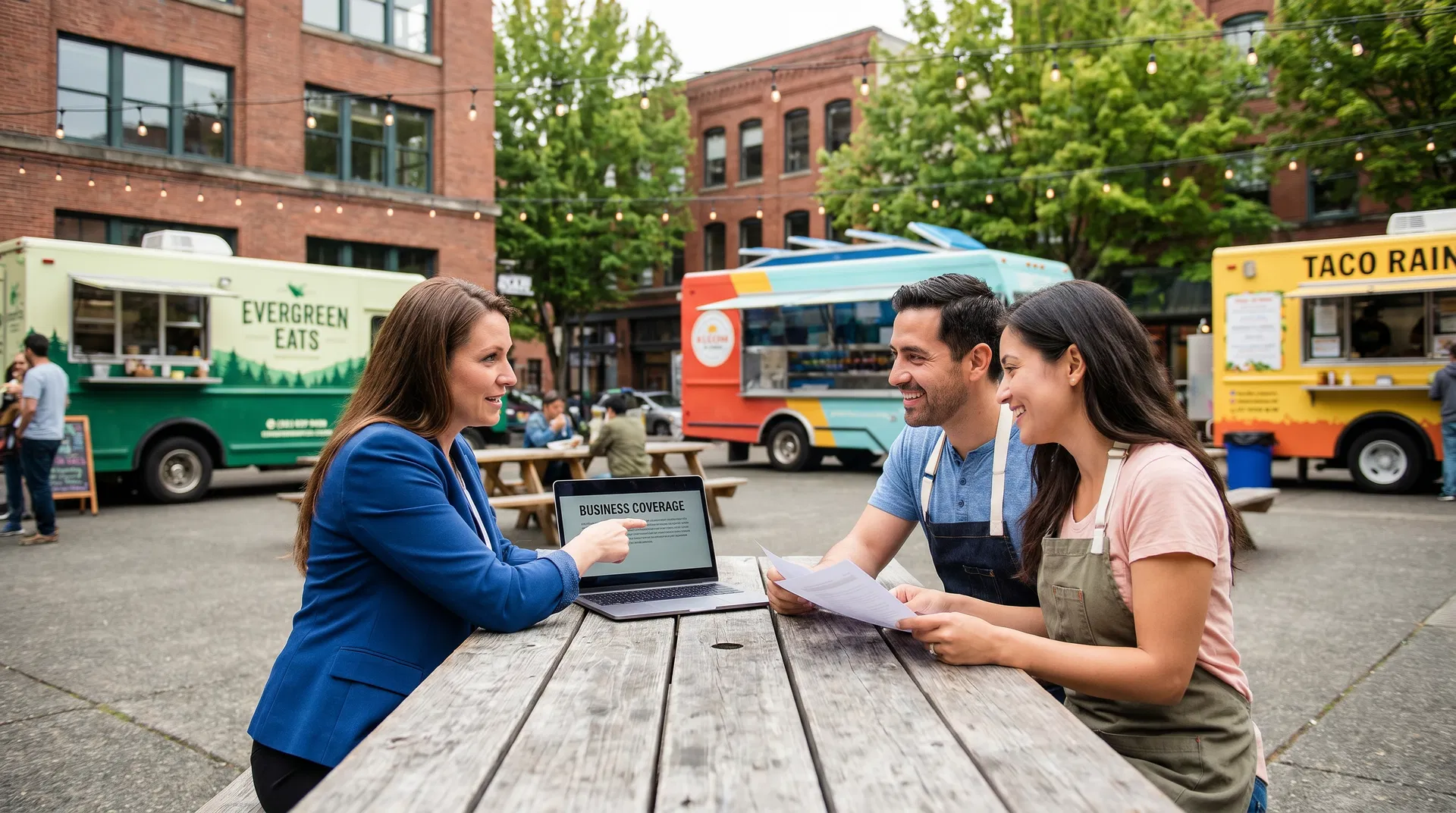
A complete mobile business insurance review takes about 30 minutes and can identify gaps that could cost tens of thousands of dollars at claim time.
What Does Food Truck Insurance Actually Cost?
One of the most common reasons mobile business owners underinsure is the assumption that proper coverage is prohibitively expensive. In reality, a complete food truck insurance package is one of the most affordable commercial insurance programs available — and the cost of being uninsured or underinsured is orders of magnitude higher.
| Coverage Type | Typical Monthly Cost | Typical Annual Cost | What It Protects |
|---|---|---|---|
| Commercial Auto | $150–$220/mo | $1,800–$2,640/yr | Vehicle, driving liability |
| General Liability (incl. product liability) | $30–$60/mo | $360–$720/yr | Customer injuries, event liability |
| Equipment Breakdown | $15–$30/mo | $180–$360/yr | Fryers, refrigeration, generators |
| Inland Marine / Property Floater | $20–$50/mo | $240–$600/yr | Equipment in transit and at events |
| Workers' Comp (1–2 employees) | $80–$150/mo | $960–$1,800/yr | Employee injuries on the job |
| Commercial Umbrella ($1M) | $25–$50/mo | $300–$600/yr | Excess liability for large events |
| Complete Package (without workers' comp) | $215–$360/mo | $2,580–$4,320/yr | Full protection for solo operator |
Cost benchmarks for a single food truck with $100K–$200K in annual revenue. Actual rates vary by state, vehicle value, equipment value, revenue, and claims history. Insure Pacific shops 50+ carriers to find the best combination.
To put these numbers in context: a single product liability lawsuit from a food-borne illness claim can easily reach $50,000–$250,000 in legal defense costs and settlement, before any judgment. A refrigeration unit failure that spoils a full day's inventory can cost $2,000–$5,000. A vehicle accident on the way to an event — with a truck worth $50,000–$150,000 — can be financially catastrophic without commercial auto coverage. The complete insurance package costs less per month than most food truck operators spend on a single weekend of supplies.
Get a Complete Mobile Business Insurance Quote
Insure Pacific works with 50+ carriers to build a complete coverage stack for food trucks, pop-up vendors, and mobile businesses across Oregon, Idaho, Nevada, Arizona, Colorado, Texas, and beyond. Let's find the right combination for your operation.
Beyond Food Trucks: Pop-Up Boutiques, Craft Vendors, and Mobile Retailers
The insurance challenges facing food truck operators apply equally — and in some ways more acutely — to non-food mobile businesses. A mobile boutique selling handmade jewelry at weekend markets, a craft vendor with $20,000 in inventory at a holiday market, a mobile massage therapist operating at wellness festivals, a mobile pet groomer driving a custom van — all of these businesses face the same fundamental gap between standard BOP coverage and the reality of a mobile, event-based operation.
For non-food mobile businesses, product liability takes a different form. A jewelry vendor whose product causes an allergic reaction, a craft vendor whose product injures a child, a mobile retailer whose display structure collapses and injures a customer — these are product and premises liability claims that a standard BOP may handle poorly or not at all when the business is operating at a third-party venue. The inland marine coverage layer is particularly critical for high-value inventory that travels to multiple markets each week.
Mobile service businesses — massage therapists, hair stylists, personal trainers, pet groomers — face an additional coverage consideration: professional liability (also called errors and omissions insurance). If a client claims your service caused them harm, professional liability covers the legal defense and any settlement. This is separate from general liability and is not included in a standard BOP. For mobile service providers, a complete coverage stack includes commercial auto, general liability, professional liability, and inland marine for any equipment or tools.
Mobile Business Insurance Checklist
Commercial auto policy in place for the business vehicle
Personal auto does not cover commercial use
General liability with product liability confirmed in writing
Don't assume — verify the endorsement
COI can name event organizers as additional insured
Required by most markets and festivals
Equipment breakdown coverage for kitchen/service equipment
Standard property doesn't cover mechanical failure
Inland marine / floater for equipment and inventory in transit
Covers property away from a fixed address
Workers' comp in place if you have any employees
Legally required in most western states
Professional liability if you provide services (not just products)
Separate from GL; covers service-related claims
Commercial umbrella if events require $2M+ limits
Inexpensive way to access higher limits
Frequently Asked Questions
Can I use my personal auto insurance for my food truck?
No. Personal auto insurance explicitly excludes vehicles used for commercial purposes. If you're driving your food truck to events and selling food, your personal auto policy will deny any claim related to commercial use. You need a commercial auto policy that covers the vehicle as a business asset. This is true in every western state — Oregon, Texas, Colorado, Nevada, Idaho, Washington, and beyond.
Does a standard Business Owner's Policy (BOP) cover my food truck?
A standard BOP covers business property at a fixed address and general liability at that location. It typically does not cover vehicles, vehicle-mounted equipment, or liability at third-party event venues. For a food truck or mobile business, a BOP alone is insufficient. You need commercial auto, a GL policy that extends to off-premises locations, equipment breakdown, and inland marine coverage — often bundled into a commercial package policy designed for mobile businesses.
What is a Certificate of Insurance (COI) and why do I need one?
A Certificate of Insurance is a one-page document that summarizes your insurance coverage — carrier, policy number, coverage types, limits, and effective dates. Most farmers markets, food festivals, and event venues require a COI before you can set up. They often also require that their organization be named as an additional insured on your policy, which means your insurance responds to claims arising at their event. Your insurance agent can produce a COI within 24 hours once your policy is in place.
I operate in multiple states. Do I need separate policies for each state?
Not necessarily. Commercial auto policies typically provide nationwide coverage. General liability policies can often be written to cover operations in multiple states. However, workers' compensation is state-specific and must be purchased separately for each state where you have employees. Insure Pacific is licensed in 10 western states and can structure a single commercial package that covers your mobile business operations across state lines — one agent, one relationship, coordinated coverage.
What happens if a customer gets sick from my food?
A food-borne illness claim falls under product liability coverage. If your general liability policy includes product liability (which it should, but must be confirmed), it will cover the legal defense costs and any settlement or judgment arising from the claim. Without product liability coverage, you're personally responsible for these costs. Food-borne illness claims can be expensive — a single outbreak affecting multiple customers can result in claims totaling hundreds of thousands of dollars.
My refrigerator broke down at a market and I lost all my inventory. Am I covered?
Only if you have equipment breakdown coverage and spoilage coverage. A standard property policy covers fire, theft, and vandalism — not mechanical breakdown. Equipment breakdown coverage specifically covers the cost of repairing or replacing equipment that fails due to mechanical or electrical causes, and can include coverage for the spoiled inventory (food spoilage coverage). Without this coverage, a refrigeration failure is an out-of-pocket loss.
Ready to Build the Right Coverage for Your Mobile Business?
Insure Pacific has been serving western entrepreneurs since 1935. We're licensed in Oregon, Idaho, Nevada, Arizona, Washington, California, Utah, Colorado, Wyoming, and Texas. One call covers your food truck, pop-up business, or mobile operation — wherever you operate across the West.
Our Licensed Coverage Area
States highlighted in blue are states where Insure Pacific holds an active insurance license.
Hover to highlight — click a state to visit its insurance page
Our Oregon Office Locations
Hover over a marker to see the office — click to visit their website.
Hover to highlight — click to visit that office's website
Ready to Get Protected?
Talk to a Local Oregon Insurance Expert
Insure Pacific has been serving Oregon families and businesses since 1935. We work with 50+ carriers so you get real options — not just one company's answer.
Related Articles
 Commercial Insurance
Multi-State Workers’ Compensation: Remote Employees, Traveling Crews, and Out-of-State Jobs
Read Article → Commercial Insurance
Import and Export Cargo Insurance: Ocean Freight, Ports, Customs, and Inland Transportation
Read Article → Commercial Insurance
Has Your Business Outgrown Its Insurance? Revenue, Payroll, New Locations, and New Services
Read Article → Commercial Insurance
Buying a Commercial Building: Insurance Questions to Answer Before Closing
Read Article →Get in Touch
Ready to protect what matters most? Contact us today for a no-obligation insurance review. Our experienced agents are here to help you find the right coverage for your needs.


