



The Independent Agent Advantage: How Shopping 50+ Carriers Saves Western Businesses More Than Money

The Independent Agent Advantage: How Shopping 50+ Carriers Saves Western Businesses More Than Money

When you call a captive insurance agent — State Farm, Allstate, Farmers, GEICO — you're talking to someone who can only sell you one company's products. When you go online to get a quote from a direct writer, you're feeding your information into an algorithm that optimizes for one carrier's profitability, not yours. But when you work with an independent insurance agent, you're accessing something fundamentally different: a professional who represents you, not the insurance company, and who can shop your risk across dozens of carriers to find the coverage that actually fits your life or your business.
For businesses and property owners across the American West — from Portland tech startups to Idaho outfitters to Nevada logistics companies to Colorado ranches — the independent agent model isn't just a preference. It's often the only path to coverage that actually works. This guide explains why, with specific examples from the industries and states that Insure Pacific serves.
The Captive Agent's Hidden Limitation
A captive agent's job is to sell you their company's products — not to find you the best coverage on the market. If their carrier doesn't write your risk class, doesn't offer the coverage you need, or prices your policy uncompetitively, a captive agent has no alternative to offer you. They will either decline to write your policy or write it with gaps. An independent agent, by contrast, can move to the next carrier on their list — and the next, and the next — until they find the right fit.
Let Us Shop 50+ Carriers for Your Business or Property
Insure Pacific is an independent agency licensed in 10 western states. One call, one agent, and access to the full market — not just one company's products.
What "Independent" Actually Means — and Why It Matters
The insurance distribution system in the United States has three main channels. Captive agents work exclusively for one carrier and can only sell that carrier's products. Direct writers — including most online platforms — sell directly to consumers without an agent, using algorithms and call centers. Independent agents and brokers represent multiple carriers and are legally obligated to act in their clients' best interests, not any single carrier's.
According to the Independent Insurance Agents and Brokers of America's 2025 Market Share Report, independent agents placed 87.2% of all commercial lines insurance written in the United States in 2024. That figure isn't an accident. It reflects the reality that complex commercial risks — the kind that businesses in tech, outdoor recreation, logistics, agriculture, and construction face every day — require market access and expertise that captive agents simply cannot provide. The independent channel also wrote 39% of personal lines premiums in 2024, up from 35.7% in 2020, as consumers increasingly recognize the value of professional representation over algorithm-driven direct purchasing.

Left: A captive agent can only offer one carrier's products — and often has to say "we can't write that." Right: An independent agent shops the full market to find the right fit.
| Factor | Captive Agent | Online Direct / Algorithm | Independent Agent |
|---|---|---|---|
| Carrier access | 1 carrier only | 1 carrier only | 50+ carriers |
| Works for | The insurance company | The insurance company | You, the client |
| Commercial lines | Limited or none | Very limited | Full market access |
| Specialty risks | Usually cannot place | Cannot place | Can access specialty markets |
| Claims advocacy | Company's interests | No advocate | Your advocate |
| Renewal shopping | Same carrier only | Same carrier only | Re-shops every year |
| Multi-state coverage | Limited to carrier's states | Limited | Coordinates across all states |
| Risk management advice | Product-focused | None | Carrier-neutral consulting |
| Relationship continuity | Agent may change | No relationship | Long-term advisor |
The Western Industries That Captive Agents Simply Cannot Serve
The American West has the most economically diverse business landscape in the country — and some of the most specialized insurance needs. From Portland's tech corridor to Idaho's outdoor recreation economy to Nevada's logistics hubs to Colorado's agricultural heartland, the businesses that drive the western economy often require coverage that no single captive carrier can provide. Here's how the independent agent model serves four of the most important western industries.
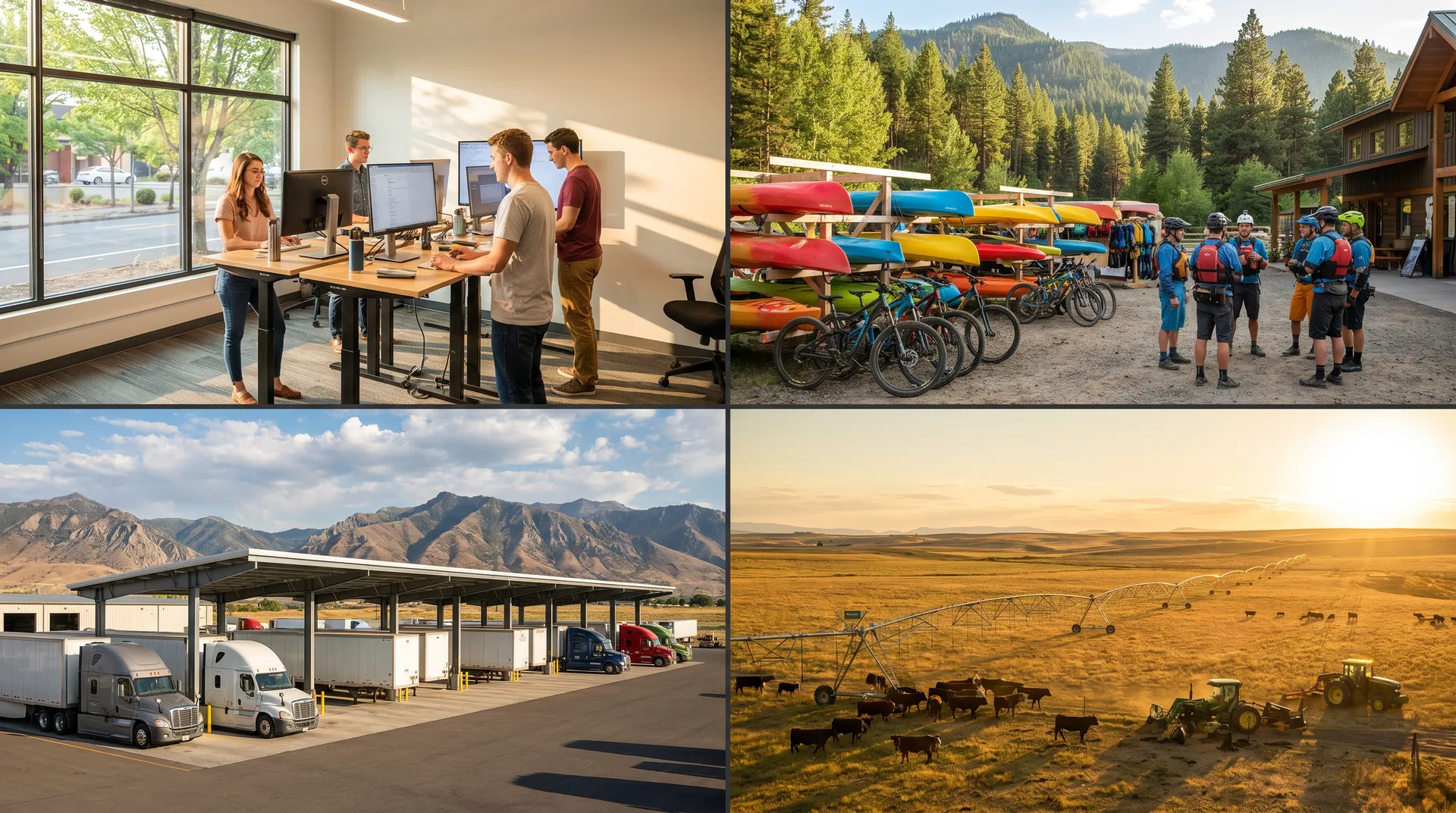
Tech startups, outdoor recreation guides, logistics companies, and farm operations — four western industries that require specialty insurance no captive agent can provide.
Technology Companies
Oregon, Colorado, Nevada, Utah
Portland, Denver, Salt Lake City, and Reno have become significant tech hubs. A software company or SaaS startup needs a coverage stack that no captive agent can assemble: cyber liability, errors and omissions (E&O), directors and officers (D&O) for VC-backed startups, and intellectual property coverage. State Farm and Allstate don't write E&O or D&O. An independent agent can access Chubb, Travelers, Beazley, Coalition, and other specialty tech carriers to build a complete program.
Learn more about Commercial InsuranceOutdoor Recreation & Guides
Oregon, Idaho, Colorado, Utah, Washington
Oregon law requires licensed outfitters and guides to carry liability insurance — and that coverage must be placed with a carrier that understands participant liability, equipment floaters, commercial auto for shuttles, and liquor liability for event operations. No major captive carrier writes guide and outfitter liability. Independent agents access specialty programs through K&K Insurance, AdvenSure, and XINSURANCE that are purpose-built for the outdoor recreation industry.
Learn more about Outdoor Recreation InsuranceLogistics & Trucking
All 10 western states
The western states are the nation's primary freight corridors — I-5, I-84, I-15, I-80, and I-10 all run through Insure Pacific's territory. Trucking and logistics companies need motor carrier liability, cargo insurance, physical damage, bobtail coverage, and commercial umbrella. Freight brokers require BMC-84 surety bonds. Captive agents don't write commercial trucking. Independent agents access Great West, Progressive Commercial, Travelers, and Canal Insurance to build complete transportation programs.
Learn more about Business InsuranceFarm, Ranch & Agribusiness
Oregon, Idaho, Nevada, Utah, Texas, Colorado
Western agriculture faces risks that no standard homeowners or BOP policy covers: livestock mortality, USDA Pasture, Rangeland, and Forage (PRF) programs, equipment breakdown on irrigation systems, agribusiness liability, and farm umbrella. Captive carriers typically cannot write livestock mortality or specialty agricultural programs. Independent agents access Nationwide Agribusiness, Farmers Mutual, Diversified Insurance Industries, and Foremost to build complete farm and ranch programs.
Learn more about Farm & Ranch InsuranceThe Five Ways Shopping 50+ Carriers Saves You More Than Money
The most obvious benefit of working with an independent agent is price — when you can compare quotes from 50+ carriers, you're far more likely to find competitive pricing than when you're limited to one company's rates. But the savings go well beyond the premium line on your invoice. Here are the five dimensions where multi-carrier access creates value that a captive agent or online platform simply cannot match.
1. Premium Savings Through Market Competition
Insurance carriers price risk differently. One carrier may rate your commercial property favorably because of your fire suppression system; another may penalize you for your location's wildfire risk score. One carrier may offer preferred rates for your industry class; another may treat it as a non-standard risk. By shopping 50+ carriers, an independent agent finds the carrier whose underwriting model most favorably views your specific risk profile — not just the cheapest option, but the best value for the coverage you actually need.
2. Coverage Quality and Completeness
Price is only meaningful if the policy actually pays when you need it. Independent agents compare not just premiums but policy forms, exclusions, sublimits, and endorsements. A captive agent selling you a BOP may not tell you that their standard form excludes the specific risk your business faces. An independent agent reviews multiple carriers' forms to find the one with the broadest coverage for your risk class — and can add endorsements from specialty markets when the standard market falls short.
3. Claims Advocacy When It Matters Most
A captive agent works for the insurance company. When you file a claim, their loyalty is to their employer — and their employer's interest is to pay as little as possible. An independent agent works for you. When a claim is disputed, underpaid, or delayed, your independent agent can advocate on your behalf, escalate within the carrier, and if necessary, help you find a public adjuster or attorney. This advocacy function is invisible until you need it — and invaluable when you do.
4. Annual Renewal Shopping Without Changing Agents
Insurance markets change. A carrier that offered competitive rates last year may have taken losses in your region and repriced aggressively at renewal. With a captive agent, your only option is to accept the new rate or find a new agent. With an independent agent, your agent re-shops your risk at every renewal across their entire carrier panel — and if your current carrier is no longer competitive, they move your business to a better option without you having to start over with a new agent relationship.
5. Access to Specialty and Surplus Lines Markets
Some risks simply cannot be placed in the standard market — cannabis businesses in Oregon, Nevada, Colorado, and Washington; hard-to-place properties in high wildfire zones; businesses with unusual liability exposures; contractors with prior losses. Captive agents have no access to surplus lines carriers. Independent agents who are licensed as surplus lines brokers can access the non-admitted market through Lloyd's of London, Markel, Burns & Wilcox, and other specialty carriers — the market of last resort that is often the only market available for the West's most unique risks.

When a claim arises, your independent agent is in your corner — reviewing policy language, escalating disputes, and advocating for the settlement you deserve.
The Online Platform Problem: Why Algorithms Can't Replace Expertise
The rise of online insurance platforms — GEICO, Progressive's direct channel, Lemonade, Next Insurance — has made it easier than ever to buy a basic policy without talking to a human. For simple personal auto insurance, this can work reasonably well. But for anything more complex — a business with multiple exposures, a property in a high-risk zone, a professional with liability exposure, a farm or ranch with specialized equipment — the algorithm-driven approach creates dangerous gaps.
Online platforms optimize for their own profitability, not yours. They present the options that maximize their revenue, not the options that best fit your risk profile. They cannot issue certificates of insurance for third-party events, cannot coordinate coverage across multiple policies, cannot advise you on coverage gaps, and cannot advocate for you when a claim is disputed. Most critically, they cannot access the specialty markets that western businesses often need — the surplus lines carriers, the specialty programs, the admitted markets in specific states that require local expertise to navigate.
The independent agent model has survived and grown — from 35.7% of personal lines market share in 2020 to 39% in 2024 — precisely because consumers and businesses are discovering that the lowest-price option is not always the best-value option. When the claim comes, the policy that was $200 cheaper per year may cost you $50,000 more in uncovered losses.
The Insure Pacific Difference: 90 Years, 10 States, 50+ Carriers
Insure Pacific has been serving Oregon communities since 1935 — nearly a century of building carrier relationships, understanding western risk profiles, and advocating for clients across the full spectrum of personal and commercial insurance. Today, we're licensed in 10 western states: Oregon, Idaho, Nevada, Arizona, Washington, California, Utah, Colorado, Texas, and Montana. That geographic footprint means we can serve businesses and property owners across the entire American West with a single agent relationship.
Our 50+ carrier relationships span the full market — from national carriers like Travelers, Progressive, Safeco, and The Hartford to regional specialists like Acuity and Foremost to specialty programs for outdoor recreation, agribusiness, technology, and transportation. When you work with Insure Pacific, you're not getting one company's products. You're getting access to the entire market, filtered through 90 years of western insurance expertise.
What Insure Pacific Shops Across 50+ Carriers
See What 50+ Carriers Can Do for Your Business
Whether you're a tech startup in Portland, an outfitter in Idaho, a logistics company in Nevada, or a ranch in eastern Oregon — Insure Pacific has the carrier access and western expertise to build the right program for your risk.
Real-World Scenarios: When the Independent Agent Model Pays Off
Abstract comparisons between agent types are useful, but the real value of the independent model becomes clear in specific situations. Here are four scenarios that illustrate why market access and professional advocacy matter — and why they're only available through an independent agent.
The Tech Startup That Needed E&O and Cyber
A Portland-based SaaS company with $3M in venture funding approached a captive agent for business insurance. The agent could write a basic BOP — but had no access to errors and omissions coverage for software failures or cyber liability for a data breach. The company's investors required both as a condition of funding. An independent agent placed the E&O with Travelers, the cyber with Coalition, and bundled the BOP with a carrier that offered preferred rates for tech companies — all under one coordinated program.
Coverage the captive agent couldn't provide, at a competitive price, with one agent managing the entire program.
The Idaho Outfitter Facing a Liability Claim
A whitewater rafting guide operation in central Idaho had purchased a general liability policy through an online platform. When a client was injured on a guided trip, the carrier denied the claim — citing an exclusion for guided adventure activities that the online platform had never disclosed. The outfitter was personally exposed for $180,000 in medical costs and legal fees. An independent agent would have identified the exclusion before binding coverage and placed the policy with a specialty outdoor recreation carrier whose form specifically covered guided activities.
The right carrier and the right form matter more than the lowest premium. Only an independent agent has access to the specialty programs that outdoor recreation businesses need.
The Nevada Logistics Company at Renewal
A freight brokerage in Henderson, Nevada had been with the same captive carrier for six years. At renewal, the carrier increased their commercial auto premium by 34% — citing regional loss trends in Nevada. The business owner had no leverage: their captive agent could only offer the new rate or cancel the policy. An independent agent re-shopped the risk across eight commercial auto carriers, found a carrier that had not taken the same losses in Nevada, and placed the renewal at a 12% decrease from the prior year's premium.
Annual renewal shopping across 50+ carriers creates ongoing savings that compound over time — savings a captive agent can never offer.
The Oregon Ranch in a High-Wildfire Zone
A cattle ranch in eastern Oregon — in a county with a high wildfire risk score — was non-renewed by their standard homeowners carrier after the carrier exited the Oregon rural market. The ranch owner contacted a captive agent, who had no alternative to offer. An independent agent accessed the surplus lines market, placed the dwelling coverage with a non-admitted carrier that specialized in high-risk rural properties, and added a farm umbrella and livestock mortality rider through admitted specialty carriers — a complete program that the standard market could not provide.
When the standard market says no, only an independent agent with surplus lines access can find a solution.
How to Choose the Right Independent Agent for Your Western Business
Not all independent agents are equal. The value of the independent model depends on the depth of the agent's carrier relationships, the breadth of their geographic licensing, and the depth of their expertise in your industry. When evaluating an independent agent for your business or property, here are the questions that matter most.
| Question to Ask | Why It Matters | Insure Pacific's Answer |
|---|---|---|
| How many carriers do you represent? | More carriers = more market access and competitive pricing | 50+ carriers across personal and commercial lines |
| Which states are you licensed in? | Multi-state licensing enables coordinated coverage across your entire portfolio | 10 western states: OR, ID, NV, AZ, WA, CA, UT, CO, TX, MT |
| Do you have surplus lines access? | Required for hard-to-place risks, high-risk zones, and specialty industries | Yes — surplus lines licensed for non-admitted market access |
| How long have you been in business? | Longevity reflects carrier relationships, market knowledge, and client trust | Since 1935 — 90 years serving Oregon and the American West |
| Do you specialize in my industry? | Industry expertise means understanding your specific risks and coverage needs | Specialists in farm/ranch, outdoor recreation, commercial, and personal lines |
| How do you handle claims? | Claims advocacy is where the independent model's value is most visible | Active claims advocacy — we work for you, not the carrier |
Frequently Asked Questions
Does working with an independent agent cost more than buying direct?
No — and in most cases it costs less. Independent agents are compensated through carrier commissions, not fees you pay directly. Because they can shop multiple carriers, they typically find more competitive pricing than you'd get by going to a single carrier directly. For commercial lines, the savings from market competition often far exceed any cost difference.
Can an independent agent write personal auto and homeowners, or just commercial?
Independent agents write both personal and commercial lines. For personal auto and homeowners, the independent model's value is most visible at renewal — when your agent re-shops your risk across carriers and moves your business if a better option exists. For commercial lines, the independent model is essential: 87.2% of all commercial insurance in the U.S. is placed through independent agents.
What's the difference between an independent agent and a broker?
In practice, the terms are often used interchangeably. Technically, an agent represents the insurance carrier (and can bind coverage on their behalf), while a broker represents the client (and must go to the carrier to bind). Most independent agents are licensed as both agents and brokers, giving them the flexibility to operate in both capacities depending on the carrier relationship and the client's needs.
I already have insurance through a captive agent. Should I switch?
It's worth getting a comparison. At a minimum, an independent agent can review your current coverage for gaps and compare your current premiums against the market. If your captive carrier is competitive and your coverage is complete, you may not need to switch. But if there are gaps in your coverage — especially for commercial risks, specialty exposures, or multi-state properties — an independent agent may be able to significantly improve both your coverage and your price.
Can Insure Pacific write insurance for businesses in states where I'm not located?
Yes. Insure Pacific is licensed in Oregon, Idaho, Nevada, Arizona, Washington, California, Utah, Colorado, Texas, and Montana. If your business operates in multiple western states, we can coordinate coverage across your entire footprint — one agent, one relationship, and a program that covers all your locations.
What types of businesses does Insure Pacific specialize in?
We serve a wide range of western businesses, including technology companies, outdoor recreation and guide operations, logistics and trucking companies, farms and ranches, food trucks and mobile businesses, non-profits, contractors, and retail businesses. We also serve personal lines clients with home, auto, life, and umbrella insurance. If you have a specialized risk, we have the carrier access to find a solution.
Ready to Experience the Independent Agent Advantage?
Insure Pacific has been serving Oregon and the American West since 1935. We're licensed in 10 states, work with 50+ carriers, and specialize in building insurance programs that actually fit your life and your business. Let us show you what the full market looks like.
Our Licensed Coverage Area
States highlighted in blue are states where Insure Pacific holds an active insurance license.
Hover to highlight — click a state to visit its insurance page
Our Oregon Office Locations
Hover over a marker to see the office — click to visit their website.
Hover to highlight — click to visit that office's website
Ready to Get Protected?
Talk to a Local Oregon Insurance Expert
Insure Pacific has been serving Oregon families and businesses since 1935. We work with 50+ carriers so you get real options — not just one company's answer.
Related Articles
 Commercial Insurance
Multi-State Workers’ Compensation: Remote Employees, Traveling Crews, and Out-of-State Jobs
Read Article → Commercial Insurance
Import and Export Cargo Insurance: Ocean Freight, Ports, Customs, and Inland Transportation
Read Article → Commercial Insurance
Has Your Business Outgrown Its Insurance? Revenue, Payroll, New Locations, and New Services
Read Article → Commercial Insurance
Buying a Commercial Building: Insurance Questions to Answer Before Closing
Read Article →Get in Touch
Ready to protect what matters most? Contact us today for a no-obligation insurance review. Our experienced agents are here to help you find the right coverage for your needs.


