



Non-Emergency Medical Transportation Insurance: Passenger Injuries, Wheelchair Lifts, Driver Screening, Contracts & Commercial Auto Limits
Non-Emergency Medical Transportation Insurance: Passenger Injuries, Wheelchair Lifts, Driver Screening, Contracts & Commercial Auto Limits

Non-emergency medical transportation (NEMT) can look straightforward from outside: a driver, a passenger, a wheelchair-accessible van, a scheduled appointment, and a completed trip. In practice, the operation can carry a layered set of responsibilities. An operator may coordinate rides through a state program, managed-care organization, brokerage, facility, private-pay arrangement, subcontractor network, or a combination of those models. The business may transport ambulatory passengers, riders who use mobility devices, companions, or clients with needs that require a particular vehicle configuration and trained assistance.
That is why a NEMT insurance conversation should start with the operation—not a generic vehicle quote. The facts matter: who dispatches the ride; whether the business contracts with a brokerage or facility; what assistance the driver provides; what vehicles, lifts, ramps, and securement systems are used; who employs the driver; how information is stored; where the business operates; and what contracts require. Start with an Insure Pacific commercial insurance review that maps the actual service before comparing coverages, carriers, limits, and exclusions.
This is general educational information, not medical, disability-accommodation, privacy, billing, licensing, employment, legal, safety-certification, contract, or coverage advice. Insurance availability, eligibility, limits, exclusions, deductibles, endorsements, regulatory requirements, program participation, reimbursement, and claim outcomes depend on the actual policy, business operations, state, contract, vehicle, carrier, underwriting, and facts of an event.
NEMT is not emergency ambulance service—and the distinction matters
CMS describes NEMT as an important benefit for people who need assistance getting to and from medical appointments. Its provider resources distinguish emergency from non-emergency transportation and discuss accepted transportation types, delivery systems, driver and vehicle acceptance criteria, and fraud-and-abuse prevention.1 That definition is a helpful starting point, but each operator needs to verify the requirements that actually govern its service.
A wheelchair-accessible van service, a brokered transportation subcontractor, a private-pay medical ride company, a senior transportation service, and a licensed ambulance provider may face different operational, program, licensing, contract, and insurance questions. Do not market a non-emergency ride as emergency medical service or assume a vehicle that carries a wheelchair has the same rules as every other accessible transportation vehicle. Ask qualified program, transportation, compliance, and legal advisers what applies to the routes and services you actually provide.
The insurance application should tell a coherent story. Explain whether drivers only transport passengers curb to curb, assist from a doorway, operate lifts or ramps, secure mobility devices, accompany passengers, perform dispatch, take payment information, or contract with facilities. Do not use a simple “passenger transportation” label if it omits the features that make the operation different. A good application gives the insurer a factual picture; it does not guarantee a particular premium, policy form, endorsement, or claim result.
Passenger injuries: the claim can begin before the vehicle moves
A passenger-injury allegation may involve a roadway collision, sudden braking, a transfer, a wheelchair securement issue, a lift or ramp event, a slip near a doorway, a fall in a parking lot, or a dispute over what assistance was promised. Some allegations may be unfounded; others may lead to a serious loss. The point of planning is not to predict an outcome—it is to make sure the business’s procedures, documentation, contracts, and insurance questions are discussed before an incident.
For a NEMT operator, commercial auto insurance is usually central, but it should not be the only conversation. Ask how a policy treats each scheduled vehicle, replacement vehicle, rented or borrowed vehicle, driver, passenger, territory, passenger capacity, business use, physical damage, towing, deductibles, and any state or contract filing. Discuss the maximum likely severity of an accident rather than selecting a liability limit solely because it meets a minimum requirement. A required limit, a customer-requested limit, and the limit that makes sense for the operation can be different questions.
Also discuss general liability insurance for premises, office, garage, parking, and non-auto allegations. The boundary between an auto policy and a general-liability policy can turn on policy wording and loss facts. A claim arising while a passenger is entering, exiting, or being assisted near a vehicle should not be assigned to a policy based on a guess. Report a potential claim promptly and let the carrier evaluate the facts and coverage.
A practical passenger-incident file
Written procedures should be clear enough for trained staff to follow and modest enough to be realistic. Keep contemporaneous records of the scheduled ride, authorization or dispatch details as applicable, pickup/drop-off information, driver and vehicle assignment, companions, any observed damage or incident, witness information, photographs where appropriate and permitted, and notifications made. Do not alter a record after the fact. If a record needs correction, use a documented correction process that preserves the original information and follows the business’s compliance requirements.
After a crash, fall, alleged injury, lift incident, or complaint, safety comes first. Call emergency services when appropriate, follow the directions of law enforcement or emergency personnel, protect people from further harm if it is safe to do so, and preserve the vehicle and evidence when practical. Gather basic facts without making admissions, promises, medical judgments, or coverage statements. Then use the insurer’s reporting process and Insure Pacific’s claims center to start the appropriate notification process. Policy conditions, program rules, and the facts of the incident control what happens next.
Wheelchair lifts, ramps, tiedowns, and restraints: connect safety records with insurance questions
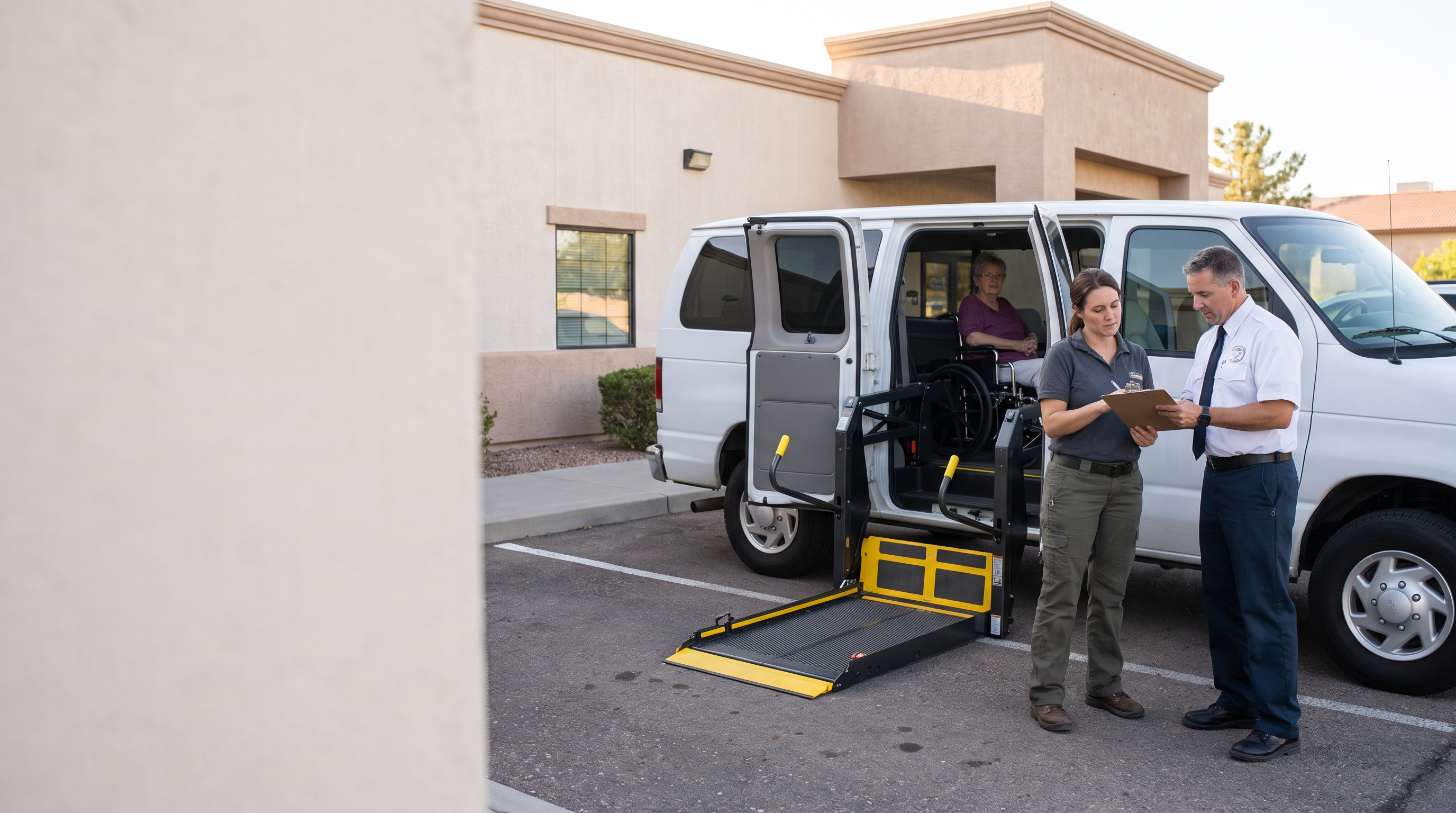
Accessible transportation can depend on equipment that has its own inspection, maintenance, operating, and training needs. Wheelchair lifts and ramps, door systems, tiedowns, docking devices, belts, wheelchairs, floor tracks, batteries, securement straps, steps, lighting, climate controls, and communication devices all deserve attention. A lift or securement system is not just a purchase order line item; it is part of the business’s daily operational risk.
A NHTSA-supported wheelchair occupant study notes the importance of proper use and positioning of crashworthy lap/shoulder restraints for people travelling while seated in wheelchairs. It specifically identifies education and training on installation, routing, and positioning of wheelchair tiedown and occupant-restraint equipment as a safety topic for transit and paratransit drivers and caregivers.2 That is not a substitute for manufacturer instructions, formal training, vehicle certification, medical direction, or applicable regulation. It is a reminder that the operation should have a deliberate, documented approach.
Ask the relevant experts how staff should be trained and re-trained, which equipment inspections are required, who may take a vehicle out of service, how a damaged tiedown or lift is reported, how maintenance is documented, and what records the business must retain. Inventory the accessories and modifications that are installed on each vehicle. An operator should never assume a maintenance routine, training course, inspection, or policy will prevent every event or ensure a claim payment.
From an insurance standpoint, explain the specialized equipment and its values. Discuss whether vehicle modifications, installed equipment, spare equipment, office equipment, and property at a garage or office need separate treatment. Equipment breakdown insurance can be worth discussing for certain sudden mechanical or electrical failures, but it is not a blanket promise for every lift, ramp, battery, maintenance issue, wear-and-tear condition, defect, recall, or lost trip. The form, cause of loss, excluded property, valuation, and endorsement language matter. Pair that discussion with commercial property insurance for a dispatch office, garage contents, computers, radios, spare parts, and other covered business property where appropriate.
Driver screening and training: a process, not a checkbox
The people behind the wheel are a core part of the NEMT risk profile. CMS’s provider booklet says that state criteria may require appropriate, current vehicle licenses and may include standards beyond the minimum such as driving-record limits, health certification, vehicle liability insurance, criminal-background checks, and quality monitoring.3 A particular state, brokerage, CCO, client contract, or insurer may add its own standards. Verify the requirements that apply to your service rather than copying another company’s checklist.
Build a driver file that fits the operation and applicable law. It may include applications, identity and work-authorization documentation, license class and expiration review, motor-vehicle record review, background-screening documentation where permitted and required, orientation, vehicle-specific training, lift and restraint training, passenger-assistance boundaries, communication training, drug/alcohol policy acknowledgments where applicable, complaint records, incident records, coaching, and renewal dates. Personnel files contain sensitive information, so access and retention must be handled with appropriate privacy, employment, and legal advice.
A driver’s status also affects the insurance discussion. Identify employees, owners, family members, temporary drivers, independent contractors, dispatchers who sometimes drive, and subcontracted transportation companies. The labels used in a contract or tax form do not by themselves settle insurance, employment, program, or liability questions. Discuss payroll, job duties, hiring practices, and return-to-work planning under the workers’ compensation or state industrial-insurance rules that apply in the state of operation. Insure Pacific’s workers’ compensation insurance information is a starting point for a broader discussion, but state programs and private coverage arrangements differ.
Commercial auto limits: think beyond the required minimum
NEMT owners often focus on the liability limit first. That makes sense: passengers, other motorists, pedestrians, cyclists, property owners, and contracting parties may be involved in a serious loss. But a useful commercial auto review is more complete. Prepare a current list of vehicles, VINs, seating or mobility-device configuration, garaging addresses, ownership/lienholder details, modifications, lift/ramp equipment, estimated values, annual mileage, operating radius, routes, parking arrangements, drivers, and loss history.
Then ask focused questions:
The right answer varies. A carrier may decline an operation, require a different form, offer limited terms, request more documentation, or price risk differently based on drivers, claims, territory, assistance provided, equipment, contracts, and growth. Avoid a one-size-fits-all limit statement. Ask a licensed agent to compare the proposed limits and deductibles with the real severity exposure and written contracts—not just an advertised rate.
For multi-vehicle operations, review Insure Pacific’s transportation insurance overview alongside the auto policy. A formal fleet, a mix of owned and subcontractor vehicles, and a single wheelchair van are different risks. The common thread is accurate information before binding coverage and when operations change.
Contracts, certificates, and subcontractors: insurance is only one part of risk transfer
NEMT operators may sign agreements with transportation brokerages, CCOs, state programs, health-care facilities, senior communities, case managers, vehicle lessors, lift vendors, dispatch-software vendors, staffing companies, and other carriers. An agreement may require insurance limits, additional-insured status, waiver-of-subrogation wording, primary/noncontributory wording, notice provisions, data safeguards, indemnity, driver screening, training, credentialing, vehicle standards, audit rights, documentation, incident reporting, or billing procedures.
Bring signed and proposed contracts to the renewal meeting early. A certificate of insurance is generally evidence of insurance at a point in time; it does not amend the underlying policy or create an endorsement. An insurance agent should help identify questions for the insurer, but a qualified attorney should review the meaning, enforceability, and risk-transfer effect of the agreement. Do not sign an insurance exhibit or represent that a policy meets a contract before confirming the actual policy and endorsements.
If the business uses subcontractors, its file should be just as disciplined as its own driver file. Document what the subcontractor does, whose vehicle is used, who dispatches, who collects payment, who carries the contract, whose name is shown to the passenger, who controls route and schedule, and how incident reporting works. Obtain and periodically review requested certificates and endorsements, but remember that an expiration date or certificate alone is not a permanent guarantee of coverage. Consider whether commercial umbrella insurance or excess liability is appropriate to discuss when primary limits, passenger exposure, and contractual requirements are considered together.
Privacy, dispatch systems, and payment information can create a cyber conversation
A modern NEMT business can hold appointment dates, pickup locations, names, phone numbers, mobility needs, dispatch notes, care-facility contacts, authorization details, driver records, payment data, GPS or telematics information, vehicle-maintenance records, and incident reports. Some information may be legally sensitive or subject to contractual privacy/security requirements. The exact obligations depend on the organization’s role, contracts, applicable law, and the information handled; do not assume that a transportation company is automatically subject to the same rules as a health-care provider.
That uncertainty is a reason for a targeted cyber insurance review, not a reason to assume coverage. Ask how the business controls access to dispatch software, email, shared documents, mobile devices, payment instructions, driver tablets, remote support, backups, and vendor accounts. Review multi-factor authentication, unique accounts, access removal, phishing training, vendor due diligence, incident response, customer/broker notification procedures, and available coverage for privacy events, ransomware, business interruption, social engineering, and legal/forensic costs. Terms and triggers can vary significantly.
If an operator makes representations about scheduling, transportation coordination, recordkeeping, or administrative services, it may also need to ask about professional liability or E&O insurance. That discussion is not an admission that a service is professional medical care, nor is it a promise that a policy covers every scheduling error, delay, miscommunication, allegation, or contract dispute. It helps identify what the policy does and does not address.
Program rules, records, and billing controls deserve the same attention as the vehicle
For operators participating in Medicaid-related NEMT, program documentation is not optional administrative clutter. CMS explains that drivers and vehicles may be subject to state acceptance criteria and that providers should bill only for services actually furnished. Its booklet describes concerns such as billing for no-shows, trips that did not happen, altered authorizations, unqualified drivers, and unqualified vehicles.3 The HHS Office of Inspector General also has an active work-plan project that uses concerning billing indicators to review potential fraud, waste, and abuse in Medicaid NEMT.4
That does not mean every record issue is fraud. It does mean that an operator needs a dependable process designed with its brokerage, CCO, state-program, and legal requirements in mind. Keep records of authorizations, assigned driver/vehicle, trips accepted and completed, cancellations/no-shows, mileage or fare support as applicable, passenger assistance policies, dispatch changes, incident reports, vehicle ownership/registration/VIN documentation, maintenance, lift/securement checks, driver qualification and training, complaints, subcontractor documents, invoices, and reconciliation. Know who can edit a record, who approves exceptions, and how corrections are documented.
Oregon’s Medical Transportation Services rules give a concrete example of why program details cannot be treated as generic. The Oregon rules describe the Authority/CCO/brokerage structure for eligible clients and require coordination with the applicable brokerage or CCO in circumstances covered by the rules. The division also addresses client rights, language access, documentation, subcontractor monitoring, denials, and records.5 Oregon Health Authority’s program page directs readers to current rules and NEMT materials.6 This article is not a substitute for either source. Confirm current requirements directly with the responsible program, brokerage, CCO, transportation authority, and qualified counsel.
Independent Insurance Agency Since 1935
Not Sure If You Have the Right Coverage?
Our licensed agents compare 50+ carriers to find you the best coverage at the right price — at no extra cost to you.
Build a renewal or startup file an underwriter can understand
A complete NEMT submission should answer the practical questions before the carrier asks them. It also helps the owner spot operational changes that need to be reported. Use this checklist before a new venture, renewal, new contract, new vehicle, new service area, lift conversion, hiring push, or material change in passenger assistance:
| Review area | Records and questions to prepare |
|---|---|
| Business model | Private-pay, brokered, program, facility, subcontractor, or mixed revenue; territories and service areas; assistance actually provided |
| Vehicles | VINs, ownership/leases, lienholders, garaging, seating/mobility configurations, lift/ramp modifications, values, mileage, maintenance and inspection history |
| Drivers | Roles, license review, MVR/background processes where applicable, training, complaint and incident process, employees versus contractors |
| Passengers | Passenger types, companions/attendants, assistance boundaries, capacity, mobility devices, transfer/securement procedures, incident reporting |
| Contracts | Broker/CCO/facility/vendor agreements, insurance exhibits, required limits, endorsements, certificates, indemnity, reporting and privacy clauses |
| Records | Authorizations, dispatch and trip records, cancellations/no-shows, billing controls, route/mileage support, record corrections, retention rules |
| Technology | Dispatch platform, telematics, payment systems, company phones/tablets, access controls, backup, vendor agreements, cyber-response plan |
| Insurance | Current policies, declarations, loss runs, vehicle schedules, driver list, property schedule, deductible tolerance, changing values, renewal timeline |
| Continuity | Backup drivers/vehicles, alternate dispatch process, lift outage protocol, weather plan, outage communication, customer/broker notification plan |
If you are starting a company, do not wait until the vehicle is in service to tell the insurer about the operation. If you are established, do not wait for renewal if you add a lift, vehicle, driver, contract, service area, passenger type, dispatch platform, subcontractor, or assistance practice. Early disclosure gives the agent and carrier a chance to assess the change; it does not guarantee acceptance or a particular coverage result.
Continuity planning: a breakdown can become a passenger-service problem
One inaccessible or disabled vehicle can affect much more than a repair invoice. It can force a dispatch change, a subcontracted replacement ride, calls to passengers or facilities, rescheduling, potential missed appointments, overtime, alternate equipment, a tow, and questions under a brokerage or facility agreement. A serious collision, lift outage, weather event, fuel interruption, software outage, or cyber incident can affect several routes at once. The business should know who has authority to stop service, who contacts passengers and contracted partners, who can approve a replacement vehicle or subcontractor, and how the operator documents that decision.
Write down a workable continuity plan before it is urgently needed. Include a current after-hours contact list; backup driver and vehicle options; accessibility and capacity requirements for alternatives; a safe method to communicate with passengers, attendants, facilities, and brokers; the location of current insurance, registration, lift, maintenance, and dispatch records; and a simple escalation path for a crash, breakdown, suspected data incident, or passenger complaint. Rehearse the plan through a tabletop exercise and update it after a significant route, vendor, software, vehicle, or contract change. A plan cannot eliminate disruption or create coverage, but it can help the business make clearer decisions when time matters.
Ask the agent to explain whether the policies being considered address any business-income, extra-expense, rental-reimbursement, physical-damage, towing, cyber-interruption, or contingent-cost questions relevant to the particular operation. Those coverages, if available, have their own waiting periods, limits, triggers, deductibles, exclusions, and conditions. A substitute ride, contractual credit, lost revenue, reputation issue, or government-program consequence is not automatically covered merely because a vehicle stopped operating.
Ask for a NEMT insurance review built around your actual operation
A NEMT business serves people on days when a missed or disrupted ride can matter. The insurance program should be discussed with the same care: accurately describe the service, organize the documents, identify the highest-severity passenger and auto exposure, disclose equipment and driver practices, read contract insurance clauses early, and plan for a disruption before it becomes a claim.
Insure Pacific can help NEMT operators and transportation businesses compare carrier options and prepare focused questions about commercial auto, liability, property, equipment, cyber, contracts, and continuity. Request a non-emergency medical transportation insurance review before accepting a new agreement, buying an accessible vehicle, expanding a route, or renewing a program. You can also contact our team to discuss the facts of your operation.
No coverage is bound, changed, or guaranteed until the appropriate carrier issues the policy or endorsement. For Medicaid, program, billing, accessibility, privacy, licensing, contract, and employment issues, confirm requirements with the responsible state/program entity and qualified compliance, legal, tax, and transportation advisers.
Frequently asked questions about NEMT insurance
Is non-emergency medical transportation the same as ambulance service?
No. CMS distinguishes NEMT from emergency transportation. An accessible passenger van, a brokered transportation service, a medical ride company, and an ambulance provider may operate under different rules, contracts, vehicle standards, and insurance arrangements. Describe your actual service to the insurer and verify program/licensing requirements directly with the appropriate authority.
How much commercial auto liability does a NEMT company need?
There is no universal answer. A state, broker, CCO, customer contract, lender, or vehicle type may impose different requirements, while the operation’s passenger exposure, vehicles, territory, assets, contracts, and loss history may justify separate analysis. Review limits and deductibles with a licensed agent and legal counsel where a contract requires them; the policy and underwriting decision control.
Does a commercial auto policy automatically cover a wheelchair lift and securement equipment?
Do not assume it does. The answer can depend on the vehicle schedule, conversion values, installed equipment, cause of loss, physical-damage terms, exclusions, deductible, endorsements, maintenance facts, and policy wording. Give the carrier a current inventory of accessibility modifications and ask for the written policy treatment.
Are driver background checks and MVRs insurance requirements?
They can be required by a program, contract, jurisdiction, or insurer, but the exact requirements vary. CMS notes that state driver criteria may include licensing, driving-record, health, liability-insurance, and background-check standards. Verify current rules and document the process that applies to your operation rather than assuming a generic checklist is sufficient.
Does NEMT insurance cover a missed appointment, scheduling mistake, or privacy incident?
Possibly, partially, or not at all depending on the allegation and policy. A missed ride can involve contractual, operational, program, customer-service, professional-liability, cyber, or other issues. A privacy event can involve the type of information, the system, legal obligations, vendor contracts, notification rules, and policy triggers. Review those scenarios before an incident rather than relying on a policy name.
What documents should I bring to an NEMT insurance renewal meeting?
Bring current policies and loss runs; vehicle/VIN/lift/modification details; driver roster and roles; operating territory; annual mileage; passenger-assistance description; broker/CCO/facility/vendor contracts; certificate and endorsement requirements; authorization, dispatch, trip, maintenance, training, and incident-control processes; cyber/dispatch-system information; and a list of planned changes. The actual policy and underwriting process determine what additional information is needed.
Sources and further reading
*This article provides general educational information only. It is not medical, safety, accessibility, privacy, billing, licensing, employment, legal, tax, program-compliance, contract, insurance, or claims advice. Insurance availability and claim outcomes depend on the actual policy, declarations, endorsements, exclusions, limits, deductibles, named insureds, underwriting, operation, vehicle, equipment, contracts, jurisdiction, program rules, and facts. Consult the responsible program entity and qualified licensed insurance, legal, compliance, transportation, and other advisers for your specific situation.*
Our Licensed Coverage Area
States highlighted in blue are states where Insure Pacific holds an active insurance license.
Hover to highlight — click a state to visit its insurance page
Our Oregon Office Locations
Hover over a marker to see the office — click to visit their website.
Hover to highlight — click to visit that office's website
Ready to Get Protected?
Talk to a Local Oregon Insurance Expert
Insure Pacific has been serving Oregon families and businesses since 1935. We work with 50+ carriers so you get real options — not just one company's answer.
Related Articles
 Commercial Insurance
General Liability Insurance: What It Covers—and What It Doesn’t
Read Article → Commercial Insurance
Multi-State Workers’ Compensation: Remote Employees, Traveling Crews, and Out-of-State Jobs
Read Article → Commercial Insurance
Import and Export Cargo Insurance: Ocean Freight, Ports, Customs, and Inland Transportation
Read Article → Commercial Insurance
Has Your Business Outgrown Its Insurance? Revenue, Payroll, New Locations, and New Services
Read Article →Get in Touch
Ready to protect what matters most? Contact us today for a no-obligation insurance review. Our experienced agents are here to help you find the right coverage for your needs.


