

Retail Lease Insurance Requirements: Tenant Improvements, Plate Glass, Signs, HVAC Systems, and Triple-Net Obligations
Retail Lease Insurance Requirements: Tenant Improvements, Plate Glass, Signs, HVAC Systems, and Triple-Net Obligations

A retail lease can transfer a cost without creating insurance coverage
A retailer can sign a lease requiring it to maintain the storefront, insure tenant improvements, replace plate glass, service the HVAC system, carry liability limits, name the landlord as an additional insured, and reimburse property-insurance charges through a triple-net structure. Those provisions may allocate real economic responsibility—but they do not guarantee that an insurance policy will pay every resulting cost.
That distinction is the starting point for retail lease insurance in 2026. The lease assigns duties between landlord and tenant. The policy determines what the insurer covers. A repair covenant, indemnity clause, certificate requirement, common-area invoice, or promise to carry insurance cannot override a policy exclusion, sublimit, valuation clause, deductible, waiting period, or endorsement.
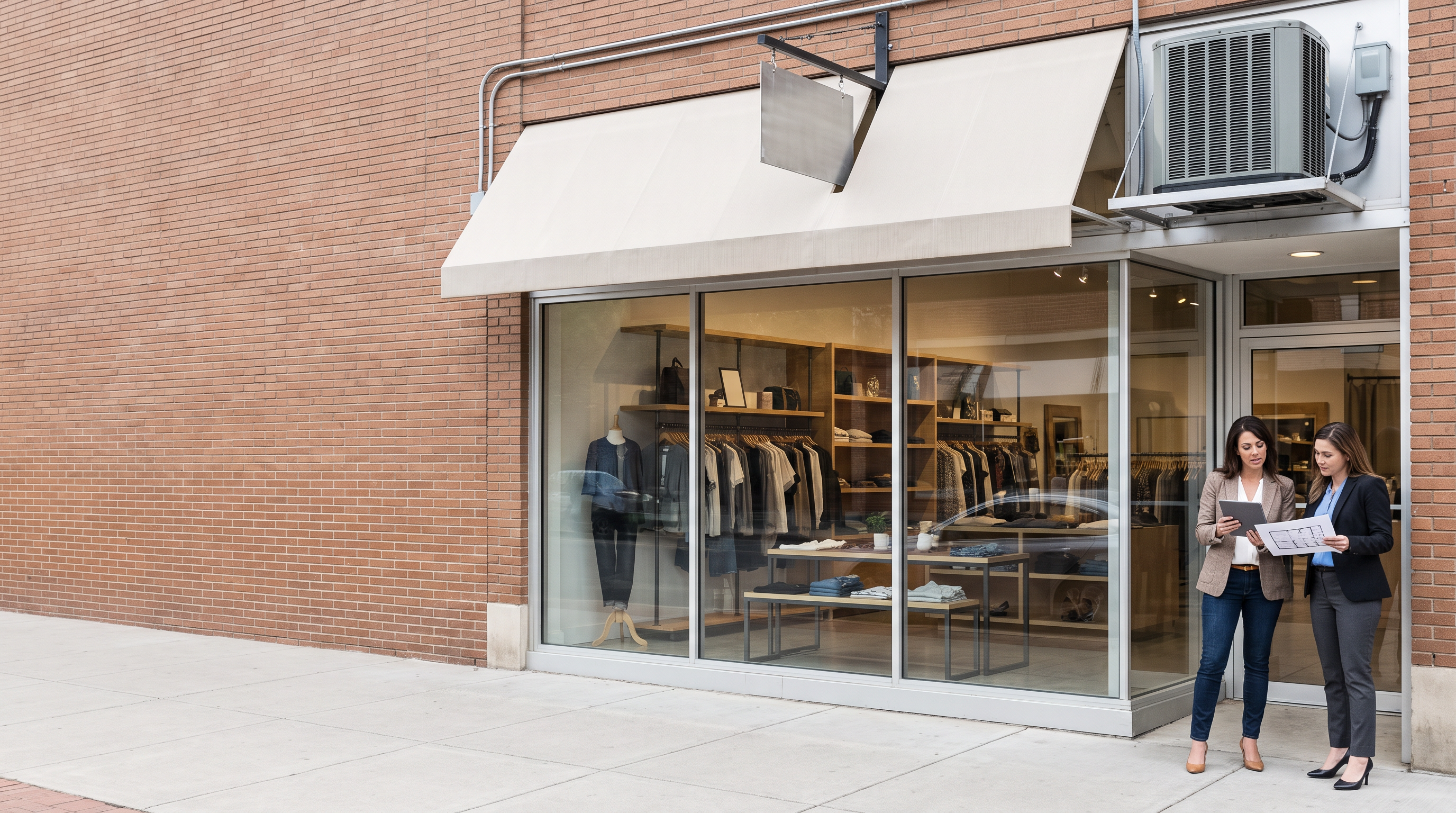
Retail tenants also have unusually visible and interconnected property. Storefront glass, doors, frames, awnings, signs, custom millwork, lighting, refrigeration, point-of-sale equipment, stock, and rooftop HVAC can be owned by different parties even though customers experience them as one store. A fire, vehicle impact, windstorm, equipment failure, water event, or vandalism loss can expose gaps between those ownership and insurance categories.
This guide is educational and is not legal, insurance-coverage, code, engineering, tax, or claims advice. The signed lease, applicable law, local requirements, and complete issued policies control. A retail tenant or landlord should have qualified counsel review the lease and a licensed insurance professional review the declarations, forms, endorsements, limits, and actual premises. For broader contract topics such as certificates, additional insureds, and waivers, see our Commercial Lease Insurance Requirements guide.
Begin with one asset-and-obligation matrix
Do not begin with a generic certificate checklist. Begin with a map of the location. Walk the premises with the lease, work letter, construction drawings, equipment schedule, and property policies. List every asset and operating obligation that could create a dispute after loss.
| Asset or obligation | Questions for the lease | Questions for the insurance program |
|---|---|---|
| Building shell, roof, structure, and foundation | Who maintains, repairs, and replaces each item? | Which policy schedules the building, at what value and deductible? |
| Storefront glass, doors, frames, and mullions | Is breakage a tenant duty regardless of cause? | Is glass part of building property, tenant property, or separately limited? |
| Tenant improvements and betterments | Who owns them during the term and after termination? | Are they included in business personal property, separately scheduled, or insured by the landlord? |
| Trade fixtures and removable displays | Must the tenant remove them and restore penetrations? | Are they business personal property at replacement cost or actual cash value? |
| Exterior and interior signs | Who approves, maintains, removes, and replaces them? | Is there an outdoor-sign sublimit or special deductible? |
| HVAC, electrical, refrigeration, and controls | Who performs maintenance, repair, and capital replacement? | Does property coverage apply, or is equipment-breakdown coverage needed? |
| Inventory and seasonal stock | Who owns it, and does consigned property belong to others? | Are peak values, spoilage, theft, transit, and valuation addressed? |
| Rent, CAM, taxes, and operating expenses | What continues after a casualty, and when does abatement apply? | Which continuing expenses are included in business-income or rental-value calculations? |
| Common areas and public approaches | Who controls sidewalks, parking, snow, lighting, and security? | Whose liability policy responds, and what contractual risk transfer applies? |
| Restoration and code work | Who controls contractors, permits, timing, and standards? | Are ordinance-or-law, builders risk, and extra-expense limits adequate? |
For each row, record the owner, user, maintenance party, repair party, replacement party, casualty-restoration party, insurance party, deductible responsibility, policy category, limit, and supporting document. Update the matrix after a build-out, assignment, sublease, renewal, change in operations, major equipment purchase, or property-policy change.
A coordinated Retail Store Insurance review should follow the matrix. The business name on the storefront is not always the only entity that needs protection; building owners, operating companies, property managers, lenders, franchisors, and related entities may have different interests.
What triple-net really means—and what it does not
Cornell Legal Information Institute describes a triple-net lease as one in which the tenant generally pays rent plus real-estate taxes, building insurance, and maintenance expenses. That is a useful starting definition, not a complete interpretation of a particular lease. “NNN” does not answer whether a tenant must replace a rooftop unit, pay for a roof membrane, absorb a catastrophe deductible, fund a code upgrade, or reimburse a capital project.
The lease should define every recoverable category and the calculation method. Important questions include:
A CAM invoice is not an insurance claim. A tenant can owe a contractually permitted operating expense even when no covered loss occurred. Likewise, the landlord’s receipt of insurance proceeds does not necessarily erase a tenant’s deductible or restoration obligation. Counsel should reconcile the operating-expense, casualty, insurance, maintenance, indemnity, and default sections instead of reading the NNN paragraph alone.
Map the insurance program to the retail premises
No single policy covers every retail lease exposure. A typical program may involve building property, business personal property, tenant improvements, liability, equipment breakdown, business income, crime, cyber, workers’ compensation, auto, flood, earthquake, builders risk, and umbrella coverage. Each has a different insured interest and trigger.
| Coverage area | Retail purpose | Questions to verify |
|---|---|---|
| Landlord building property | Building, fixtures, permanently installed systems, and sometimes completed improvements | Are tenant-funded improvements included in building value? Are glass and signs limited? |
| Tenant business personal property | Stock, furniture, equipment, removable fixtures, and property used in operations | Are seasonal peaks, consigned property, property of others, and off-premises property included? |
| Tenant improvements and betterments | Tenant’s use interest in qualifying non-removable improvements | How are they valued if repaired, not repaired, paid by another party, or left undamaged? |
| Commercial general liability | Covered third-party injury or property-damage claims from premises and operations | Are the correct entities additional insured under actual endorsements? What exclusions apply? |
| Business income and extra expense | Tenant income, continuing expenses, and reasonable extra cost after a covered suspension | What is the trigger, waiting period, limit, restoration period, and extended period? |
| Rental value or loss of rents | Landlord rental-income exposure after covered damage | Are base rent, percentage rent, CAM, and other charges included in the calculation? |
| Equipment breakdown | Qualifying mechanical, electrical, or pressure failure | Which equipment, utilities, spoilage, income, and code extensions are included? |
| Flood and earthquake | Perils commonly excluded from ordinary property forms | Are separate policies or endorsements needed for both property and income exposures? |
| Umbrella or excess liability | Additional liability limits over scheduled underlying policies | Does it follow the required additional-insured treatment and underlying terms? |
A Business Owners Policy can combine important property and liability protection for an eligible retailer, but package convenience does not eliminate the need to examine schedules, sublimits, exclusions, and endorsements. Larger or more complex stores may need separate policies or specialized forms.
Tenant improvements: classify the build-out before valuing it
Tenant improvements and betterments, often shortened to TIB, can include flooring, walls, ceilings, built-in cabinetry, plumbing, lighting, electrical work, counters, fitting rooms, and other permanent alterations paid for by the tenant that cannot legally be removed. A removable display case or refrigeration unit may instead be a trade fixture or business personal property. Landlord-funded work, prior-tenant improvements, and base-building systems can fall into still different categories.
A public ISO building-and-personal-property specimen describes TIB as the tenant’s use interest in qualifying non-removable improvements made at the tenant’s expense. That is useful illustrative policy language; it does not decide ownership under the lease, and it is not proof that a particular policy uses the same form or edition.
Before opening, maintain an itemized TIB file containing:
Do not insure only the furniture and stock while overlooking a six-figure build-out. Conversely, do not add every fixed item to both the landlord’s building value and the tenant’s limit without coordinating interests and preventing inconsistent expectations.
TIB valuation can change after the loss
Tenant improvements can settle differently depending on what happens after damage. An ISO specimen illustrates why the analysis can involve repair timing, actual cash value, replacement-cost options, the remaining lease term, renewal options, and whether another party pays for the work. The issued policy controls.
The practical questions are:
The lease casualty clause should address access, notice, repair control, restoration standard, insurance proceeds, rent and CAM abatement, completion deadlines, termination rights, and responsibility for deductibles and uninsured amounts. A retailer that can terminate a lease may still lose the economic value of its build-out. A retailer required to remain may need enough income and extra-expense protection to survive a long restoration.
Major alterations may also require Builders Risk Insurance or renovation coverage while work is underway. Confirm who procures it, when it begins and ends, whether the existing structure is included, how delay costs are treated, and how coverage transitions to the operating policy.
Plate glass is a component—not a complete coverage answer
Retail leases often use “plate glass” as shorthand for the visible storefront. The actual assembly may include insulated glass units, tempered or laminated panes, doors, lites, frames, mullions, locks, glazing, transoms, decorative film, security glass, lettering, and adjacent finishes. Each component can have different ownership, replacement cost, and cause-of-loss treatment.
A lease may require the tenant to replace broken glass regardless of fault. A property policy may respond only when an insured interest suffers direct physical damage from a covered cause, subject to the deductible, exclusions, limits, and conditions. Those are not the same promise.
Review these scenarios before loss:
| Scenario | Lease question | Coverage question |
|---|---|---|
| Vehicle hits the storefront | Who secures and restores the opening? | Is vehicle impact covered, and which policy includes the glass and frame? |
| Vandalism breaks a door lite | Does the tenant pay the glass deductible? | Are vandalism, theft, boarding, and rekeying covered? |
| Wind damages glass and awning | Who owns the awning and sign attached to it? | Do wind/hail exclusions or catastrophe deductibles apply? |
| Seal failure clouds insulated glass | Is maintenance or replacement assigned to the tenant? | Does wear, deterioration, or faulty installation exclusion apply? |
| Sprinkler or firefighting water damages displays | Who owns the merchandise and fixtures? | Are stock, improvements, water damage, and cleanup within insured property? |
| Broken glass forces a temporary closure | Does rent continue? | Does the event satisfy the business-income trigger and waiting period? |
After a loss, protect people, call emergency services when needed, notify the property manager and insurer, photograph the entire assembly, preserve damaged pieces where safe, board the opening reasonably, retain receipts, and avoid permanent disposal before insurer inspection when practical. Safety and local authority directions come first.
Signs and awnings need their own schedule
Exterior signs are not merely decorations. A channel-letter sign can include a cabinet, raceway, transformers, wiring, mounting hardware, structural support, lighting controls, and a dedicated electrical feed. Monument signs, projecting signs, digital displays, awnings, and interior required signs create different property and liability questions.
A public ISO property-form specimen illustrates a $2,500 per-sign, per-occurrence outdoor-sign limitation unless the declarations show otherwise. That number is an example from a specimen—not a statement about any current policy—but it demonstrates why a generic business-personal-property limit may not be enough for custom fabrication, engineering, permits, installation, electrical work, and facade repair.
Create a sign and awning schedule showing owner, location, dimensions, construction, electrical components, installation date, replacement cost, permit holder, inspection records, maintenance contractor, policy, limit, and deductible. Ask specifically about wind, hail, vandalism, vehicle impact, electrical damage, mechanical failure, code work, removal, and business-income effects.
Property coverage is only part of the picture. A loose sign, collapsing awning, or falling glass can injure a customer or damage a neighboring building. Review Commercial General Liability Insurance, contractor insurance, indemnity, additional-insured requirements, and any city or landlord permit conditions separately from the property policy.
Local rules can require landlord consent, zoning or historic review, right-of-way approval, engineered attachments, electrical permits, clearances, insurance, indemnity, and ongoing maintenance. The U.S. Department of Justice’s ADA Standards also distinguish ordinary branding from certain required permanent, directional, egress, restroom, parking, and accessible-route signs. Use the authority having jurisdiction—not a prior tenant’s installation—as the source of current requirements.
HVAC, electrical, and refrigeration: define the operating boundary
A retail lease may state that the tenant “maintains” the HVAC without explaining whether that means filters and service calls, major repair, full replacement, crane cost, roof work, code upgrades, or end-of-life capital expense. Similar ambiguity can affect electrical panels, transformers, controls, refrigeration racks, walk-in units, water heaters, pumps, fire systems, and emergency power.
Attach a system schedule to the lease file. For each asset, identify:
A maintenance obligation does not prove insurance coverage. A maintenance record also does not create coverage—but current records can support underwriting, causation analysis, claim documentation, and faster repair decisions. The U.S. Department of Energy’s Better Buildings program links preventive HVAC maintenance to equipment life, performance, and energy savings.
Equipment breakdown fills a different role from ordinary property coverage
A public ISO special-form specimen illustrates that “special form” does not mean every internal failure is covered. Specimen exclusions address wear and tear, deterioration, mechanical breakdown, artificially generated electrical energy, faulty work, and ordinance or law, subject to wording and exceptions. Carrier forms and endorsements vary.
Equipment Breakdown Insurance can address qualifying mechanical, electrical, or pressure failures under its own definitions and exclusions. Retailers should review:
Consider a grocery, florist, restaurant-retail concept, pharmacy, or specialty food store. Replacing a compressor may be only one part of the loss. Spoiled stock, emergency refrigeration rental, overtime labor, temporary relocation, customer communication, and lost peak-period sales can exceed the equipment cost. Those downstream losses require their own insured triggers and limits.
For qualifying stationary refrigeration appliances, EPA Section 608 rules can impose owner/operator leak-repair, reporting, and recordkeeping duties. The federal rule applies to specified appliances and refrigerants; do not assume every system is subject to the same threshold. The lease should identify who is the legal owner/operator, who receives service records, who makes required reports, and how compliance information is transferred when a tenant or contractor changes.
Ordinance or law can turn a repair into a larger project
A covered loss can trigger current building, fire, electrical, energy, accessibility, signage, zoning, historic, or floodplain requirements. The damaged component may be only part of the cost. Demolition of undamaged work, design changes, permits, professional fees, accessibility upgrades, and delayed approvals can expand the project.
Ordinary property valuation does not necessarily include every code-driven expense. Review ordinance-or-law coverage for:
The International Existing Building Code is a model code; it becomes enforceable only as adopted and modified by a jurisdiction. Before estimating a claim or negotiating a restoration clause, identify the current adopted codes and ask the local building official, fire authority, planning department, and accessibility professionals what applies.
Business income, rental value, flood, and the casualty clause must align
The tenant and landlord protect different revenue streams. The tenant may need business income and extra expense for net income, continuing expenses, temporary space, expedited equipment, and recovery of operations. The landlord may need rental value or loss-of-rents coverage for base rent, percentage rent, CAM, taxes, or other scheduled rental income.
These coverages generally require the policy’s own covered physical-loss trigger and follow defined waiting and restoration periods. A lease provision that abates rent does not create business-income coverage. A policy payment does not decide whether CAM continues under the lease.
Model at least four scenarios:
1. A covered fire damages the tenant space but not the rest of the center.
2. A building-system failure closes the store without external fire or storm damage.
3. A catastrophe damages the center and creates a long permit and equipment delay.
4. Flood damages both the building and the retailer’s stock.
FEMA confirms that flood insurance is separate protection for businesses, owners, and renters. The NFIP General Property Form addresses covered direct flood damage under its terms but excludes business interruption and other economic loss. A flood property policy therefore should not be treated as a complete retail continuity plan.
For building values, use a current Commercial Property Insurance review rather than market value or the prior tenant’s estimate. For income, use financial records and a realistic restoration model that accounts for permits, long-lead materials, seasonal sales, temporary operations, staff retention, customer recovery, and an extended business-income period.
Additional insured, indemnity, and waiver are different tools
An indemnity clause allocates specified liability between contracting parties. Additional-insured status can provide a qualifying party access to another party’s liability policy within the endorsement’s scope. A waiver of subrogation concerns an insurer’s right to seek recovery after paying a loss. These tools can coordinate, but they do not perform the same job.
For a retail lease, verify:
A Commercial Umbrella Insurance policy can add limits over scheduled underlying insurance, but it should not be assumed to broaden excluded property damage, fill an uninsured contractual promise, or automatically match every additional-insured endorsement.
A certificate is a snapshot—not an endorsement
The Texas Department of Insurance and ACORD both emphasize that a certificate cannot provide or change coverage beyond the policy. A certificate holder is not automatically an additional insured. A checked box does not replace the endorsement. Cancellation notice cannot be promised by a certificate if the policy or law does not provide it.
For an important retail lease, maintain an evidence-of-insurance file containing:
| Document | What to confirm |
|---|---|
| Certificate of insurance | Carrier, policy number, dates, listed insured, coverage categories, and high-level limits |
| Declarations | Named insured, premises, property values, limits, deductibles, forms, and policy period |
| Additional-insured endorsement | Exact insured parties, trigger, location/operations, scope, and duration |
| Waiver-of-subrogation endorsement | Applicable policy and parties, and whether the wording matches the lease request |
| Primary/noncontributory endorsement | Whether actual wording exists and applies to the required party |
| Property-interest endorsement | Mortgagee, loss payee, lender’s loss payable, or other insured-interest treatment as appropriate |
| Umbrella or excess evidence | Underlying schedule, limits, attachment, and additional-insured treatment |
| Renewal calendar | Deadlines before expiration, construction, assignment, or carrier change |
Recheck the file at lease execution, possession, construction, opening, renewal, assignment, sublease, change in use, and carrier replacement. Administrative compliance is ongoing—not a one-time certificate exchange.
Independent Insurance Agency Since 1935
Not Sure If You Have the Right Coverage?
Our licensed agents compare 50+ carriers to find you the best coverage at the right price — at no extra cost to you.
Stress-test limits, deductibles, and uninsured amounts
Lease minimums are often only a contractual floor. They are not a substitute for current valuation or loss modeling. Ask what happens when:
Record who pays each property deductible, liability retention, catastrophe deductible, coinsurance penalty, uncovered code cost, and amount above policy limits. The lease may allocate those costs even when the insurer does not pay them.
A retail casualty needs a dual-track response
After loss, the tenant and landlord should protect people and preserve both insurance and contractual rights.
First: safety and emergency control
Call emergency services when needed. Isolate broken glass, electrical hazards, refrigerant release, unstable signs, water, and unsafe walking surfaces. Follow fire, police, utility, environmental, and building-authority instructions. Do not delay necessary emergency work solely to protect evidence.
Second: notice and documentation
Notify the insurer or broker promptly under every potentially responsive policy. Give contractual notice to the landlord, tenant, property manager, lender, and other required parties at the addresses and by the methods in the lease. Photograph and video the loss before cleanup when safe. Preserve glass fragments, failed parts, controls, signs, invoices, maintenance logs, access records, surveillance video, incident reports, and witness information.
Third: mitigation without overcommitting
Board openings, stop active water, secure merchandise, move vulnerable property when reasonable, and retain receipts. Obtain insurer direction before permanent replacement or disposal when practical. Avoid signing broad releases, admitting fault, directing another party’s insurer, or promising coverage.
Fourth: separate the loss categories
Prepare inventories for landlord building property, TIB, removable fixtures, tenant equipment, stock, property of others, signs, glass, and temporary repairs. Keep business-income, extra-expense, rental-value, CAM, payroll, sales, and restoration records separate but coordinated.
Fifth: reconcile repair authority and proceeds
The lease may control contractor selection, restoration standards, access, review, deadlines, proceeds, rent abatement, and termination. The policy may impose proof, cooperation, appraisal, preservation, and repair conditions. Manage both tracks with counsel, the adjusters, and licensed insurance professionals.
A 30-day retail lease insurance workflow
| Timing | Retail and lease action | Insurance action |
|---|---|---|
| Days 1–7 | Collect the lease, work letter, plans, asset list, maintenance agreements, and permit history | Identify every relevant policy, insured entity, location, value, limit, deductible, and endorsement |
| Days 8–14 | Build the asset-and-obligation matrix; resolve ownership, maintenance, replacement, and casualty duties | Compare building, TIB, stock, signs, glass, HVAC, income, flood, and liability treatment to the matrix |
| Days 15–21 | Review NNN/CAM definitions, capital items, deductibles, contractor requirements, and restoration language with counsel | Request missing forms, additional-insured and waiver endorsements, valuation changes, and equipment-breakdown options |
| Days 22–30 | Finalize contractor controls, emergency contacts, claims protocol, renewal calendar, and record ownership | Bind approved changes before possession or work starts; distribute claim contacts and retain the final evidence file |
Repeat the workflow before a major build-out, rebrand, refrigeration installation, roof or HVAC replacement, assignment, sublease, change in store concept, seasonal inventory peak, policy renewal, or location expansion.
Questions to ask before signing or renewing in 2026
Frequently asked questions
Does a triple-net lease make the tenant responsible for everything?
No. A triple-net label usually signals that the tenant pays specified taxes, insurance costs, and maintenance or operating expenses, but the signed lease defines the actual allocation. Roof, structure, capital replacements, deductibles, glass, HVAC, and casualty restoration can be handled differently.
If the lease says the tenant must insure an item, will the tenant’s policy cover it?
Not automatically. The tenant must have an insurable interest recognized by the policy, the item must fall within covered property, the cause of loss must be covered, and limits, exclusions, deductibles, valuation, and conditions apply. A contractual obligation can be broader than insurance.
Who insures tenant improvements?
The answer depends on ownership, funding, removability, lease wording, and policy definitions. The tenant may insure its use interest as TIB; the landlord may include completed fixtures in building value; or a coordinated arrangement may apply. Avoid double assumptions and omitted values.
Is broken storefront glass always covered?
No. Sudden vandalism or vehicle impact can present a different coverage analysis from seal failure, deterioration, faulty installation, maintenance, flood, or excluded wind. Confirm the insured property, cause-of-loss form, deductible, limit, and lease duty.
Are signs covered as business personal property?
They may be building fixtures, tenant property, or separately limited outdoor property. A specimen ISO form illustrates a per-sign sublimit, which may be much lower than replacement cost. Check the declarations and endorsements for the actual policy.
Does property insurance cover an HVAC failure?
Not necessarily. Ordinary property forms can exclude or limit mechanical breakdown, electrical energy, deterioration, and maintenance-related loss. Equipment-breakdown coverage may address qualifying failures under separate wording and limits.
Does equipment-breakdown coverage pay lost sales and spoiled inventory?
Only if the actual policy includes applicable business-income, extra-expense, spoilage, or utility-service coverage and the event meets its trigger. Review waiting periods, sublimits, covered equipment, utility requirements, and exclusions.
Is a certificate holder an additional insured?
No. A certificate is evidence of policy information. Additional-insured status requires applicable policy language or an endorsement. A certificate cannot create that status by itself.
Does flood insurance cover lost retail income?
The NFIP General Property Form excludes business interruption and other economic loss. Flood property coverage and income-continuity planning must be evaluated separately, along with any private-market options.
What should a retailer do first after storefront or equipment damage?
Protect people, contact emergency services as needed, prevent further damage when safe, give prompt insurer and lease notice, photograph the condition, preserve damaged components, retain receipts and financial records, and avoid making unverified coverage promises.
Turn lease language into a working protection plan
A strong retail lease insurance program does not begin or end with a certificate. It connects the lease’s asset ownership, operating duties, NNN/CAM charges, indemnity, casualty, and restoration terms to the policies that actually insure the tenant and landlord.
Insure Pacific can help retail businesses and property owners organize those exposures, compare available carrier approaches, and identify questions for counsel and the property team. Request a retail insurance quote or contact Insure Pacific before signing, opening, renovating, or renewing a location.
References
California Department of Insurance — Commercial Insurance Guide
NAIC — Business Interruption and Business Owner Policy
IRMI — Tenants’ Improvements and Betterments: Important Considerations
Texas Department of Insurance — Certificates of Insurance FAQ
ACORD — Certificates of Insurance FAQ
FEMA/NFIP — Standard Flood Insurance Policy, General Property Form
U.S. Department of Energy — Preventative Maintenance for Commercial HVAC Equipment
U.S. Environmental Protection Agency — Stationary Refrigeration Leak Repair Requirements
U.S. Department of Justice — 2010 ADA Standards for Accessible Design
International Code Council — 2024 International Existing Building Code
Insurance Information Institute — Filing a Business Insurance Claim
Our Licensed Coverage Area
States highlighted in blue are states where Insure Pacific holds an active insurance license.
Hover to highlight — click a state to visit its insurance page
Our Oregon Office Locations
Hover over a marker to see the office — click to visit their website.
Hover to highlight — click to visit that office's website
Ready to Get Protected?
Talk to a Local Oregon Insurance Expert
Insure Pacific has been serving Oregon families and businesses since 1935. We work with 50+ carriers so you get real options — not just one company's answer.
Related Articles
 Commercial Insurance
General Liability Insurance: What It Covers—and What It Doesn’t
Read Article → Commercial Insurance
Multi-State Workers’ Compensation: Remote Employees, Traveling Crews, and Out-of-State Jobs
Read Article → Commercial Insurance
Import and Export Cargo Insurance: Ocean Freight, Ports, Customs, and Inland Transportation
Read Article → Commercial Insurance
Has Your Business Outgrown Its Insurance? Revenue, Payroll, New Locations, and New Services
Read Article →Get in Touch
Ready to protect what matters most? Contact us today for a no-obligation insurance review. Our experienced agents are here to help you find the right coverage for your needs.