



The Colorado River Is Running Out: What It Means for Homeowners, Farmers, and Businesses in Arizona, Nevada, Utah, and Colorado

The Colorado River Is Running Out: What It Means for Homeowners, Farmers, and Businesses in Arizona, Nevada, Utah, and Colorado

The Colorado River is running out of water — and the consequences for homeowners, farmers, and businesses across Arizona, Nevada, Utah, and Colorado are no longer a distant threat. Lake Mead is projected to hit a record-low elevation of 1,036 feet in 2026. Lake Powell is on track to shatter its own 2023 record low. A proposed post-2026 framework would cut Arizona's water supply by 760,000 acre-feet — nearly half of what the state typically receives. This is not a future problem. It is unfolding right now, and it has direct, practical consequences for what you can insure, what your coverage will actually pay, and what your property may be worth in five years.
Insure Pacific is one of the only independent insurance agencies licensed across all four of the states most directly affected by this crisis — Arizona, Nevada, Utah, and Colorado. This guide is not an environmental think-piece. It is a practical insurance guide for the people who own land, run farms, and operate businesses in the Colorado River Basin right now.
The Coverage Gap Almost Nobody Is Talking About
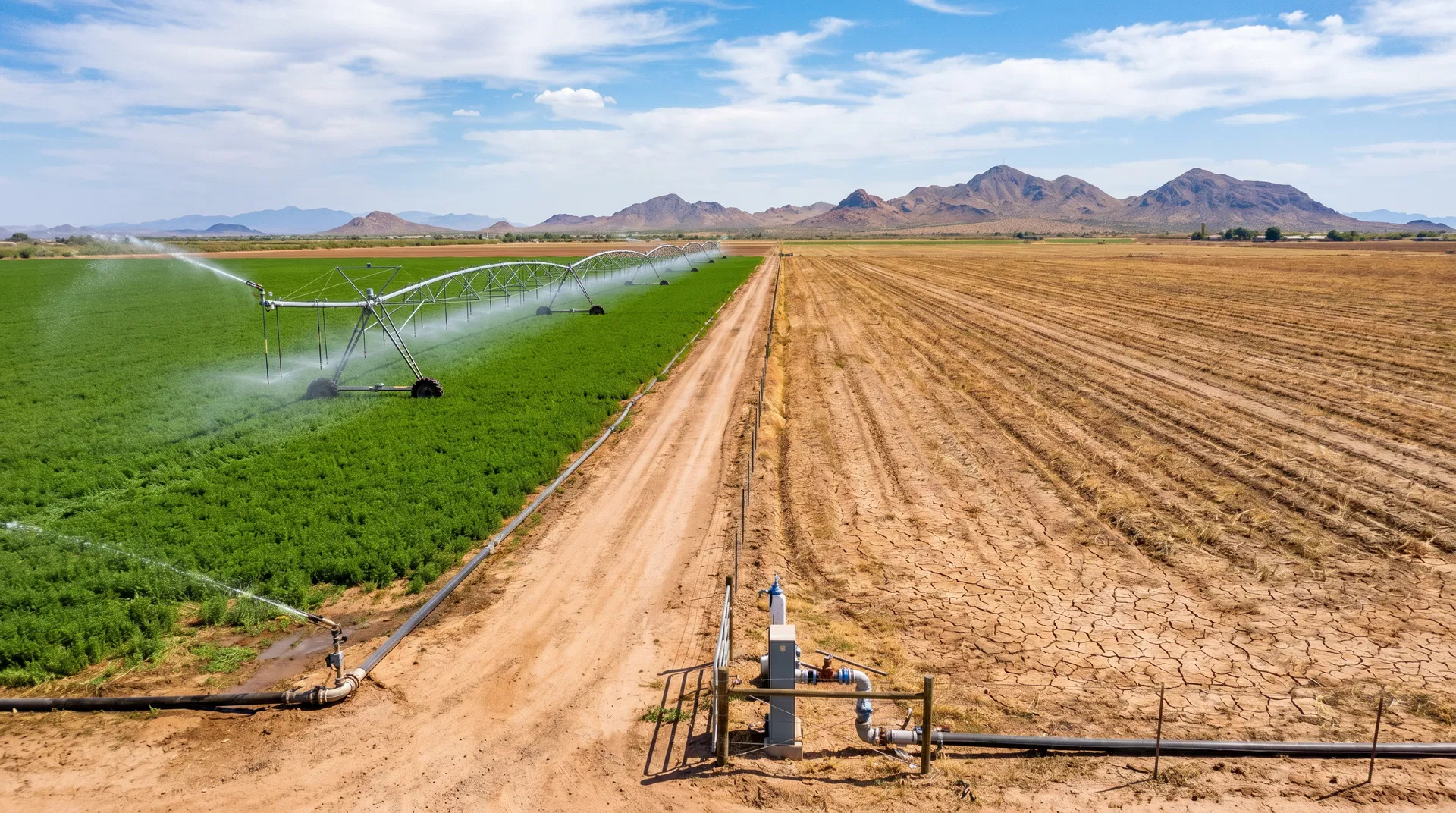
Standard farm and commercial property insurance policies do not cover losses caused by water rights curtailment. A fire that destroys your warehouse triggers business interruption coverage. A government curtailment order that forces you to fallow your fields does not. This gap is real, it is wide, and it is affecting thousands of agricultural businesses across Arizona, Nevada, Utah, and Colorado right now.
Get a Farm, Ranch, or Commercial Insurance Review
Insure Pacific is licensed in Arizona, Nevada, Utah, and Colorado. We shop 50+ carriers to find coverage that actually fits your water-risk exposure.
The Scale of the Crisis: What the Numbers Actually Mean
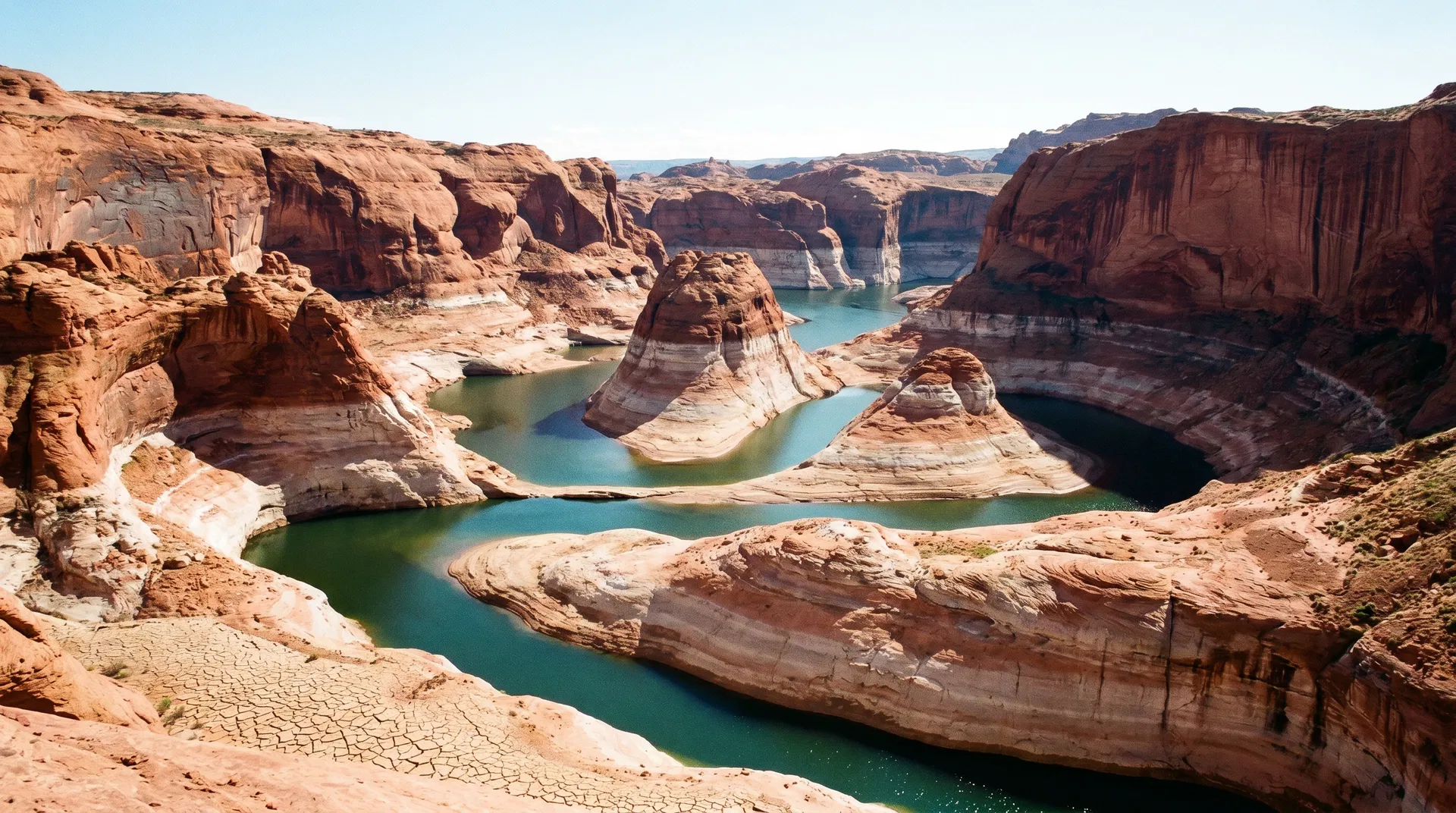
The Colorado River supplies water to more than 40 million people across seven states and irrigates roughly 5.5 million acres of farmland that produces a significant share of the nation's winter vegetables, cotton, and alfalfa. The river's two largest reservoirs — Lake Mead on the Nevada-Arizona border and Lake Powell on the Utah-Arizona border — together hold approximately 80 percent of the entire system's storage capacity. As of early 2026, Lake Powell sat at roughly 27 percent of capacity.
The inflow forecast makes the situation even starker. The volume of water expected to flow into Lake Powell between April and July 2026 is approximately 800,000 acre-feet — just 13 percent of the historical average for that period, and the lowest inflow on record. This is not a single bad year following a string of normal ones. The Colorado River Basin has experienced two decades of accelerating aridification driven by rising temperatures, reduced snowpack, and increased evaporation. The river is structurally over-allocated: the water rights granted in the early 20th century were based on flow measurements taken during an unusually wet period that has not been replicated since.
The Negotiation Impasse and What It Means for Your State
The current operating rules governing the Colorado River expire at the end of 2026. The seven basin states were supposed to agree on a replacement framework by November 2025. They missed that deadline. As of mid-2026, the Lower Basin states (Arizona, California, and Nevada) have submitted a joint proposal to the Bureau of Reclamation calling for 1.25 million acre-feet of combined reductions beginning in 2027, but the Upper Basin states have not agreed to a unified plan.
The proposed Lower Basin framework would distribute cuts unevenly. Arizona would absorb approximately 760,000 acre-feet of reductions — roughly 61 percent of the total Lower Basin obligation and close to half of the state's typical annual Colorado River allocation. California would take 440,000 acre-feet, and Nevada would absorb 50,000 acre-feet. Nevada's relatively small cut reflects the fact that the Las Vegas Valley Water District recycles nearly all indoor water use back to Lake Mead. Arizona's agricultural users, by contrast, have already borne the brunt of Tier 1 and Tier 2 shortage cuts, and the proposed framework would deepen those reductions significantly.
| State | Basin | Proposed Reduction | Primary Impact |
|---|---|---|---|
| Arizona | Lower | 760,000 acre-feet (~48% of allocation) | Agriculture (CAP deliveries), new development |
| Nevada | Lower | 50,000 acre-feet (~7% of allocation) | Limited — high recycling rate in Las Vegas |
| California | Lower | 440,000 acre-feet (~14% of allocation) | Imperial Valley agriculture, Southern CA cities |
| Colorado | Upper | TBD — compact curtailment risk | Junior water rights, ski resort snowmaking |
| Utah | Upper | TBD — compact curtailment risk | Agriculture, St. George area growth |
What Farmers and Ranchers Need to Know Right Now
The USDA's Federal Crop Insurance Program paid $5.6 billion in drought-related losses to farmers in the seven Colorado River basin states between 2017 and 2023. Drought-related payments in the Colorado River states increased 297 percent over that period — faster than the national average. The largest single category was rainfall index policies ($2.96 billion). The second-largest was "failure of irrigation supply or equipment" ($1.1 billion) — a direct reflection of the water shortage problem.
Federal crop insurance through the USDA Risk Management Agency provides some protection, but it has significant limitations. Multi-Peril Crop Insurance (MPCI) covers yield losses from drought, but it is calibrated to historical yield averages and may not fully compensate for the economic impact of a complete crop failure caused by water curtailment. Pasture, Rangeland, and Forage (PRF) insurance pays based on rainfall index measurements — which means it can pay even when your specific operation hasn't lost a crop, but can also fail to pay when your losses are severe but the regional index doesn't reflect them.
For farm and ranch operations in Arizona, Nevada, Utah, and Colorado, the most important insurance review right now involves three questions: Does your current crop insurance cover irrigation failure losses, and at what level? Does your commercial property policy cover the value of your water rights as a business asset? If your farm is forced to fallow fields for a season or more due to water curtailment, what income replacement coverage do you have in place?
The Three Coverage Gaps Driving the Most Risk
Water Rights Curtailment
Standard farm and commercial property policies do not cover losses caused by a government curtailment order. No physical damage = no coverage under most standard forms. Specialized parametric products are the emerging solution.
Business Interruption
Business income coverage requires a 'direct physical loss' to trigger. A water curtailment order is a regulatory action, not physical damage. Most businesses in water-dependent industries are exposed without realizing it.
Property Value Decline
Homeowners insurance covers physical damage — not the decline in property value caused by water scarcity. Homes in the Phoenix and Tucson metro areas face long-term value uncertainty as water supply reliability becomes a real estate factor.
Farm & Ranch Insurance Review — Free Consultation
Our agricultural specialists can review your current coverage for water-risk gaps and help you understand what federal crop insurance does and doesn't cover.
Business Interruption Insurance: What It Covers and What It Doesn't
Business interruption insurance is one of the most misunderstood coverages in the commercial insurance market, and the Colorado River crisis brings its limitations into sharp relief. Standard business interruption coverage pays for lost revenue and continuing expenses when a covered physical loss forces your business to close or operate at reduced capacity. The key phrase is "covered physical loss." A fire that destroys your warehouse triggers business interruption coverage. A water curtailment order that forces you to fallow your fields does not.
There are some specialized coverage forms that can help. Contingent business interruption coverage pays when a supplier or customer suffers a covered physical loss that disrupts your operations. Service interruption coverage, sometimes available as an endorsement, can cover losses caused by the interruption of utility services — but water curtailment by a government authority is generally not the same as a utility service interruption caused by physical damage to infrastructure.
The most promising emerging solution for agricultural water risk is parametric insurance — coverage that pays based on a measurable index (such as reservoir levels, rainfall measurements, or streamflow data) rather than on actual losses. Parametric crop insurance products can be structured to pay when Colorado River reservoir levels drop below specified thresholds or when irrigation water deliveries fall below a specified percentage of contracted amounts. An independent agent with access to specialty agricultural markets — like Insure Pacific — is best positioned to identify these options.
State-by-State Insurance Considerations
Arizona
Most ExposedArizona faces the largest proposed water cuts of any state. The Central Arizona Project has already reduced deliveries to agricultural contractors under shortage conditions. Agricultural users hold the most junior CAP water rights and are cut first. Farms in the Phoenix and Tucson Active Management Areas that depend on CAP water should conduct a comprehensive review of their crop insurance, property coverage, and business interruption options. For commercial businesses that depend on water-intensive operations — food processing, landscaping, hospitality — the risk of water cost increases and supply restrictions should be factored into your coverage review. Learn about our commercial insurance options →
Nevada
Relatively InsulatedNevada's relatively small proposed cut reflects the Las Vegas Valley Water District's aggressive water recycling program, which returns nearly all indoor water use to Lake Mead as treated effluent. However, Nevada's agricultural users — particularly in the Moapa Valley and other rural areas — do not benefit from the urban recycling system and face more direct exposure to shortage cuts. For Nevada homeowners and businesses, the more pressing concern is the indirect effect of water scarcity on property values and the continued increase in wildfire risk driven by drought conditions. Learn about our homeowners insurance options →
Utah
Upper Basin RiskUtah is an Upper Basin state, which means its water rights are governed by a different legal framework than Arizona and Nevada. Utah's fastest-growing communities — particularly in Washington County (St. George) and along the Wasatch Front — are planning significant future water use increases that depend on continued Colorado River access. Agricultural users in Utah's Colorado River drainage, including the Grand Valley and Moab areas, should review their water rights priority dates and understand their curtailment exposure. Learn about our farm and ranch insurance options →
Colorado
Headwaters RiskColorado sits at the headwaters of the Colorado River and has historically enjoyed significant water security. But Colorado's compact obligation requires it to allow sufficient water to flow downstream to meet Lower Basin entitlements. As Upper Basin inflows decline, Colorado faces increasing pressure to limit new water development and potentially curtail existing junior rights. The ski industry — a major economic driver — depends on snowmaking water rights that could be among the first curtailed in a shortage. Agricultural operations in the Grand Valley, the Gunnison Basin, and the San Luis Valley should be reviewing their water rights exposure. Learn about our farm and ranch coverage options →

The Prior Appropriation Doctrine: Why "First in Time" Matters for Insurance
The western states' water law is built on the prior appropriation doctrine — "first in time, first in right." Water rights are granted with a specific priority date, and in a shortage, the most junior (most recently granted) rights are curtailed first. Senior rights holders continue to receive their full allocation until the supply is exhausted. This system creates a hierarchy of risk that has direct implications for property values and insurability.
A farm with senior water rights dating to the 1890s is in a fundamentally different risk position than a farm with rights granted in the 1970s. The senior farm may continue to irrigate even in a severe shortage; the junior farm may be completely curtailed. This difference in water security is not reflected in standard farm insurance premiums, which typically do not ask about the priority date of your water rights. As curtailments become more frequent and severe, the gap between senior and junior rights holders will widen — and the insurance market will eventually need to price that difference.
What Insure Pacific Can Do for You
Insure Pacific is one of the very few independent insurance agencies licensed across all four of the states most directly affected by the Colorado River crisis — Arizona, Nevada, Utah, and Colorado — as well as Oregon, Washington, Idaho, California, Wyoming, and New Mexico. You can see our full list of licensed states on our website.
As an independent agency, Insure Pacific works with more than 50 carriers, including specialty agricultural markets, commercial property carriers with experience in water-stressed regions, and emerging parametric insurance providers. We can review your current farm, ranch, commercial property, or homeowners coverage for gaps related to water risk — and we can shop the market to find the best available options.
The Colorado River crisis is not going away, and the insurance implications are only going to become more significant as post-2026 operating rules take effect. Now is the time to understand your coverage, not after a curtailment order arrives.
Frequently Asked Questions
Does my farm insurance cover losses caused by water rights curtailment?
Standard farm insurance policies generally do not cover losses caused by water rights curtailment. Coverage for water-related losses typically requires specialized crop insurance through the USDA Federal Crop Insurance Program, and even that coverage has limitations when it comes to curtailment-specific losses. Parametric insurance products that pay based on reservoir levels or delivery percentages are an emerging option. Contact Insure Pacific to discuss your specific situation.
Will my business interruption insurance pay if I can't operate due to water restrictions?
Standard business interruption insurance requires a direct physical loss to trigger coverage. A government-ordered water restriction or curtailment is a regulatory action, not a physical loss, and generally will not trigger standard business interruption coverage. Some specialized coverage forms — including service interruption endorsements and contingent business interruption coverage — may provide partial protection in specific circumstances.
How does the Colorado River crisis affect my homeowners insurance?
Homeowners insurance covers physical damage to your home and personal property from covered perils. It does not protect against property value decline caused by water scarcity. However, the drought conditions driving the Colorado River crisis also significantly increase wildfire risk throughout Arizona, Nevada, Utah, and Colorado — and that wildfire risk has direct implications for your homeowners coverage. Review your dwelling replacement cost limits, your extended replacement cost endorsement, and your additional living expense coverage with your agent.
What is parametric insurance and can it help with water risk?
Parametric insurance pays a predetermined amount when a measurable trigger event occurs — such as a reservoir dropping below a specified elevation or irrigation water deliveries falling below a specified percentage. Unlike traditional insurance, it does not require you to document actual losses; the payment is triggered automatically when the index hits the threshold. These products are not yet widely available through standard channels, but Insure Pacific's access to specialty agricultural markets means we can identify options that most agents cannot.
Is Insure Pacific licensed in Arizona, Nevada, Utah, and Colorado?
Yes. Insure Pacific is licensed across all four of the states most directly affected by the Colorado River crisis, as well as six additional western states. Our multi-state licensing means we can place coverage for agricultural operations, commercial properties, and homeowners across the entire Colorado River Basin.
Talk to an Agent About Water Risk Coverage
Don't wait for a curtailment order to find out what your policy doesn't cover. Insure Pacific serves Arizona, Nevada, Utah, Colorado, and six other western states.
Our Licensed Coverage Area
States highlighted in blue are states where Insure Pacific holds an active insurance license.
Hover to highlight — click a state to visit its insurance page
Our Oregon Office Locations
Hover over a marker to see the office — click to visit their website.
Hover to highlight — click to visit that office's website
Ready to Get Protected?
Talk to a Local Oregon Insurance Expert
Insure Pacific has been serving Oregon families and businesses since 1935. We work with 50+ carriers so you get real options — not just one company's answer.
Related Articles
 Farm & Ranch
One Ranch, Several Policies: Coordinating Home, Farm, Commercial Auto, and Umbrella Insurance
Read Article → Farm & Ranch
Cattle Ranch Insurance in the American West: The Complete Guide to Property, Livestock, Equipment, Liability, and Income Protection
Read Article → Farm & Ranch
Custom Grazing Insurance: Who Covers Cattle, Fences, Pasture, Death Loss, and Liability?
Read Article → Farm & Ranch
Grain Bin and Feed Storage Insurance: Collapse, Wind Damage, Contamination, and Stored Commodities
Read Article →Get in Touch
Ready to protect what matters most? Contact us today for a no-obligation insurance review. Our experienced agents are here to help you find the right coverage for your needs.


