

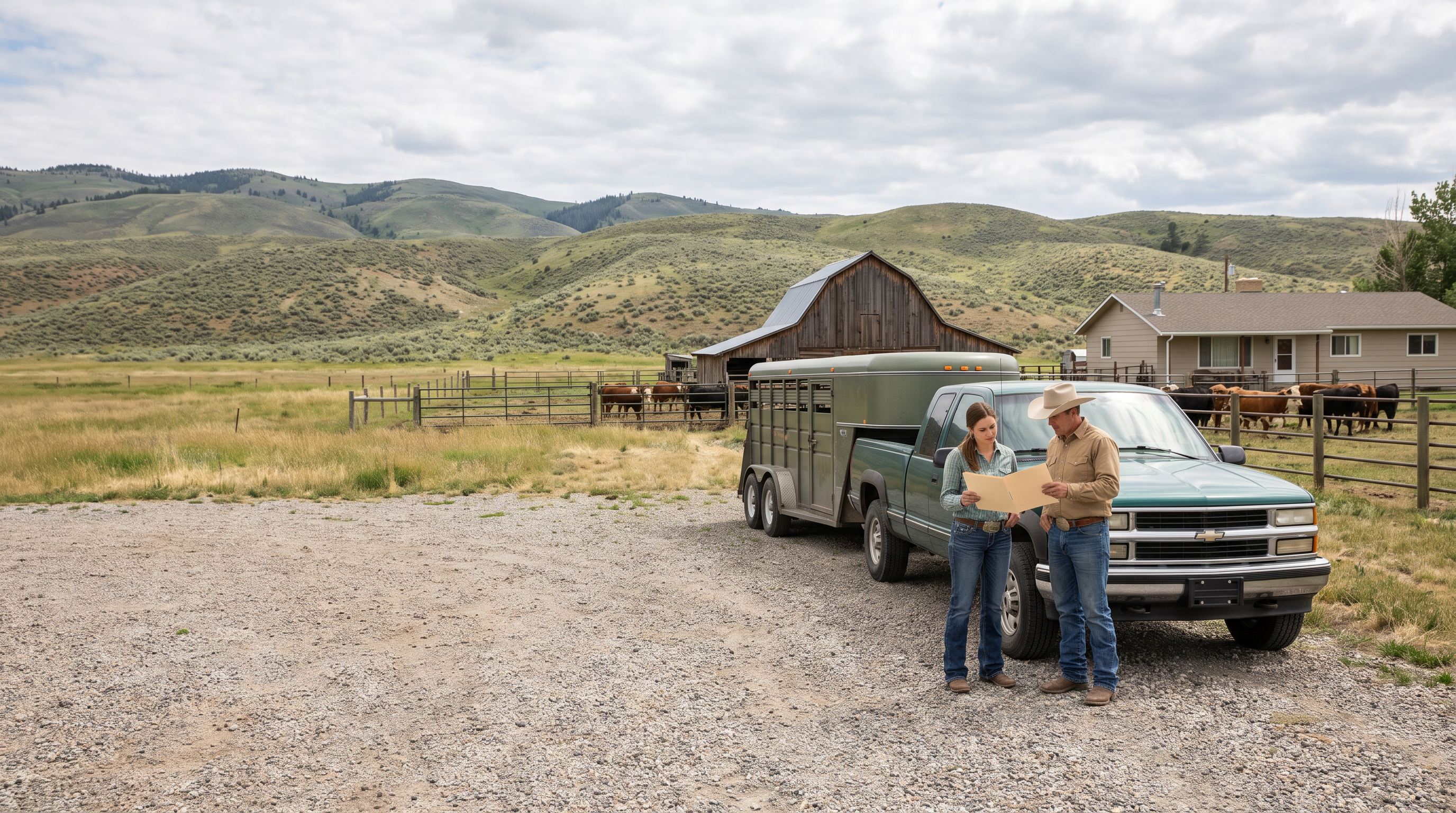

Your house sits on the ranch. The ranch pickup carries the kids to town in the morning and pulls a stock trailer in the afternoon. A family trust owns the land, an LLC runs the cattle operation, and an adult child keeps equipment in the shop. All of it may look like one place. Your insurance contracts may see several different owners, activities and risks.
Coordinating ranch insurance means making the home, farm, auto and umbrella policies agree about who is insured, what is insured and how the operation works. It is not simply putting four declarations pages in the same folder. A policy can be appropriate on its own and still leave a gap where it meets another policy.
This guide takes a practical look at ranch insurance across the American West. The goal is a clear coverage map for the household and working operation—not a promise that one policy covers everything or that every ranch needs the same insurance package.
The short answer: start with one complete ranch profile
List every owner, entity, location, building, vehicle, driver and income-producing activity. Then assign the intended policy and review the actual forms. Finally, confirm that any umbrella recognizes the underlying coverage and insureds. Combining premiums or renewal dates can be convenient, but neither proves the policies fit together.
1. Give every policy the same picture of the ranch
Start with how the ranch actually operates, not the description from an application completed years ago. Include the residence, barns, shops, hay storage, corrals, water systems and leased acreage. Record cattle ownership, equipment ownership, vehicle titles and where property travels. Separate your own production from services performed for someone else.
A useful profile explains who lives on site, who works there and who visits. A family residence, employee bunkhouse, long-term rental and guest cabin can create different insurance questions even when all four share a driveway. A pasture lease across a county line is another location, not just more acreage on the original parcel.
The Ohio State University Farm Office's explanation of farm policies is a helpful starting point: declarations identify the insured and coverage details, while exclusions, conditions and endorsements can substantially change the protection. Reading only the premium page misses much of the contract.
Home and household
Residence, contents, living expenses, household liability and occupancy.
Farm property and operations
Scheduled structures, equipment, livestock interests, locations and farming activities.
Vehicles and road use
Titled owners, drivers, errands, towing, employee use and hauling arrangements.
Higher liability limits
Eligible underlying policies, insured entities, attachment and exclusions.
2. Match people, trusts and LLCs to their actual roles
Suppose the family trust owns the residence and land, a ranch LLC owns the cattle, and one spouse personally owns the pickup. Putting the family surname on every application does not necessarily insure each legal interest. A claim may name the landowner, operator, driver and business separately.
Give your agent the exact legal names and describe who owns, leases and operates each asset. An operating LLC may need named-insured treatment for its operations. A lender may need a mortgagee or loss-payee provision for its financial interest. A landowner may need liability treatment under a tenant's policy. These roles are not interchangeable.
A certificate is not the same as insured status
Being shown as a certificate holder generally provides evidence of insurance; it does not by itself make the holder an insured. Additional-insured status can be limited to specified relationships or activities. Property loss-payee status addresses a different interest from liability protection. Ask which endorsement or policy provision establishes the intended status and retain the documentation.
Do the same review after an estate-planning change, marriage, inheritance or business restructuring. Moving a truck into an LLC or transferring the ranch into a trust can affect eligibility and insurance interests. Coordinate the change with the agent and your legal or tax advisers before relying on the old paperwork.
3. Decide how the ranch residence belongs in the program
Some farm and ranch packages combine the dwelling and household belongings with farm structures, farm personal property and liability. Other arrangements use a separate homeowners policy. The important question is not which label sounds broader. It is whether the selected forms correctly address the residence, its occupancy and the surrounding operation.
Travelers distinguishes farm/ranch coverage from homeowners insurance because ordinary homeowners coverage is not designed to insure the farming business. That distinction matters when the shop contains business tools, the barn houses livestock or customers enter the property. An outbuilding's proximity to the house does not establish coverage for its business use.
When reviewing home insurance, ask about the dwelling's reconstruction estimate, household contents, personal liability and additional living expense. Then ask what changes when a structure is rented, used for employee housing or converted to paid guest lodging. Describe actual use; do not assume a family relationship makes every occupancy personal.
Home living expenses and ranch income are different losses
If a covered fire makes the house uninhabitable, additional living expense may address qualifying increased household costs under the dwelling coverage. It does not automatically replace lost ranch revenue. Ranch business-income protection, extra expense or other income-related coverage has its own triggers, limits and conditions. Ordinary cattle-price changes or drought-related revenue loss are not automatically covered by a property policy.
A single wildfire could damage the house, hay barn and machinery while interrupting operations. The same event does not mean one limit or one deductible necessarily applies to everything. Review each coverage part, any separate deductible and the causes-of-loss wording. Flood, earth movement, wear and deterioration need their own analysis rather than an assumption that a broad package includes them.
4. Coordinate farm property, equipment and livestock interests
A property schedule should distinguish the residence from operating structures and their contents. Identify the shop, tack room, hay shed, irrigation equipment, fences and other improvements. Record building dimensions, construction, condition and use. A generic description such as “farm buildings” may not tell an underwriter which property is intended to be insured.
In a farm property insurance review, compare limits with current replacement or repair costs, not simply purchase price, assessed value or loan balance. Ask how replacement-cost conditions, actual cash value, scheduled versus blanket coverage and any insurance-to-value requirement apply. Blanket coverage can offer flexibility, but it is not an unlimited promise for every asset at every location.
List borrowed, rented and leased equipment separately. The rental agreement may make you responsible for damage that your policy does not cover, or require a specific valuation or loss-payee arrangement. Ask about property away from the ranch, in transit, at a repair shop or on another producer's ground. New acquisitions may have reporting deadlines or temporary limits; confirm the actual terms.
For cattle, identify whether they belong to the operating entity, a family member or a customer. Livestock insurance questions include covered causes of loss, valuation, scheduled animals versus groups and transportation. Liability for someone else's animals is a separate question from insurance for animals you own. Neither disease nor unexplained disappearance should be presumed covered.
5. Keep farm liability aligned with all income-producing activities
The ranch may begin with cattle production and later add custom baling, snow removal, horse boarding, equipment rental or a venue business. Those are not merely changes in revenue. They can alter the type of activity the insurer agreed to cover.
University of Missouri Extension recommends reviewing farm liability exclusions and operational changes, including custom work, agritourism and nonfarm activities. The lesson is to ask about your activities specifically—not to assume every carrier excludes or includes them in the same way.
A farm liability review should address premises, animals, products, services for others, leased land and contracts. It should also distinguish damage to your own property from liability for injury or damage to others. For example, cattle escaping onto a road raise different questions from the cost to replace the cattle themselves.
Employee injuries require separate analysis under the applicable state's system, not a substitution of farm general liability or an umbrella. In Washington, employers should review the L&I state industrial-insurance program or approved self-insurance as applicable. Requirements and available employer-liability arrangements differ by jurisdiction. This article does not establish a ranch's labor-law obligations.
6. Classify pickups by ownership, drivers and use—not appearance
Two identical pickups can belong in different insurance arrangements. One may be a personally owned family vehicle used for occasional ranch errands. Another may be owned by the LLC, driven by employees and used to deliver hay or haul animals. Neither the pickup body style nor a farm registration alone answers the insurance question.
For each vehicle, record the titled owner, named insured, garaging address, normal drivers, radius of travel, towing and business use. Include occasional drivers and adult children who no longer live at home. Tell the agent if a worker takes the truck home, a family member uses it in another business or the ranch begins hauling for compensation.
Some personal policies allow certain business uses; others restrict relevant vehicles or activities. Some ranch vehicles need a commercial arrangement. Compare the actual terms of personal auto insurance and commercial auto insurance with the full facts. Do not solve the issue by calling paid hauling an “errand” on the application.
Progressive Commercial's farm-truck guidance illustrates why actual work matters: using a vehicle on a farm does not automatically qualify it for that insurer's farm-truck product. Broader delivery or hauling activities can call for a different commercial-auto review. This is a product-specific example, not an all-state rule for every pickup.
Owned, hired and non-owned vehicles are different exposures
A rented truck used for a sale-day trip and an employee's own car used to collect supplies are not the same as a truck the ranch owns. Ask whether hired and non-owned auto liability is needed, who is protected and what exceptions apply. Liability protection for the ranch does not automatically pay for damage to the employee's car or the rented vehicle.
Also review physical damage, deductibles, towing, rental reimbursement and relevant uninsured/underinsured motorist options. Liability limits address claims against insureds; they are not a repair budget for your own pickup. Disclose cross-state trips and any transportation for others. Insurance, vehicle registration, driver licensing and motor-carrier rules are separate reviews, and this article does not declare an operation exempt from them.
Independent Insurance Agency Since 1935
Not Sure If You Have the Right Coverage?
Our licensed agents compare 50+ carriers to find you the best coverage at the right price — at no extra cost to you.
7. Review stock trailers, cargo and farm equipment separately
A truck policy may respond to liability involving an eligible attached trailer under its terms, but that does not establish physical-damage coverage on the trailer itself. Record trailer ownership, identification, value and use. Ask how coverage changes when the trailer is detached, borrowed, rented or pulled by a different vehicle.
Then consider the animals or goods inside. A trailer collision can involve damage to the truck, damage to the trailer, loss of cattle and injury to another motorist. Those losses may require different coverages. If the cattle belong to a neighbor, responsibility under a hauling contract is not proof that the truck policy covers their value.
Tractors, UTVs and mobile machinery also need careful classification. A piece of equipment's treatment under farm liability or auto coverage may depend on definitions and use. Road travel, hauling on a trailer and use at someone else's jobsite create different questions. Ask which policy addresses each situation and whether any gap remains between a mobile-equipment provision and an auto exclusion.
8. Verify that the umbrella sits over the policies you mean it to
An umbrella is primarily a liability tool. It is not additional property insurance for barns or a general reserve for every excluded claim. A personal umbrella, farm umbrella and commercial umbrella may have different insureds, eligible underlying policies and excluded activities.
When considering umbrella insurance, ask the agent to trace the connection from the household and operating entities to each underlying liability policy. A personal umbrella that recognizes family auto and homeowners coverage may not recognize an LLC's ranch operation or commercial auto policy. A farm umbrella should not be assumed to include a separate venue or trucking business.
For example, American Family's farm/ranch umbrella description refers to personal and qualifying commercial-auto exposures, with restrictions. State Farm's personal umbrella guidance identifies minimum underlying-insurance requirements. These examples show why the exact product and its conditions matter; they are not statements that any particular carrier will accept your ranch.
Check these details in the actual policy
- Underlying coverage: Which home, farm and auto policies must be listed or otherwise qualify?
- Insureds: Are the intended individuals, trust and operating entities protected for the relevant activity?
- Required limits: What limits must you maintain, and what happens if underlying coverage lapses or is reduced?
- Attachment and defense: When can the higher layer respond, and how do defense costs and exhaustion provisions operate?
- Exclusions and retention: Are business activities, auto uses or other hazards excluded, and is any self-insured retention relevant?
Do not assume the umbrella will drop down to repair missing underlying insurance. Some forms measure their obligation as though required underlying limits had been maintained, leaving the insured responsible for the gap. Others contain different conditions. Ask for the applicable language, not a verbal description of “another million on everything.”
There is no universal right umbrella limit for all Western ranches. Consider the number of vehicles and drivers, road exposure, public access, contractual obligations, assets at risk and available insurance options. Any example limit is a discussion point, not a quote or a legal adequacy standard.
9. Look beyond matching dates and multi-policy discounts
Using one insurer may make billing and claims administration easier. Using different insurers may provide a better fit for specialized risks. Neither structure guarantees coordination. Evaluate the complete program's coverage, exclusions, insureds, deductibles and attachment requirements before comparing total premium.
Renewal dates matter because changes can occur at different times. If commercial auto is replaced in March and the umbrella renews in August, the higher layer still needs to recognize the replacement arrangement in March. The agent should check whether notification, an endorsement or insurer approval is required before the change takes effect.
Compare proposed replacement coverage before cancelling existing insurance. Confirm effective times, binding instructions, vehicle and property schedules, endorsements and any remaining conditions. A quote is not proof that coverage is bound. Where a claims-made specialty coverage is involved, retroactive dates and reporting provisions deserve a separate review rather than simply matching the renewal date.
10. Three ranch scenarios that expose coordination problems
These are hypothetical review examples, not predictions of coverage or claim outcomes.
The trust owns the barn; the LLC owns the equipment
A fire damages both. The property review must establish the correct insured interests, scheduled building, business contents and valuation. If the barn is listed but the LLC's equipment is not insured as intended, buying a larger umbrella does not solve the property problem. The fix is the right property coverage and insured treatment before the loss.
The family pickup becomes an employee work truck
The vehicle is transferred to the ranch LLC and a hired hand begins driving it daily. The old personal policy and personal umbrella may no longer fit. Ownership, driver eligibility, business use, underlying limits and umbrella recognition all need review together. Merely renewing the old identification card leaves those questions unanswered.
The ranch adds paid events and outside hauling
The farm policy was arranged for cattle production, but the owners start hosting weddings and hauling a neighbor's animals for a fee. These new operations can create liability, transportation, property and contract exposures outside the original program. Disclose them before accepting bookings or loads. A certificate requested by a customer does not create coverage that the policy excludes.
11. Contracts and leased land should match the coverage map
Pasture leases, equipment rentals, lender agreements, grazing contracts and hauling arrangements can assign obligations to different parties. Identify who must insure the property, who is responsible for maintenance, who bears particular losses and whether additional-insured or waiver-of-subrogation provisions are requested.
Let the agent review insurance provisions and let counsel review the legal obligations. A promise to indemnify another party can be broader than insurance coverage. A certificate or umbrella limit alone does not establish compliance. Ask whether the requested endorsements are available and applicable to the actual agreement before signing it.
Keep land schedules current when adding seasonal pasture or operating across state lines. Include off-site hay storage and equipment locations. State law, carrier territory, wildfire conditions, access and property use can affect underwriting. Approval for the home ranch does not automatically extend to every newly acquired or rented location.
12. Bring this file to a coordinated ranch insurance review
Start with complete current policies and endorsements, not just bills and identification cards. A coordinated review is easier when your agent can compare the program with one current set of operating facts.
- Ownership: Legal names, trusts, LLCs, deeds, vehicle titles and ownership of cattle and equipment.
- Locations and uses: Owned and leased parcels, residences, employee housing, rentals, public access and storage away from the ranch.
- Property values: Building details, equipment inventories, livestock interests, seasonal hay/feed values and recent improvements.
- Vehicles and drivers: VINs, trailer details, garaging, driver roster, towing, travel radius and all personal/business uses.
- Operations: Revenue sources, custom services, hauling, boarding, events, employees and contractors.
- Contracts: Leases, loans, rental agreements and requested insurance endorsements.
- Policy connections: Effective dates, required underlying limits, umbrella schedules, exclusions and unresolved coverage questions.
- Loss information: Prior claims, open matters, safety improvements and a current emergency-contact list.
Ask for a written list of proposed changes and unanswered questions. Record what has been bound, what is still being quoted and which endorsements remain pending. Do not describe a policy as fixed until the requested coverage has actually been confirmed.
13. After an accident, coordinate notice—not coverage guesses
Protect people first and call emergency services when needed. Take reasonable steps to prevent further damage if safe, preserve photos and records, and follow the policies' reporting instructions. A major incident may involve property, auto, farm liability and umbrella insurers, each with its own notice requirements.
Provide factual information about the people involved, ownership, location, vehicle use and affected property. Keep demands, legal papers, contracts, receipts and communications. Avoid assuming the policy with the largest limit is the only one that needs notice or that notifying one carrier automatically notifies the others.
The Insure Pacific Claims Center can help you find reporting resources. Your agent can help organize communications, but insurers determine coverage under the contracts. Timely reporting and good records support the process; they do not guarantee payment.
Frequently asked questions about coordinating ranch insurance
Can one farm and ranch policy cover my home and my ranch business?
Some farm and ranch packages can include the dwelling, household belongings, farm buildings, farm personal property and liability. That does not make every vehicle, business activity or location automatically insured. Compare the declarations, schedules, forms and endorsements with what you own and do. Separate policies may still be needed.
Does my personal auto policy cover my ranch pickup?
The answer depends on ownership, drivers, actual use, vehicle type and policy wording. Occasional ranch errands are not the same risk as an LLC-owned truck, employee driving or hauling for others. Disclose the complete use and obtain the insurer's coverage decision rather than assuming every ranch pickup needs commercial auto or every personal policy allows ranch use.
Does an umbrella automatically cover both personal and ranch liability?
No. A personal umbrella, farm umbrella and commercial umbrella can have different insureds, underlying-policy requirements and exclusions. Verify that the intended farm liability and auto policies are scheduled or otherwise eligible, that the correct people and entities qualify as insureds, and that required underlying limits are maintained.
Does insuring my stock trailer also insure the cattle inside it?
Not automatically. Trailer liability, damage to the trailer, damage to the tow vehicle and loss of livestock are separate coverage questions. Ownership of the animals, covered causes of loss, transportation terms and any care-custody-control or cargo coverage must be reviewed.
Should the ranch LLC, family trust and landowner all be on every policy?
Not necessarily in the same capacity. The right treatment depends on each party's ownership, operations, liability exposure and the insurer's forms. Named insured, additional insured, mortgagee and loss payee are different roles. Give the agent the ownership documents and contracts and ask for the appropriate treatment on each policy.
Will buying several policies from one company eliminate coverage gaps?
No. A single insurer may simplify administration, but each policy still has its own coverage terms. Multiple insurers can also form a coordinated program. Compare insureds, locations, activities, exclusions, effective dates and umbrella attachment rather than judging coordination by the number of insurance companies.
How often should ranch insurance policies be reviewed together?
Review them together at renewal and before material changes such as a land purchase, vehicle transfer to an LLC, new driver, leased pasture, custom hauling, a rental home or public events. Do not wait until the next annual renewal to report a change that affects eligibility, ownership or use.
Which insurer should I notify if a ranch accident involves several policies?
Report the facts promptly to every potentially applicable insurer as required by the policies, including the umbrella insurer when appropriate. Your agent can help coordinate notice, but the insurers determine coverage. Preserve evidence, protect people and property safely, and avoid assuming one claim report automatically notifies every carrier.
One ranch deserves one coordinated review
You do not necessarily need one policy, one company or one renewal date. You need a program that reflects the household, the ranch business and the connections between them. Start with the ownership and operations, then check the home, farm, auto and umbrella contracts together.
Insure Pacific can help you organize those questions and compare available coverage options. Bring the full policy set and a current description of the ranch so the conversation goes beyond renewing last year's limits. Availability and terms depend on the insurer, location and operation.
Sources and further reading
The following sources informed the coverage-coordination principles in this guide. Product descriptions and university-extension explanations do not replace your own policy forms or state-specific professional advice. Accessed November 2, 2026.
- Travelers: Farm and Ranch Insurance vs. Homeowners Insurance — residence and farming-business coverage distinctions.
- Ohio State University Farm Office: Understanding the Farm Insurance Policy — declarations, forms, exclusions and property categories.
- University of Missouri Extension: Know What Your Farm Liability Insurance Covers — activities, insureds, road exposure and regular review.
- Progressive Commercial: Farm Truck Insurance — vehicle use and farm-truck product eligibility.
- American Family: Farm and Ranch Liability Umbrella — qualifying underlying exposures and product restrictions.
- State Farm: Personal Liability Umbrella Policy — required underlying insurance and policy conditions.
Educational information, not legal, tax, financial or individualized insurance advice. Coverage depends on the issued policies, endorsements, exclusions, limits, deductibles, facts of loss and applicable law. Examples do not guarantee coverage. An insurance review does not bind, change or cancel a policy unless the insurer or authorized representative confirms the action.