



Oregon Farm & Ranch Insurance in 2026: What Every Agricultural Producer Needs to Know Before Wildfire Season
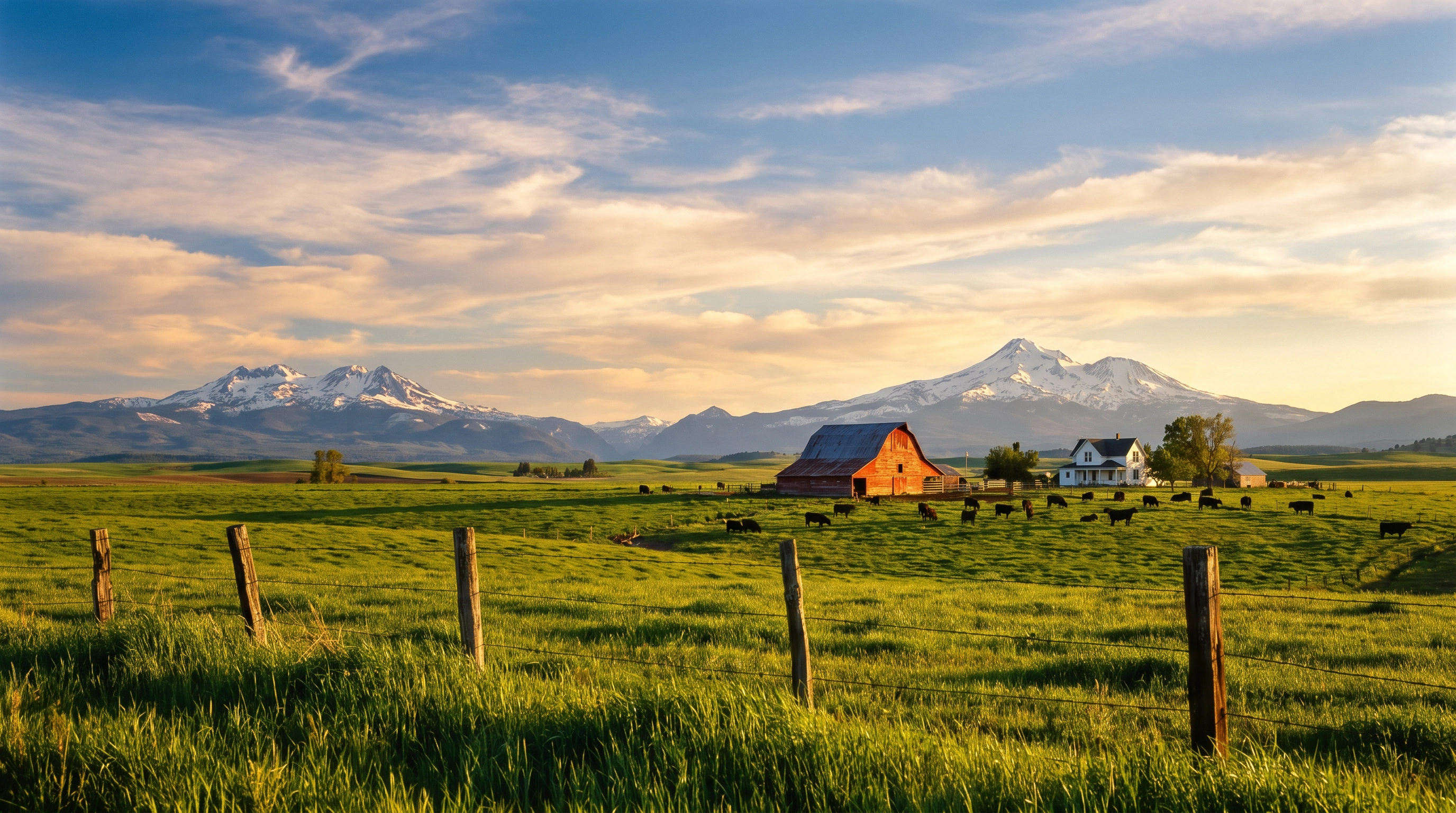
Oregon Farm & Ranch Insurance in 2026: What Every Agricultural Producer Needs to Know Before Wildfire Season

Oregon agriculture is the backbone of the Pacific Northwest economy — from the cattle ranches of Crook County and the hay operations of the Klamath Basin to the wheat fields of the Columbia Plateau and the lavender farms of Central Oregon. But in 2026, the insurance landscape for farms and ranches has shifted dramatically. Wildfire seasons are arriving earlier, burning longer, and reaching properties that were once considered low-risk. Carriers are tightening underwriting standards, raising premiums, and in some cases non-renewing policies in fire-prone rural areas entirely.
If you operate a farm or ranch in Oregon — whether a 5-acre hobby farm near Sisters or a 2,000-acre cattle operation outside Prineville — this guide is for you. We cover what has changed in 2026, the most critical coverage gaps facing agricultural producers right now, and the specific steps you should take before wildfire season peaks in late July and August.
Why 2026 Is a Pivotal Year for Oregon Farm Insurance
The 2020 Labor Day fires were a turning point. In a single week, those fires burned over one million acres across Oregon, destroyed hundreds of farm structures, killed thousands of livestock, and caused losses that many producers are still recovering from. In the years since, the insurance market for rural Oregon properties has fundamentally changed.
In 2026, several trends are converging that every Oregon farmer and rancher needs to understand:
Carrier withdrawals from high-risk zones — Several standard carriers have restricted new business or non-renewed existing policies in Deschutes, Crook, Jefferson, Klamath, and Lake counties. Producers who have held the same policy for 20 years are receiving non-renewal notices for the first time. If your carrier has withdrawn from your area, understanding your options is urgent.
Premium increases of 30–80% — Even producers who retain coverage are seeing sharp premium increases. Properties in the Oregon Department of Forestry's highest-risk zones are seeing the steepest increases. The Oregon Department of Consumer and Business Services (DCBS) has documented statewide premium growth that outpaces inflation in every rural county.
Stricter underwriting requirements — Carriers are now requiring defensible space documentation, ember-resistant venting, and fire-resistant roofing as conditions of coverage — not just as discount qualifiers. Failure to meet these requirements can result in coverage denial or policy cancellation.
Specialty markets filling the gap — Where standard carriers have withdrawn, surplus lines markets and specialty agricultural programs are stepping in. These markets can provide coverage, but often at higher cost and with different terms. Working with an independent agency like Insure Pacific — which has access to 50+ carriers including specialty agricultural markets — is more important than ever.
The 5 Most Critical Coverage Gaps on Oregon Farms Right Now
Based on the claims and coverage reviews our agents have conducted across Central Oregon in 2025 and 2026, these are the five gaps we find most often on Oregon farm and ranch policies:
1. Undervalued farm structures
Construction costs have increased 40–60% since 2020. A barn that cost $80,000 to build in 2015 may cost $130,000 to replace today. If your policy still reflects 2015 values, you are significantly underinsured. After a total loss, you would receive only a fraction of what it costs to rebuild — leaving you to cover the gap out of pocket.
The solution is a replacement cost valuation update. Ask your agent to run a current replacement cost estimate on every structure on your property — not just the dwelling, but every barn, equipment shed, grain bin, hay storage, corral, and outbuilding. This should be done annually, not just at policy inception.
2. Livestock not covered or undervalued
Livestock mortality coverage is one of the most commonly missing components of Oregon farm policies. Many producers assume their livestock is covered under their general farm property coverage — it typically is not, or it is covered only under a sublimit that does not reflect the current value of the herd.
Cattle prices have risen significantly. A cow-calf pair that was worth $1,500 in 2020 may be worth $2,500 or more today. If your policy was written at 2020 values and has not been updated, your livestock coverage may be 40–50% inadequate. For high-value animals — registered breeding stock, performance horses, prize bulls — individual animal mortality coverage with a current veterinary appraisal is essential.
3. Farm equipment not scheduled or undervalued
Modern farm equipment is extraordinarily expensive. A new John Deere combine can exceed $600,000. A tractor with attachments easily reaches $200,000. Yet many farm policies still carry equipment schedules from 5 or 10 years ago, reflecting values that bear no relationship to current replacement costs.
Equipment coverage should be reviewed every year. Any new equipment purchased in the past 12 months should be added to the schedule immediately — most policies provide only 30 to 60 days of automatic coverage for newly acquired equipment. After that window closes, unscheduled equipment is uninsured.
4. No agritourism liability coverage
Oregon's agritourism industry has exploded in recent years. Pumpkin patches, corn mazes, lavender farms, farm-to-table dinners, wedding venues on ranch properties, and farm stays are generating significant revenue for Central Oregon producers. But many of these operations are running without adequate liability coverage for their visitor activities.
Standard farmowners policies often include a sublimit for agritourism liability — sometimes as low as $100,000 — or exclude it entirely. If a visitor is injured at your farm event, a $100,000 sublimit will not go far. For farm wedding venues and event facilities, Insure Pacific's event insurance team can structure coverage that addresses both the ongoing farm operations and the event-specific exposures.
5. No wildfire mitigation documentation
This is the gap that is costing Oregon producers the most in 2026 — not because they lack coverage, but because they cannot prove their mitigation efforts to their carrier. Carriers are increasingly requiring documented evidence of defensible space, ember-resistant venting, and fire-resistant roofing. Without documentation, you may be paying for coverage that your carrier could dispute at claim time.
Insure Pacific's wildfire mitigation program helps farm and ranch clients document their defensible space improvements, qualify for premium discounts, and maintain the documentation carriers require. This is not just about saving money — it is about ensuring your coverage holds when you need it most.
Insure Pacific has been protecting Oregon agricultural operations since 1935. Our farm and ranch specialists will review your current coverage, identify gaps, and compare options across 50+ carriers — including specialty agricultural markets.
Get a Free Farm Insurance Review → (541) 238-7775 Text Us!What to Do Before Wildfire Season Peaks
Wildfire season in Central Oregon typically peaks between late July and mid-September. Here is a practical checklist for farm and ranch operators to complete before that window arrives:
Review your policy declarations page. Pull out your current policy and verify the coverage limits on your dwelling, farm structures, equipment, and livestock. Compare those limits to current replacement costs. If the numbers do not match, call your agent immediately.
Walk your property and document everything. Take a video walkthrough of every structure on your property — inside and out. Document every piece of equipment, every animal, every improvement. Store this documentation off-site (cloud storage or a safety deposit box). This documentation is essential for a smooth claims process after a fire.
Create or update your defensible space. Oregon State University Extension recommends a minimum 30-foot ember-resistant zone immediately around structures, with a 100-foot reduced-fuel zone beyond that. Clear dead vegetation, trim tree branches to 10 feet above the ground, and remove combustible materials from under decks and porches.
Check your irrigation systems. Functional irrigation is one of the most effective wildfire defenses on a farm or ranch. Verify that all pivot systems, pump stations, and water lines are operational before fire season. Document the condition and value of your irrigation infrastructure for insurance purposes.
Notify your agent of any changes. If you have added structures, purchased equipment, increased your herd, or started any agritourism activities since your last policy review, notify your agent before fire season. Coverage gaps that exist at the time of a loss cannot be corrected retroactively.
Farm & Ranch Insurance Coverage Types: A Quick Reference
For producers who are building or reviewing their coverage program, here is a summary of the key coverage types available through Insure Pacific's farm & ranch program:
Farmowners Policy — The foundation of most agricultural insurance programs. Combines dwelling coverage, farm structure coverage, farm personal property, and farm liability in a single policy. Best suited for smaller operations and hobby farms.
Farm Package Policy — A more flexible, modular approach for larger operations. Allows separate limits and terms for each coverage component. Better suited for commercial grain farms, large cattle ranches, and diversified operations.
Livestock Mortality Insurance — Covers the death of individual animals or entire herds from specified perils. Can be written on a blanket or scheduled basis. Individual animal coverage available for high-value horses, breeding bulls, and registered livestock.
Farm Equipment Insurance — Covers physical damage to tractors, combines, ATVs, irrigation equipment, and other farm machinery. Equipment breakdown endorsements available for mechanical and electrical failures.
Crop Insurance — Federal crop insurance programs administered through USDA-approved carriers. Covers yield losses and revenue shortfalls from drought, hail, frost, and other covered perils. Enrollment deadlines vary by crop and county — contact Insure Pacific well before your county's sales closing date.
Farm Liability Insurance — Covers bodily injury and property damage claims arising from farm operations. Products liability, agritourism liability, and employer's liability endorsements available.
Workers Compensation — Required by Oregon law for most farm employers. Oregon workers compensation requirements for agricultural employers have specific provisions for seasonal and migrant workers.
Commercial Auto Insurance — Covers farm trucks, trailers, and vehicles used in agricultural operations. Commercial auto coverage is separate from personal auto and must be specifically endorsed for farm use.
Umbrella Insurance — Provides additional liability limits above your underlying farm and auto policies. Particularly important for operations with significant public access, agritourism activities, or large equipment values. Farm umbrella policies are available in $1 million increments.
Independent Insurance Agency Since 1935
Not Sure If You Have the Right Coverage?
Our licensed agents compare 50+ carriers to find you the best coverage at the right price — at no extra cost to you.
Oregon-Specific Considerations: Crook, Deschutes, and Jefferson Counties
Central Oregon's three primary agricultural counties each have distinct risk profiles that affect insurance availability and pricing:
Crook County — Home to some of Oregon's largest cattle ranches, Crook County has seen significant carrier withdrawals in recent years due to wildfire risk. The Prineville area, where Insure Pacific's Prineville Insurance office is located, has deep roots in agricultural insurance. Our agents understand the specific risks facing Crook County ranchers and have access to specialty markets that continue to write coverage in the area.
Deschutes County — The Bend area and surrounding high desert have seen explosive growth in hobby farms, horse properties, and small agricultural operations. Wildfire risk is significant in the western portions of the county near the Cascade foothills. Agritourism operations near Sisters and Tumalo are a growing segment of the county's agricultural economy.
Jefferson County — The Madras area is one of Oregon's most productive agricultural regions, with significant hay, seed, and specialty crop production. Irrigation infrastructure — including the North Unit Irrigation District — represents substantial insurable value that must be properly covered.
How Insure Pacific Helps Oregon Agricultural Producers
Insure Pacific has been protecting Oregon farms and ranches since 1935. As an independent agency with offices in Bend, Prineville, and Brookings, we have deep roots in Oregon agriculture and access to the full range of carriers — from standard markets to specialty agricultural programs — that serve Oregon producers.
Our farm and ranch specialists do not just sell policies. We conduct comprehensive coverage reviews, help clients document defensible space improvements, navigate carrier non-renewals, and build programs that fit the specific needs of each operation. Whether you run a 5-acre hobby farm or a 5,000-acre commercial ranch, we have the expertise and the market access to find the right coverage at a competitive price.
Related Resources
Don't wait until fire season is at your fence line. Insure Pacific's farm and ranch specialists serve agricultural operations across Oregon, Washington, Idaho, Nevada, Utah, Colorado, California, Arizona, and Texas. Call us at (541) 238-7775, visit our contact page, or request a free quote online.
Request a Free Quote → Contact Our Farm TeamOur Licensed Coverage Area
States highlighted in blue are states where Insure Pacific holds an active insurance license.
Hover to highlight — click a state to visit its insurance page
Our Oregon Office Locations
Hover over a marker to see the office — click to visit their website.
Hover to highlight — click to visit that office's website
Ready to Get Protected?
Talk to a Local Oregon Insurance Expert
Insure Pacific has been serving Oregon families and businesses since 1935. We work with 50+ carriers so you get real options — not just one company's answer.
Related Articles
 Farm & Ranch
One Ranch, Several Policies: Coordinating Home, Farm, Commercial Auto, and Umbrella Insurance
Read Article → Farm & Ranch
Cattle Ranch Insurance in the American West: The Complete Guide to Property, Livestock, Equipment, Liability, and Income Protection
Read Article → Farm & Ranch
Custom Grazing Insurance: Who Covers Cattle, Fences, Pasture, Death Loss, and Liability?
Read Article → Farm & Ranch
Grain Bin and Feed Storage Insurance: Collapse, Wind Damage, Contamination, and Stored Commodities
Read Article →Get in Touch
Ready to protect what matters most? Contact us today for a no-obligation insurance review. Our experienced agents are here to help you find the right coverage for your needs.


