



Wildfire Insurance in the West: Defensible Space, Home Hardening, Renewals & What to Do After a Non-Renewal
Wildfire Insurance in the West: Defensible Space, Home Hardening, Renewals & What to Do After a Non-Renewal

Wildfire readiness is no longer only a seasonal checklist. Across the West, homeowners, landlords, second-home owners, and commercial property owners are being asked more detailed questions about roofs, surrounding vegetation, access, nearby fuels, maintenance, and the conditions that shape a property’s exposure to embers and radiant heat. A thoughtful insurance review should be part of that work—not a last-minute search after a notice arrives.
This guide explains how to organize a wildfire insurance review, where defensible space and home hardening fit, how to prepare for a renewal or a non-renewal, and how property-defense technology can become one practical layer of a broader plan. It is educational only. Coverage, eligibility, pricing, underwriting, notices, and claim outcomes depend on the actual policy, insurer, property, location, state rules, and facts of a loss.
Begin with the policy you have—not the coverage you assume
Most homeowners policies commonly address direct fire damage, and may address smoke and ash damage, subject to the actual policy form, limits, deductibles, exclusions, and claim facts. That broad statement should not substitute for reading the declarations page. Oregon’s Division of Financial Regulation recommends reviewing policy limits, exclusions, and deductibles with an agent or insurer at least annually.1
Set aside the declarations page and ask clear questions about the dwelling limit, other structures, personal property, loss of use or additional living expense, liability, ordinance or law, debris removal, separate wildfire or wind deductibles, and the valuation method that applies. If you own a rental, vacation home, farm building, or commercial property, the right policy and income-protection questions may differ from the questions for a primary residence.
Review these related protections together rather than in isolation: Homeowners Insurance, Wildfire Insurance, Umbrella Insurance, and, where relevant, Landlord Insurance. An independent insurance review can clarify what is presently insured; it cannot promise that a carrier will renew or write a future policy.
Defensible space is about the area around the structure
Defensible space means managing vegetation and combustible materials around a home or other structure to reduce the likelihood of ignition and give firefighters safer, more effective conditions when they are able to respond. It is not synonymous with clear-cutting a property, and the specifics depend on terrain, vegetation, local rules, and professional advice.
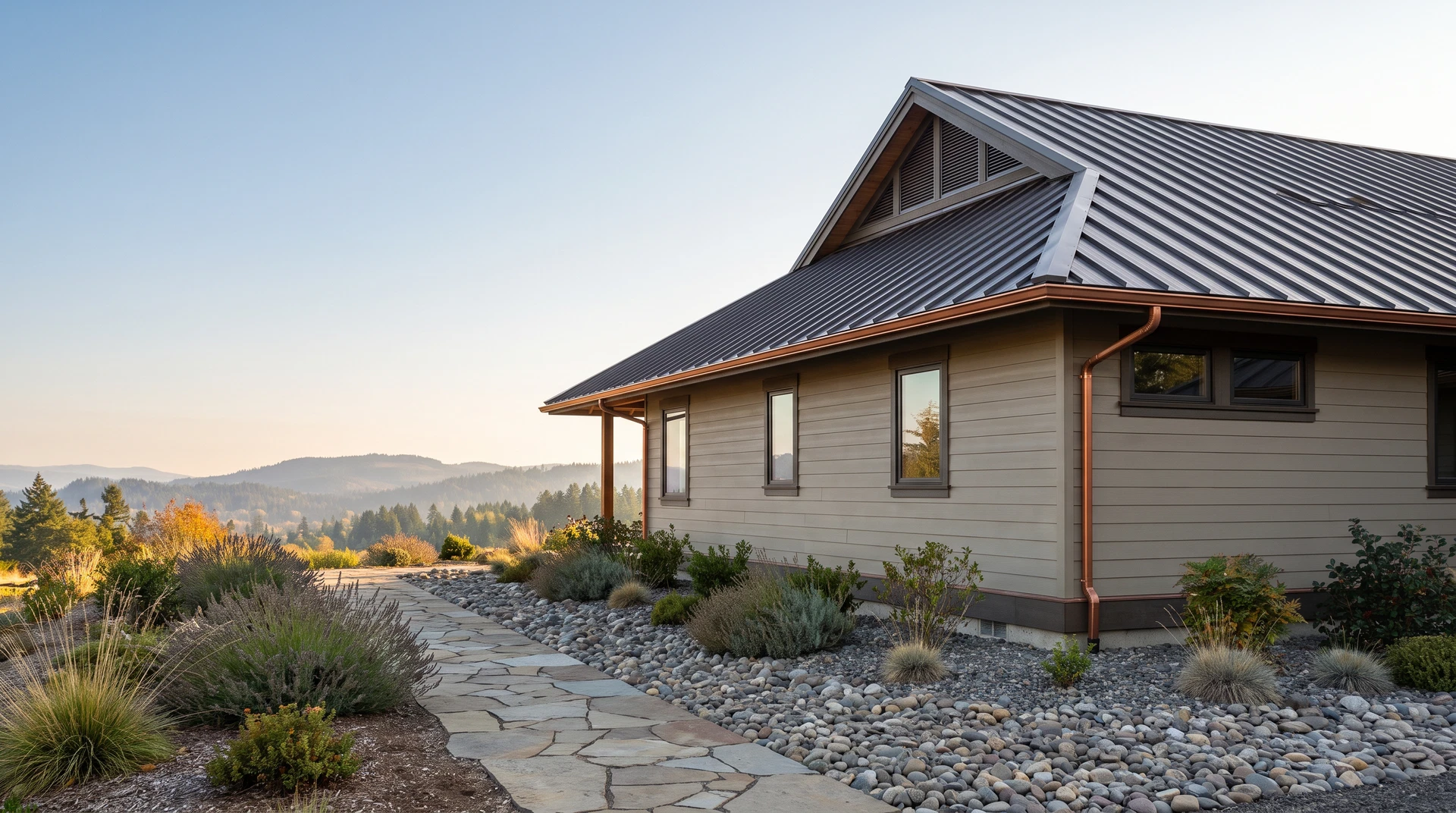
Oregon’s State Fire Marshal emphasizes three areas: the home itself, the immediate zero-to-five-foot zone, the five-to-thirty-foot intermediate zone, and the extended area beyond that.2 Start close to the building. Remove leaves, needles, and debris from roofs and gutters. Keep combustibles away from foundations, decks, and patio areas. Consider noncombustible materials such as gravel, stone, or pavers close to the building where appropriate. Keep firewood, spare lumber, furniture cushions, and other combustible storage away from the structure.
Further out, the work becomes property-specific: mowing grass, pruning lower branches, managing brush beneath trees, reducing ladder fuels, keeping vegetation separated, and preserving equipment and emergency access. The Oregon State Fire Marshal also identifies practical details such as clear driveway access, reflective address signage, and clearance near propane tanks. Use local fire authority, extension, forestry, code, and qualified landscape guidance rather than relying on a generic checklist alone.
Home hardening reduces ember-entry opportunities
In a wildfire, wind-borne embers may travel ahead of the flame front. Home hardening focuses on the vulnerable building elements that can allow embers or heat to ignite materials at or near a structure. Oregon State University Extension describes it as improvements in building materials, structural elements, sealing, screens, and maintenance that reduce the chance of ignition.3
Prioritize the condition of the roof, gutters, vents, siding, windows, decks, eaves, fences where they meet the home, and attachments such as sheds. OSFM guidance suggests clearing roof and gutter debris, using metal mesh over attic and crawlspace vents, reducing combustible materials near the structure, and using more ignition-resistant materials when replacement projects are already planned. The appropriate material, method, and timing should be decided with qualified contractors and applicable building requirements in mind.
Hardening does not guarantee that a home will survive a wildfire or that an insurer will offer or renew coverage. It can, however, create a better documented conversation about the work you have completed, why it was completed, and how the property is maintained.
Build an evidence file before renewal questions arrive
The practical value of mitigation is easier to discuss when it is documented. Create a simple, dated property-readiness file. Include before-and-after photographs, receipts, permits where applicable, invoices, contractor details, landscape-maintenance records, roof or gutter service documents, exterior improvement records, and photographs from multiple approaches to the property.
Also keep a current home inventory. DFR recommends photographing rooms, storage areas, closets, garages, sheds, and significant personal property; note make, model, description, and approximate value where useful.1 Securely store the inventory, policy declarations, deed or lease, mortgage information, contractor records, and emergency contacts in a protected digital location that can be accessed away from home.
If the property is a rental or commercial site, add a rent roll, tenant contacts, lease responsibilities, maintenance agreements, equipment schedules, and copies of certificates of insurance from vendors when appropriate. Those records can support both continuity planning and a more organized claim discussion.
Technology can be one layer of property readiness
Physical mitigation, evacuation planning, and insurance are not mutually exclusive. Property owners who want to explore an additional layer of readiness can review Insure Pacific’s Wildfire Protection Technology page. It describes options intended to help a qualified specialist conversation around water supply, pressure, storage, piping, activation, power, maintenance, winterization, access, and the conditions at a specific property.
That technology is not a substitute for official evacuation instructions, emergency services, defensible space, or an insurance policy. It is also not a promise that a property will be protected, that a claim will be paid, or that an insurer will change a renewal decision. Think of it as a possible risk-management layer to discuss alongside a site assessment, maintenance plan, home hardening, and insurer or agent review.
What insurers may review at renewal
Insurers do not all use the same underwriting criteria. A carrier may consider location, surrounding fuels, access, roof condition and material, nearby structures, claims history, concentration of exposure, local response conditions, repair costs, prior inspection information, and its own risk model. Do not assume an online map, a neighborhood condition, or a single mitigation project determines the answer.
In Oregon, state consumer guidance notes that insurers must consider home-hardening and defensible-space efforts in rating and underwriting, while retaining flexibility in how they make those decisions.1 The same page also states that the former statewide wildfire hazard map may not be used for rating and underwriting, though insurers may continue using their own proprietary models. That is why a homeowner should ask for a plain-language explanation of the actual notice and the property-specific factors involved.
For a more resilient annual review, ask: Is the dwelling limit aligned with realistic rebuilding costs? Are outbuildings, detached garages, fences, retaining structures, and personal property reflected accurately? Are there new roofs, additions, renovations, solar equipment, backup generators, or upgrades the insurer needs to know about? Has the property changed from owner-occupied to rental or seasonal use? Do the liability limits reflect the household’s assets and activities?
If you receive a non-renewal notice, act early and methodically
A non-renewal does not necessarily mean you are uninsured today, but it does create a timeline. Read the notice carefully, confirm the effective date, and ask what information or factors led to the decision. Gather your current declarations page, loss history, property photos, mitigation records, roof and exterior documentation, and any inspection report. Contact an independent agent early enough to evaluate available options before the expiration date.
Do not cancel a current policy before replacement coverage is bound. Do not assume that an informal verbal indication is proof of coverage. Request written confirmation of the policy, deductibles, limits, exclusions, effective date, and any coverage conditions. If a notice appears unclear or you have a consumer-protection question in Oregon, DFR’s consumer advocacy resources can provide education and assistance.1
Where admitted-market options are limited, an agent may discuss alternatives such as surplus-lines coverage or the Oregon FAIR Plan, which is an insurer of last resort and has separate coverage structure, limits, requirements, and considerations. These are not interchangeable with a standard homeowners policy. The exact solution depends on the property and available markets at that time.
Independent Insurance Agency Since 1935
Not Sure If You Have the Right Coverage?
Our licensed agents compare 50+ carriers to find you the best coverage at the right price — at no extra cost to you.
An evacuation plan protects people first
Insurance and property hardening cannot replace an evacuation plan. Ready.gov advises households to use several alert sources, know evacuation routes, keep essential supplies available, protect important documents, and follow direction from local authorities.4 If an evacuation order is issued, leave when directed. Do not stay behind to run equipment, water landscaping, or attempt property defense.
Prepare a go-bag, medication list, pet plan, vehicle fueling routine, family contact plan, and offsite meeting place. Save electronic copies of the policy, inventory, key phone numbers, and proof of identity. During smoke events, follow public-health guidance and consider a clean-air room or high-efficiency filtration plan. For rural homes, plan for unreliable power, limited cell coverage, gates, and multiple exit routes.
After a wildfire: document, protect, and ask before rebuilding
Do not return until authorities say it is safe. Photograph damage and the condition of the property before moving or discarding items when you safely can. Take reasonable steps to prevent further damage or theft, retain receipts, and speak with the insurer before beginning permanent repairs. Oregon DFR specifically advises retaining damaged property until the insurer has inspected it and maintaining records for temporary repairs.1
Ask how the deductible applies, whether additional living expense or loss-of-use benefits may be available, how debris removal is treated, what documentation is needed, and how actual-cash-value and replacement-cost payments will be handled. Communicate with a mortgage servicer if a lender is named on payments. Be cautious with unsolicited repair offers, high-pressure settlement tactics, and anyone seeking payment before work is documented and appropriately authorized.
Wildfire can also change water and slope conditions. Burned areas may face increased flooding or mudflow risk for years, and standard property policies often treat flood differently. DFR notes that NFIP flood coverage typically has a waiting period, making it a conversation to have before a storm threat is imminent.1 Review Flood Insurance separately rather than assuming it is embedded in a homeowners policy.
A practical annual wildfire insurance and readiness checklist
| Review area | Questions to ask and actions to document |
|---|---|
| Insurance limits | Do dwelling, contents, other structures, loss of use, liability, and deductible terms match the current property and household? |
| Property condition | Are roof, gutters, vents, siding, decks, fences, access, and exterior storage maintained and photographed? |
| Defensible space | Have close-in combustibles, vegetation, ladder fuels, debris, and propane-clearance issues been addressed appropriately? |
| Home hardening | What planned roof, vent, window, siding, deck, or attachment improvements should be discussed with qualified professionals? |
| Technology | Would a site-specific conversation about water, activation, power, maintenance, and wildfire protection technology be helpful? |
| Evacuation | Are alerts, routes, go-bags, pets, medications, vehicle fuel, and important records ready to go? |
| Non-renewal response | Are policy documents, mitigation evidence, inspection details, and enough lead time organized before expiration? |
Talk with an independent agent before the next fire season
The most useful insurance conversation begins before a notice, smoke event, or evacuation. Insure Pacific can help organize questions around available homeowners, landlord, second-home, farm, commercial property, excess liability, and flood options. We can also help you discuss how documented hardening, defensible space, and a property-defense technology consultation fit into a broader risk-management plan. We cannot promise a particular coverage result, price, renewal, or claim outcome.
To start, request a quote or insurance review, call (541) 238-7775, or send a message to Insure Pacific. For the technology discussion specifically, visit Wildfire Protection Technology.
References
[1] Oregon Division of Financial Regulation — Wildfires
[2] Oregon State Fire Marshal — Defensible Space
[3] Oregon State University Extension Fire Program — Preparing Your Home
Our Licensed Coverage Area
States highlighted in blue are states where Insure Pacific holds an active insurance license.
Hover to highlight — click a state to visit its insurance page
Our Oregon Office Locations
Hover over a marker to see the office — click to visit their website.
Hover to highlight — click to visit that office's website
Ready to Get Protected?
Talk to a Local Oregon Insurance Expert
Insure Pacific has been serving Oregon families and businesses since 1935. We work with 50+ carriers so you get real options — not just one company's answer.
Related Articles
 Personal Insurance
Full-Time RV Insurance: When Your Motorhome Becomes Your Primary Home
Read Article → Personal Insurance
ADU Insurance: Is Your Backyard Cottage Covered by Your Homeowners Policy?
Read Article → Personal Insurance
Water Damage Insurance: Hidden Leaks, Sewer Backups, Service Lines, Sump Pumps, Mold, and Smart Shutoff Devices
Read Article → Personal Insurance
Home Insurance Replacement Cost in 2026: Why Rebuilding Your Home Could Cost More Than Its Market Value
Read Article →Get in Touch
Ready to protect what matters most? Contact us today for a no-obligation insurance review. Our experienced agents are here to help you find the right coverage for your needs.


